Marc Rubinstein makes a provocative pivot: while the world fixates on the 1929 crash as the mirror for today's market volatility, he argues the Panic of 1907 offers the far more dangerous blueprint for our current financial fragility. The piece challenges the popular narrative that retail speculation is the primary threat, suggesting instead that the unregulated, opaque world of non-bank lenders poses a systemic risk that the 1929 analogy simply cannot capture.
The Allure of the 1929 Parallel
The article begins by acknowledging the cultural moment surrounding Andrew Ross Sorkin's new book, 1929, which has reignited interest in the Great Crash. Rubinstein notes how Sorkin describes the chaos of Black Thursday: "At exactly 10 a.m. he punched the bell to signal the opening of trading. Men began yelling and gesticulating. Phones started ringing incessantly. The bloodbath had begun…" This vivid reconstruction sets the stage for a comparison that many investors are eager to make. Sorkin, in his podcast appearances, draws direct lines between the speculative fervor of the 1920s and today, likening the Radio Corporation of America to the modern tech giant Nvidia. "I think there's probably some things that are happening in our economy today that do mirror that period," Sorkin observes.
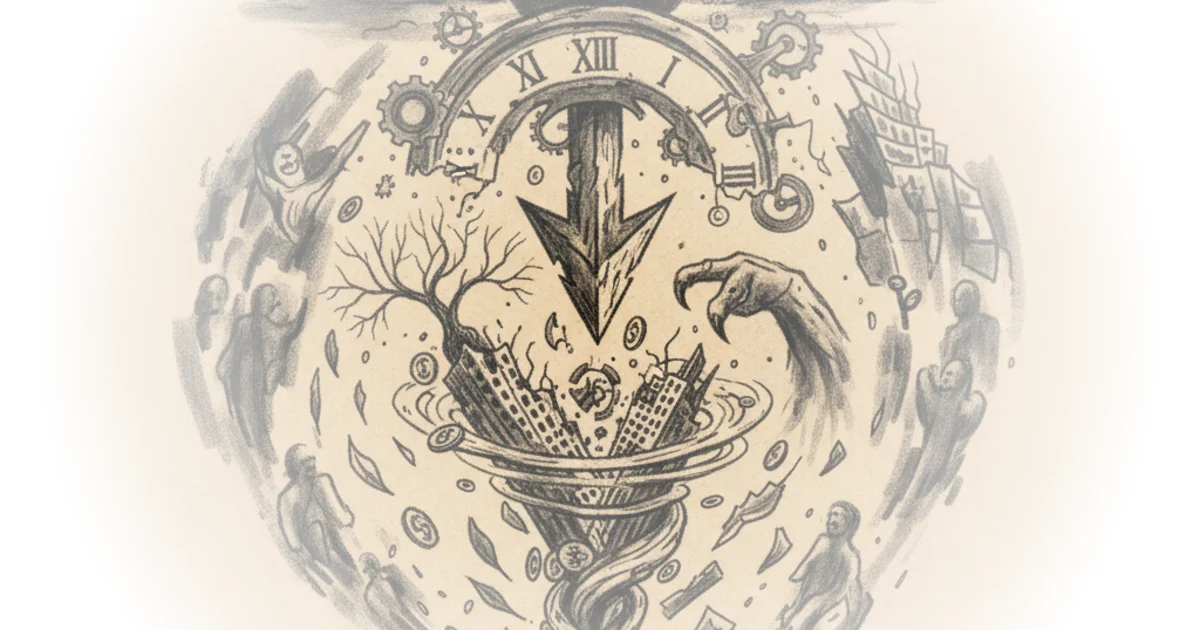
Rubinstein acknowledges the human instinct to find these patterns, noting that "speculation remains the twin of innovation." However, he quickly dismantles the utility of this comparison for understanding current systemic risks. The 1929 crash was driven by margin calls and a stock market collapse, but the structural weaknesses of the financial system itself were not the primary focus. Rubinstein argues that while retail participation is high today, looking at 1929 blinds us to the real danger lurking in the shadows of the banking sector.
Such pattern-matching is deeply human – we instinctively search history for roadmaps to the future. Yet while there are echoes of 1929 in today's markets, especially around retail participation in the market, it's another historical episode that may offer even more relevant parallels.
Critics might argue that dismissing the 1929 parallel entirely ignores the psychological drivers of market crashes, which remain remarkably consistent regardless of the era. The fear of loss and the herd mentality are timeless, even if the mechanisms have changed. Rubinstein, however, insists that the mechanism of failure is what matters most for policy and risk management today.
The Shadow Banking Legacy of 1907
The commentary shifts to the Panic of 1907, a crisis born not from the stock exchange floor, but from the collapse of trust companies. Rubinstein paints a picture of the Knickerbocker Trust Company, where "about 100 people, mostly small shopkeepers, mechanics, and clerks, waited patiently on the sidewalk to reclaim their deposits." The scene was orderly at first, but the speed of the run revealed the fragility of an institution that operated outside the safety nets of traditional banking.
These trust companies were the "shadow banks" of their day, emerging with explosive growth since the 1880s. Rubinstein points out that while their lending was half that of national banks in 1890, "by 1906 they had achieved parity." Their danger lay in their structure: "Less regulated than traditional banks, trust companies could assume more risk and take advantage of opportunities not available to banks." Because they held minimal cash reserves and were outside the protective umbrella of the New York Clearing House, they were uniquely vulnerable to a loss of confidence.
The author draws a sharp line from 1907 to the present, noting that "Trust companies no longer enjoy the same status, but their legacy survives in other forms." The Global Financial Stability Board recently estimated that non-bank financial intermediaries now hold nearly half of all global financial assets. This sector remains opaque and deeply intertwined with traditional banks, creating a web of risk that is difficult to untangle. Rubinstein highlights the concern of JPMorgan's Jamie Dimon, who warned on an earnings call: "Yes, there will be additional risk in that category that we will see when we have a downturn. I expect it to be a little bit worse than other people expect it to be, because we don't know all the underwriting standards that all these people did… I would suspect that some of those standards may not be as good as you think."
Knickerbocker Trust didn't survive that day in October, but its demise would reveal vulnerabilities in the financial system that resonate today.
This framing is effective because it moves the conversation from the visible volatility of stock prices to the invisible, structural rot within the financial plumbing. The argument holds up well against recent regulatory discussions that have struggled to define and monitor these non-bank entities. However, a counterargument worth considering is that the post-2008 regulatory environment, including stress tests and capital requirements, has fundamentally altered the landscape in ways that 1907 did not anticipate. Rubinstein implies the risk is identical, but the safeguards may be more robust, even if imperfect.
Bottom Line
Rubinstein's strongest contribution is reframing the current market anxiety away from the stock ticker and toward the shadow banking system, using the Panic of 1907 as a precise historical analogue for modern non-bank fragility. The piece's biggest vulnerability is its reliance on the assumption that the opacity of these institutions is as unmanageable today as it was in 1907, potentially underestimating the impact of two decades of post-crisis regulation. Readers should watch for how regulators define and monitor these non-bank intermediaries as the next economic downturn approaches.