Derek Muller has done something rare in this piece: he's taken something millions of people do casually — bowling a few frames at the local alley, wearing those gloriously outdated rental shoes — and revealed it as a remarkably sophisticated technology. The title alone signals ambition. "This is the biggest most in-depth video about bowling ever," he declares early on. That's a bold claim, but he's not joking.
What's Inside a Bowling Ball?
The piece opens with a visual revelation that's almost外科-like in its precision. Muller sent a bowling ball to Creative Electron for a 3D X-Ray Scan, and what emerged challenges the assumption that bowling balls are perfect solid spheres. "I always expected bowling balls to be you know perfect solid spheres," he says, "but there's something inside here and it's not symmetric and it's not even centered in the ball."
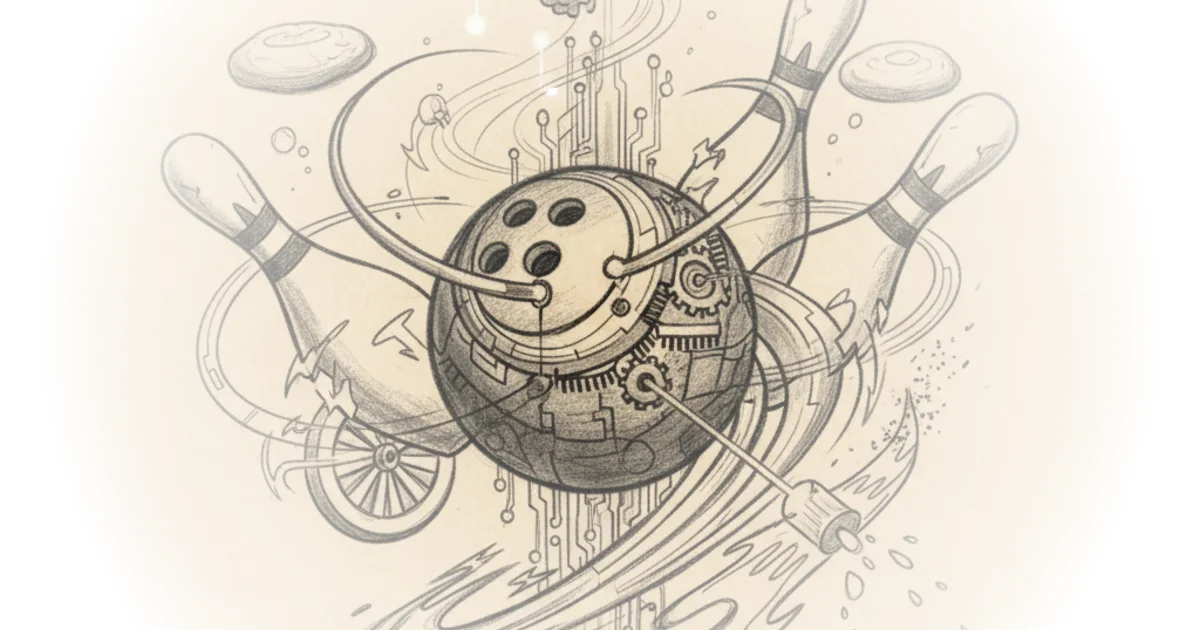
This is where the piece becomes genuinely eye-opening. The asymmetrically shaped weight blocks embedded in cores of lightweight glass beads represent a fundamental shift in how the sport works. At Storm Bowling — one of only 11 bowling ball manufacturers worldwide — Muller shows us exactly how these balls are made. "When we make bowling balls we always start in the center," explains a worker at the facility, "and the center part of the bowling ball is the weight block." The difference in density between filler material and core is "quite a bit about 2 and 1 half to three times more dense in the inner weight block than it is in the core material."
The manufacturing process itself is hypnotic. Balls spin at nearly 2,000 RPMs on lathes, trimming surfaces until they become perfectly round. The balls emerge "extremely porous and very very dull" from this stage — requiring further finishing before any bowler can use them.
Bowling's Ancient Roots
What makes this piece particularly compelling is its archaeological depth. Muller traces bowling back 7,000 years to wall drawings in an ancient Egyptian tomb. In Germany, bowling pins represented sins — and knocking them down was a religious ritual. "You're a good Christian if you could knock them all down," he recounts.
The American story is even stranger. Nine-pin bowling was banned because it promoted gambling. The legend goes that people cleverly invented ten-pin bowling to get around the law. In the US today, nine-pin bowling is only played in Texas — "because it was the one state that didn't ban it instead charging attack." This detail alone shows how regulatory history shaped modern bowling in ways most sports fans never consider.
The Physics of a Strike
The technical explanation of how strikes actually work reveals Muller at his best. For average bowlers like himself, throwing straight down the middle is intuitive but ineffective. "If you want to give me any tips or I've watched LeBron Bowl you won't be worse than him," he jokes — acknowledging that amateur approaches differ fundamentally from professional strategy.
For pros like Pete Weber or Chris Barnes, hitting the head pin square-on is not the perfect strategy. "If you hit the head pins Square on going straight you're unlikely to knock down all the pins." Instead, the ideal contact point involves angles. "Chances for a strike are much higher if the center of the ball hits the pins just to one side of the head pin board 17 and A2 in which case the ball takes out the 1 3 5 and nine pins."
The margin for error is staggeringly small. "To have an over 90% chance of getting a strike the center of the ball has to hit with an error smaller than half a board." A bowling lane is about 3½ feet wide and 60 feet long — and the target area is effectively a few inches. "Needless to say, throwing a ball 60 ft straight at a Target smaller than a dime is a tough task."
The Oil Revolution
Perhaps the most transformative element Muller documents is how oil changed bowling fundamentally. Originally, lanes were oiled simply to protect wood from damage. "The original idea was just to protect the surface of the lane," he explains. "It was not to manufacture anything from a competitive scoring type environment."
But applying oil meant that balls no longer gripped the lane — they could skid, rotating not in their direction of travel. This created what Muller calls "the three parts of any pro Bowers throw: the skid The Hook and the roll." When a bowler releases the ball, it can be going 20 miles per hour and spinning at 500 RPM — nearly ten full revolutions per second.
Now there are machines specifically for applying oil to lanes. These cost $30,000 and work like dot matrix printers, laying oil with varying degrees of thickness across the lane. "They can lay the oil on with varying degrees of thickness across the lane and extend the oil pattern different distances," Muller notes. The oil extends about two-thirds down the lane — roughly 40 or 45 feet.
Oil was originally just to protect the surface, but it became the foundation for competitive scoring.
The Ball Evolution
The equipment itself has transformed dramatically over decades. "Hard rubber bowling balls was what I started with maybe mid '70s and then the yellow dot the Columbia yellow dot which is a plastic ball," says one professional bowler. Then urethane — "I won a lot of titles with the urethane stuff." Now reactive resin balls, which are modified polyurethane with a more porous surface giving more grip in oil, dominate the sport.
Counterpoints Worth Considering
Critics might note that while Muller documents these technological advances compellingly, he occasionally frames them as discoveries rather than developments. The history of bowling equipment wasn't accidental — it was deliberately engineered over decades by manufacturers seeking competitive advantage. Also, his claim that bowling is "the most popular participatory sport in the United States" requires verification; other surveys often rank golf, tennis, or cycling higher.
Bottom Line
Muller's strongest move is making the invisible visible — showing how asymmetric weight blocks inside seemingly simple balls create rotational dynamics that determine professional outcomes. His biggest vulnerability is overreach: calling this "the biggest most in-depth video about bowling ever" sets an impossibly high bar, and while he largely delivers, some sections (like the history) feel more exploratory than definitive.
The piece succeeds because it transforms something we thought we understood — throwing a ball at pins — into something far more complex. After watching, you'll never look at a $2 rental shoe the same way again.