Rick Rubin, the legendary music producer turned spiritual interlocutor, does not offer a self-help guide to finding a partner; instead, he argues that romantic love is a violent, necessary dismantling of the self. In this conversation with poet David Whyte, Rubin reframes the agony of heartbreak and the ecstasy of new love not as emotional fluctuations, but as a deliberate subversion of identity designed to force human maturity. For the busy professional who views relationships as a logistical challenge or a source of stress, this piece offers a startling alternative: love is not about maintaining a comfortable status quo, but about willingly walking into a doorway of light that leads to a life you cannot yet imagine.
The Architecture of Subversion
Rubin and Whyte begin by dismantling the modern obsession with stability, suggesting that the initial spark of love is actually a rejection of one's current reality. Rubin writes, "The powers of romantic love are to do with subversion of your present identity." This is a radical claim in a culture that prizes optimization and risk mitigation. The authors argue that the brain literally changes during this phase, blurring logic to allow for a new way of being. They suggest that if we could see straight, we would never leave our current circumstances to build something new.
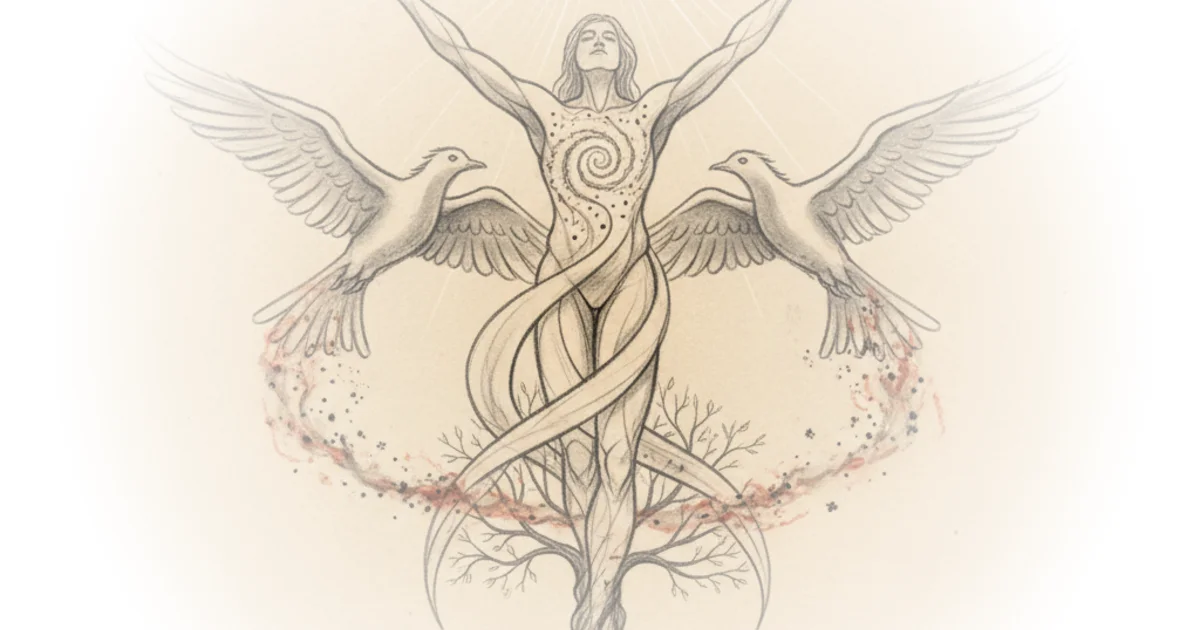
The conversation pivots to the danger of loving an idealized version of a person rather than their actual desires. Citing the French philosopher Simone Weil, Rubin notes, "What we love in other people is the hoped for satisfaction of our desires. We do not love them for their desires." This distinction is crucial; it suggests that true intimacy requires seeing the other person as a separate entity with their own trajectory, not merely as a mirror for our own needs. Rubin posits that maturity arrives when we realize the ideal we fell for has its own life, one that must evolve alongside us. Critics might argue that this philosophical framing ignores the very real power dynamics and incompatibilities that cause relationships to fail, but the authors are less interested in practical logistics than in the phenomenological experience of being in love.
"You raise your house down to the foundations and hopefully the other person does the same and we build from the meeting."
The Geography of Longing
The dialogue moves from the internal to the external, using Whyte's personal narrative of leaving a marriage to illustrate how love can be a commitment to one's own future self. Rubin describes a moment where Whyte, attending a wedding while his own marriage was dissolving, found a physical path in Ireland that mirrored his internal state. Whyte describes walking up a hill where limestone walls met to form a "little doorway of light," feeling as though he could "walk straight off into the thin air of my new life." Rubin interprets this not as a metaphor for escape, but as a literal reorientation of the soul.
This section highlights the authors' belief that love is a mutual invitation into vulnerability. Rubin explains that the word vulnerability comes from the Latin vulnu, meaning wound, implying that to be open to love is to be open to being hurt. He asserts that in a true union, the declaration "I love you" is actually a statement of "we love us," signaling a new, shared entity. This reframing of love as a collective identity formation is powerful, though it risks glossing over the individual agency required to maintain that union when the initial "subversion" wears off.
The Blessing of Unrequited Love
Perhaps the most striking portion of the conversation addresses the pain of unrequited love, which Rubin and Whyte treat not as a failure, but as a necessary rehearsal for the inevitable changes in any long-term relationship. Rubin suggests that the anxiety of a text not being returned is a microcosm of the larger existential shifts that occur over decades. He argues that even after a relationship ends, the love does not disappear; it simply changes seasonality. "It's all love," Rubin states. "It's just that the seasonality of the love has changed."
To illustrate this, Rubin recites a poem he wrote as a "blessing for unrequited love," offering grace to the person who cannot love him back. He writes, "Let me be generous enough and large enough and brave enough to say goodbye to you without any understanding to let you go into your own understanding." This is a profound shift from the typical narrative of resentment or closure. Instead of demanding answers, the speaker offers a blessing for the other's freedom and future. The authors suggest that this ability to bless the unknown is the ultimate sign of maturity, turning the pain of rejection into a doorway for personal growth.
"May you always be in the sweet central hidden shadow of my memory without needing to know who you were when you first came, who you were when you stayed, and who you will become in your freedom now that you have passed through my life and gone."
Bottom Line
Rubin and Whyte succeed in transforming the concept of romantic love from a transaction of needs into a spiritual discipline of self-destruction and reconstruction. Their strongest argument lies in the redefinition of vulnerability as a structural necessity rather than a weakness. However, the piece's greatest vulnerability is its reliance on a poetic, almost mystical framework that may feel inaccessible to those currently navigating the gritty, unromantic realities of divorce or toxic relationships. For the listener willing to engage, the takeaway is clear: love is not about finding a perfect partner, but about finding the courage to let your old self die so a new one can emerge.
"Just beyond yourself. It's where you need to be. Half a step into self-forgetting and the rest restored by what you'll meet."
Final Verdict
This conversation is a masterclass in reframing emotional pain as a catalyst for evolution, offering a rare perspective that values the unknown over the secure. While it lacks practical advice for relationship maintenance, its philosophical depth provides a necessary counter-narrative to the modern obsession with control and predictability in love. Readers should listen not for a roadmap, but for a permission slip to let go of the life they know in favor of the one waiting just beyond the horizon.