The Infinite Money Glitch Meets Gravity
For months, digital asset treasury companies enjoyed what many dubbed an "infinite money glitch": issue shares, buy Bitcoin, watch the stock price surge, repeat. Strategy, the company formerly known as MicroStrategy and led by Michael Saylor, rode this flywheel harder than anyone. At its peak, investors were paying three dollars for every one dollar of Bitcoin exposure the company held. Richard Coffin of The Plain Bagel walks through exactly how that flywheel has now seized up, and why the community response has veered from financial analysis into conspiracy theory.
The mechanics are straightforward. Bitcoin has fallen roughly 30% from its all-time high. Treasury companies that loaded up near those highs are now underwater. Strategy itself, despite years of accumulation, has a cost basis approaching the current price. The premium-to-NAV ratio that made the entire model work has collapsed, with several companies now trading at a discount to the Bitcoin on their balance sheets.
The only reason the business model of selling shares to buy Bitcoin worked was because of this valuation premium. The fact that investors were kind of turning a blind eye to math for a second. Now that the shares are trading at a discount to net asset value, it doesn't really make sense to keep issuing shares. It will actually destroy value for current shareholders.
This is the central problem that Coffin identifies, and it deserves more attention than the conspiracy theories that have overshadowed it. When a company's entire business model depends on a perpetual premium, the disappearance of that premium does not merely slow growth. It inverts the logic of the operation entirely. Issuing shares at a discount to NAV dilutes existing shareholders. The rational move becomes selling Bitcoin to buy back shares, which of course threatens to trigger the very death spiral everyone fears.
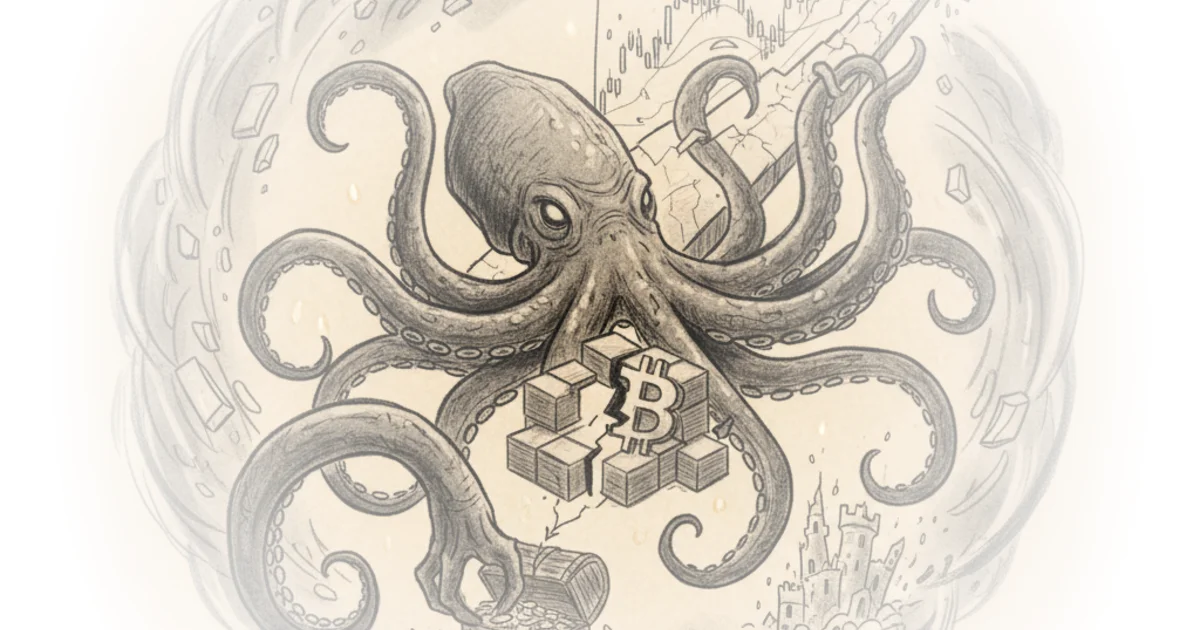
Strategy's Debt Structure: Safer Than It Looks, But Not Safe
Coffin offers a nuanced breakdown of Strategy's financial obligations. The company carries roughly $8.2 billion in convertible notes and $5.8 billion in preferred shares, with annualized payment obligations in the ballpark of $684 million. Against $59 billion in Bitcoin holdings, those numbers look manageable on paper.
There are genuine structural advantages in how Strategy has designed its capital stack. Many of its convertible notes carry no interest payments. Its preferred shares allow dividend payments in MSTR stock rather than cash. Missing a preferred dividend does not constitute a default. These are not trivial features; they give the company meaningful runway even in a prolonged downturn.
So yes, technically the company could survive a further Bitcoin price decline by liquidating its holdings and hurting investors, but that's not really much consolation for investors who are currently down on their investment.
This is the distinction that gets lost in the online discourse. "The company will survive" and "your investment is safe" are two very different statements. Strategy can meet its obligations by selling Bitcoin and diluting shareholders. That is survival in the corporate sense. For the retail investors who bought the stock at elevated multiples, it amounts to watching the company slowly convert their equity into creditor payments.
The JPMorgan Conspiracy: A Case Study in Deflection
When positions go against investors, someone must be blamed. In this case, the target is JPMorgan Chase. The accusations range from the plausible-sounding (increased margin requirements on Strategy shares) to the fantastical (a hidden short position so large it could bankrupt the bank if Strategy rallied 50%).
Coffin methodically dismantles each claim. The publicly reported short interest on Strategy sits around 10% of float, which is notable but nowhere near the levels being suggested. JPMorgan's 13F filings show a net long position in MSTR worth hundreds of millions. The bank's market capitalization is roughly 16 times larger than Strategy's, with six times Strategy's worth of shareholder equity alone. The notion that a 50% rally in one mid-cap stock could threaten such an institution does not survive contact with basic arithmetic.
It seems pretty clear that most of these rumors are very much unsubstantiated attempts to just drive demand for the stock. So, you got to be careful of any sort of claim you see on social media or any personality who blindly cheerleads a given investment.
The specific allegations tell a revealing story. JPMorgan published a note warning that Strategy faced potential delisting from major indices like MSCI USA and NASDAQ 100. This followed MSCI's own announcement by over a month. Critics frame this as JPMorgan manufacturing bad news. The more mundane explanation is that an investment bank issued a research note about a developing risk to its clients, which is precisely what investment banks are supposed to do.
Similarly, the increased margin requirements that some JPMorgan clients reportedly experienced are not unique to that institution. TD Ameritrade restricts the loan value on Strategy shares to 25%. When a company receives a "highly speculative" credit rating, brokerages limit how much clients can borrow against it. This is standard risk management, not a coordinated attack.
The GameStop Playbook Does Not Transfer
The attempt to frame Strategy as a GameStop-style short squeeze candidate reveals something important about how financial narratives spread online. The GameStop episode of 2021 involved genuinely unusual circumstances: short interest exceeding 100% of float, a small group of hedge funds with concentrated positions, and a stock price low enough for retail investors to move meaningfully. None of those conditions apply to Strategy.
What does transfer, unfortunately, is the rhetorical framework. Cast a large institution as the villain. Frame buying as an act of rebellion rather than a financial decision. Suggest that holding through losses is loyalty rather than stubbornness. It is a powerful narrative, and Coffin is right to point out the irony: the community accusing banks of manipulation is itself attempting to manipulate demand through unsubstantiated claims.
The Macro Picture Is Doing the Heavy Lifting
Underneath all the drama about JPMorgan lies a more prosaic reality. Monetary conditions are tightening. The Federal Reserve's reverse repo facility has dropped from $2 trillion to $2 billion. Lending conditions are constricting. When borrowing gets more expensive and liquidity dries up, speculative assets sell off. Bitcoin, for all its unique properties, remains correlated with risk appetite.
Coffin is careful not to overstate the significance of these indicators, noting that some commentators have blown these charts out of proportion. The tightening is real but gradual. There is no single catalyst for the sell-off comparable to the Terra/Luna collapse of 2022. What there is, instead, is a slow withdrawal of the easy-money conditions that inflated these valuations in the first place.
Bottom Line
The Bitcoin treasury model was always a leveraged bet dressed up as a corporate strategy. It worked spectacularly when Bitcoin was rising because the premium-to-NAV flywheel created genuine, if temporary, value for shareholders. Now that the flywheel has reversed, the companies face an uncomfortable choice between diluting shareholders, selling Bitcoin, or defaulting on obligations to creditors. Strategy has more runway than most, thanks to its cleverly structured debt, but "the company probably will not go bankrupt" is a far cry from "this is a good investment." The JPMorgan conspiracy serves primarily as a distraction from these fundamental realities, giving investors a villain to blame rather than a spreadsheet to read. As Coffin dryly observes, it will be interesting to see when the CFA program starts teaching "spreading rumors of a short squeeze and blaming banks" as a portfolio management technique.