Ryan Grim and Jeremy Scahill deliver a harrowing dispatch that refuses to let the world look away from the convergence of climate catastrophe and military siege in Gaza. While headlines often reduce the conflict to casualty counts, this piece exposes a chilling economic architecture: a billion-dollar profiteering ring operating in the shadows of starvation, all while winter storms sweep away the last fragile shelters of the displaced. The authors force a confrontation with the reality that the blockade is not just a security measure, but a revenue-generating system for a select few.
The Architecture of Suffering
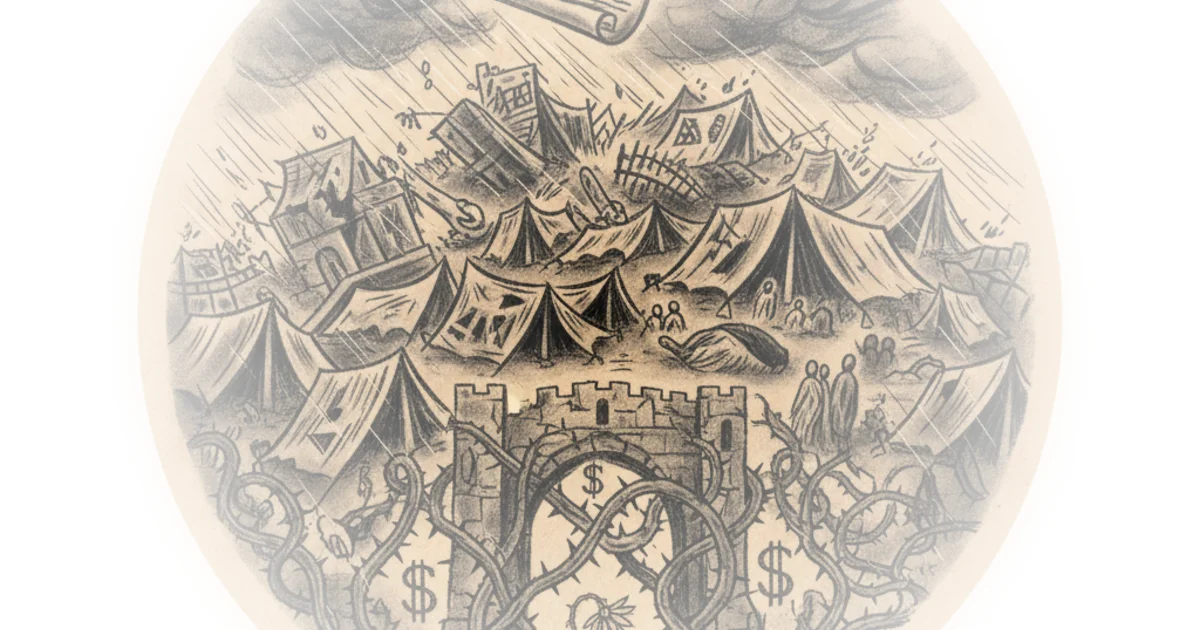
The coverage opens with a visceral accounting of the human toll as winter storms batter the enclave. Grim and Scahill write, "At least 12 Palestinians have been killed or have gone missing in Gaza over the past 24 hours as torrential rains, high winds, and flooding batter the enclave." This is not merely bad weather; it is a man-made disaster exacerbated by policy. The authors highlight that 27,000 tents have been destroyed, leaving 1.5 million people exposed. The cruelty lies in the specifics: aid organizations cannot deliver the very tools needed to survive. As Grim and Scahill note, "basic tool kits, sandbags, and water pumps have not been allowed into Gaza due to 'long-standing access restrictions' by Israel." This framing is effective because it shifts the blame from the storm to the gatekeepers. The International Organization for Migration confirms these materials are critical, yet they remain blocked. A counterargument often heard is that security concerns necessitate strict controls, but the refusal to allow sandbags to reinforce shelters against rain suggests a priority on containment over survival.
These materials are critical for repairing and reinforcing shelters against continued rainfall and mitigating floods in sites, yet they are denied.
The narrative then pivots to the violence that continues unabated amidst the flooding. Grim and Scahill recount a grandfather's testimony of his grandson being shot and then crushed by a tank, a detail that strips away the abstraction of "collateral damage." The authors write, "Civil Defense teams are struggling to respond to hundreds of distress calls." This juxtaposition of natural disaster and military aggression creates a suffocating atmosphere. The report also touches on the broader geopolitical web, referencing the Royal Air Force base at Akrotiri in Cyprus. Grim and Scahill point out that declassified footage reveals British spy flights streamed high-resolution video of Gaza to Israel in real time, noting that up to 116 previously undisclosed surveillance missions were conducted after aircraft disabled their trackers. This historical thread connects the current devastation to a long history of Western military complicity, reminding readers that the war machine is global, not just local.
The Billion-Dollar Monopoly
Perhaps the most explosive revelation in the piece is the investigation into the economics of aid. Grim and Scahill detail a report from Mada Masr that uncovers a network of businessmen who reaped $1 billion by "coordinating" the entry of goods. "The economic coordination system ran through Rafah in partnership with al-Argany's Sons of Sinai company and a small group of Palestinian permit holders," they explain. This is not a story of inefficiency; it is a story of a monopoly. The authors argue that this system drove up prices and created a profit center out of humanitarian necessity. The core of their argument is that the blockade has been monetized. "Coordination fees tied to this system exceeded $1 billion over two years," they state. This evidence is staggering because it suggests that the suffering of the population is a line item on a balance sheet. Critics might argue that coordination is necessary to prevent weapons smuggling, but the authors make a compelling case that the scale of fees points to systemic graft rather than security logistics.
The Global Ripples
The piece widens its lens to show how these dynamics influence international relations and domestic US politics. Grim and Scahill report on a planned $35 billion deal for natural gas from the Leviathan field to Egypt, a project that continues to move forward despite the humanitarian crisis. They note that Israeli officials are working with senior US diplomats to secure the trip, highlighting the prioritization of energy deals over human rights. Meanwhile, in Washington, the executive branch is aggressively dismantling regulations. Grim and Scahill write, "President Trump signed an executive order on Thursday that blocks states from enacting any laws regulating or limiting artificial intelligence." This move creates a federal "AI Litigation Task Force" to challenge state laws, a direct assault on local governance. The authors also highlight the internal fractures within the administration, noting that Indiana Republicans rejected a redistricting plan pushed by the White House. "21 Republican state senators joined Democrats to vote it down," they observe, suggesting limits to the executive's influence even within its own party.
The human cost of these policies is personified in the story of Kilmar Abrego Garcia, a man wrongly deported to a notorious Salvadoran prison. Grim and Scahill write, "A federal judge ordered ICE to immediately release Kilmar Abrego Garcia," adding that officials "misled the tribunal" in their attempts to deport him. This legal victory stands in stark contrast to the administration's broader crackdown. Similarly, the report details how a five-year-old Palestinian boy with aggressive cancer was denied entry for life-saving treatment because his registered address is in Gaza, despite living in Ramallah. The authors frame this not as a bureaucratic error, but as a violation of international law. "Lawyers say the child urgently needs a bone marrow transplant, which is unavailable in the West Bank or Gaza," they write. This refusal underscores the lethal rigidity of the border regime.
The refusal to allow a five-year-old to enter for cancer treatment is not a bureaucratic error; it is a violation of international law.
The commentary also addresses the diplomatic fallout, noting that British officials threatened to leave the International Criminal Court if it pursued arrest warrants for Israeli leaders. Grim and Scahill write, "Britain threatened to cut funding and withdraw from the Rome Statute if the court pursued an arrest warrant for Israeli Prime Minister Benjamin Netanyahu." This reveals the fragility of international justice when faced with the geopolitical weight of major powers. The piece concludes with a look at the domestic political landscape, where the House voted down an executive order stripping collective bargaining rights, a rare moment of bipartisan pushback against union-busting.
Bottom Line
Ryan Grim and Jeremy Scahill have crafted a piece that connects the dots between climate disaster, military occupation, and economic exploitation, revealing a system where human life is secondary to profit and political maneuvering. The strongest element is the exposure of the billion-dollar aid profiteering ring, which fundamentally reframes the blockade as a revenue stream rather than a security necessity. The biggest vulnerability of the piece is the sheer volume of crises covered, which risks overwhelming the reader, but the authors manage this by anchoring every statistic in a human story. The reader should watch for how the US administration's deregulation of AI and its support for energy deals intersect with its foreign policy, as these domestic shifts are increasingly dictating the fate of populations abroad.