Matt Stoller argues that the real barrier to effective governance isn't political gridlock, but the invisible hand of commercial monopolies that have quietly taken over the machinery of the state. While voters are rightly furious at their leaders, Stoller suggests they are misidentifying the enemy: it is not just the politicians, but the "private governments"—from fire truck manufacturers to health insurance middlemen—that dictate the terms of public life. This is a crucial reframing for anyone tired of the usual blame games, offering a structural diagnosis for why cities feel ungovernable and costs keep rising.
The Shadow Governance
Stoller opens by observing a recurring pattern in American politics: voters repeatedly throw out incumbents, only to find the underlying system unchanged. "In 2006, 2008, 2010, 2014, 2016, 2018, 2020, 2022, and 2024, voters threw the bums out... And I think the reason is because most of our leaders are only looking at the public governments, not the private governments - aka commercial monopolies - that undergird them." This is a bold claim, yet the evidence he marshals is hard to dismiss. He points to the pandemic, noting that "during Covid, it was Apple and Google, not governments, who set public health policy around contact tracing through their control of mobile privacy settings."
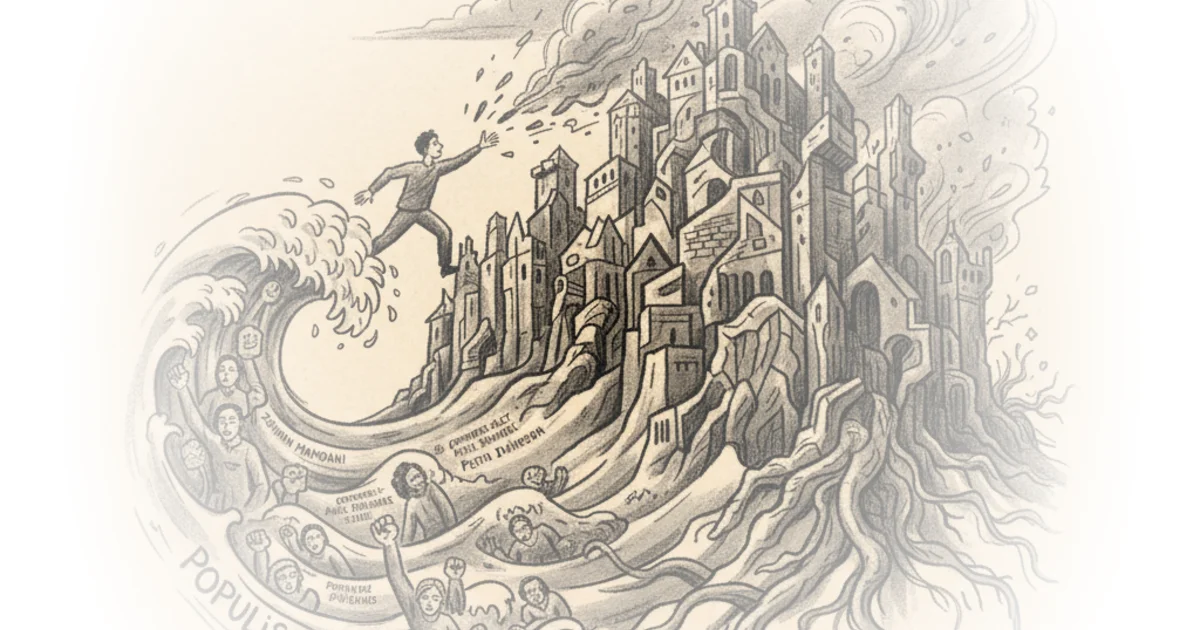
The author's framing here is sharp. He isn't just listing corporate power; he is describing a shift in sovereignty where essential public functions are outsourced to entities that answer to shareholders, not citizens. Stoller notes that despite the anti-establishment rhetoric of recent administrations, "neither broke with the status quo on its alignment with Wall Street." This observation cuts through the partisan noise, suggesting that the problem is systemic rather than merely a failure of a specific political party.
"The shadow private governance model, controlled by financiers, is what Americans dislike."
This insight lands because it explains the deep-seated frustration that fuels populism. It's not just that things are expensive; it's that the rules of the game are written by private actors who have no incentive to serve the public good. Stoller highlights the appointment of Lina Khan, a leading antitrust scholar, by New York City's new leadership as a potential turning point. "Is there now a nascent unification of political populism with governing expertise?" he asks, suggesting that the new crop of officials might finally be willing to tackle the economic termites eating away at city budgets.
The Cost of Safety and Infrastructure
The article moves from abstract theory to concrete, costly examples, starting with public safety equipment. Stoller details how a handful of corporations have turned fire trucks and police gear into monopolized markets. He cites a recent investigation into companies like REV Group and Oshkosh, which have made it "extremely hard to repair fire trucks," driving up prices and delaying deliveries. The situation is even more dire with law enforcement technology. Stoller writes, "Baltimore, Maryland; Augusta, Maine; and Howell, New Jersey have sued Axon, alleging that the company has committed antitrust violations, abused its market power, and forced cities to pay exorbitant fees for a basic, but crucial piece of law enforcement tech."
The financial impact is staggering. Stoller notes that after Axon acquired a competitor, "body cam prices had risen 50 percent. By 2022, those prices had nearly tripled, reaching $490 per camera." But the real shock comes from the shift in business model: "You no longer purchase and own, you 'subscribe' with a fee and it is $500,000 a year." This subscription model locks cities into long-term contracts, making it nearly impossible to switch vendors even when the service is poor or the price is unjustified.
Critics might argue that government procurement is inherently complex and that switching vendors for critical safety equipment carries risks. However, Stoller counters this by pointing out that the "prestige factor" often drives these decisions, with officials too scared to try new suppliers. He suggests that New York City could break this cycle by "bringing antitrust suits here in coordination with other cities, or investing directly in startups or potential rivals who could make similar cheaper products."
The pattern repeats in emergency communications. Stoller highlights a New York Times report on flash floods in Texas, where a monopoly by Motorola Solutions left responders with inadequate equipment. "The grueling job was made more difficult because the radio system they needed to coordinate the response was not up to the task," he writes. With Motorola controlling 70-80% of the market, prices have soared, with a single radio site costing $500,000 today compared to $300,000 seven years ago. This isn't just inefficiency; it's a direct threat to public safety.
The Software Stranglehold
Perhaps the most insidious monopoly Stoller identifies is in the software that runs our cities. He points to Tyler Technologies, a company that manages everything from jail booking to school bus tracking. "Where court-record software is concerned," Stoller quotes an analyst, "Tyler has a near-monopoly and that it's hard to even find a website for one of its rivals." This creates a "lock-in" effect where cities are trapped in outdated, expensive systems because the cost of switching is prohibitive.
Stoller describes these systems as "identity of record" software, which are "usually bad quality and very difficult to move off of." The solution, he argues, lies in using legal tools to force interoperability. "The way to address this problem is to use legal tools and bargaining power to open up this software to third party developers, and foster the interoperability of data." This is a pragmatic approach that leverages the city's purchasing power to break the stranglehold of entrenched vendors.
Health Care and the Middlemen
The argument extends to health care, where Stoller identifies pharmacy benefit managers (PBMs) and insurance companies as the primary drivers of cost. He notes that states like Ohio, Kentucky, and New York have begun to replace these corporate middlemen with public systems, saving money and improving patient care. "Oregon recently banned corporate ownership of medical practices, and Arkansas passed a law to break up insurers," he writes, highlighting a growing trend of state-level resistance to corporate consolidation.
In New York City, the mayor has significant leverage over the largest municipal health system in the country. Stoller suggests that this system could be used to negotiate better drug prices and bypass expensive wholesalers. "New York City could also seek to contract with California for cheap insulin," he proposes, pointing to the potential for cross-state collaboration to lower costs. However, he also acknowledges the entrenched interests at play, noting that the board of the city's hospital system includes a Goldman Sachs managing director and a UnitedHealth Care advisor.
"The cost of commercial rent in New York City, for instance, is inflated by the widespread use of non-disclosure agreements by landlords, as well as by bank loans whose covenants make it very hard to drop list rent prices, and privilege chain stores."
Stoller's analysis of the broader economy reveals how these monopolies extend beyond specific sectors. He points to credit card networks like Visa and Mastercard, which "cost every business in the economy money by taking a cut of every transaction." He also notes the recent legal victory against Google's advertising technology, suggesting that cities could demand damages for their role as ad buyers. This broadens the scope of the argument, showing that the problem is not isolated to a few bad actors but is a systemic feature of the modern economy.
Bottom Line
Stoller's most compelling contribution is his identification of the "private governments" that have quietly assumed control over public functions, turning essential services into profit centers. His argument is strongest when he connects specific, costly examples—from fire trucks to software—to a broader theory of governance failure. However, the biggest vulnerability lies in the political feasibility of his solutions; breaking up entrenched monopolies requires a level of political courage and coordination that has been rare in recent decades. The coming years will test whether the new wave of populist leaders can translate this analysis into action, or if they too will be swallowed by the very systems they seek to reform.