This piece cuts through the usual noise about screen time to ask a startling question: what if the way nations regulate short-form video is actually a proxy for their long-term geopolitical power? Joseph Webster argues that the United States is sleepwalking into a cognitive crisis while rival powers actively weaponize or restrict these tools to shape their own societies. For busy leaders tracking the future of human capital, this analysis offers a rare comparative lens, suggesting that the battle for national strength is being fought not just in boardrooms, but in the dopamine loops of a teenager's feed.
The Authoritarian Playbook
Webster opens by dissecting the starkly different strategies employed by Beijing and Moscow. He notes that China's approach is paradoxical to Western observers: "Beijing is restricting children's access to short-form videos within China while allowing nearly unrestricted access abroad." This dual track allows the state to shield its own youth from the very addictive algorithms it exports. The author details how Chinese authorities enforce a "youth mode" on Douyin, limiting users under 14 to just 40 minutes a day and cutting off access between 10 p.m. and 6 a.m.
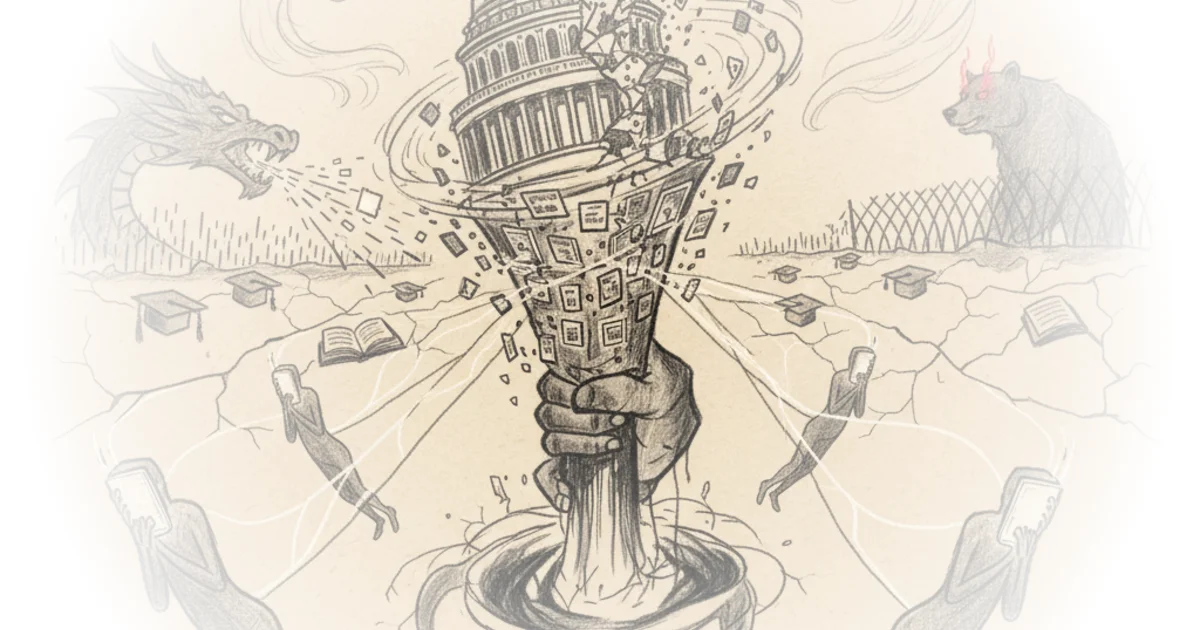
The argument here is that these aren't just technical settings; they are cultural interventions. Webster points out that Beijing has targeted content violating its "code of conduct," such as suspending a user dubbed "China's Kim Kardashian" to curb materialism. While this censorship serves political ends, the author suggests it inadvertently removes the "aspects of social media that often foster insecurity among young users." This is a nuanced take: it acknowledges the authoritarian overreach while admitting the policy has a side effect of reducing the toxic social comparison that plagues Western platforms.
However, the effectiveness of these measures is not absolute. Webster admits that "many children still find ways to bypass these restrictions such as by using their parents' accounts," with a quarter of China's youth internet users exceeding gaming limits in 2024. Critics might note that relying on state coercion to fix a societal problem ignores the root causes of addiction, which are often rooted in broader social isolation or educational pressure. Yet, the data remains compelling: a 2024 government report showed the percentage of Chinese youths playing online games for more than three hours a week dropped from 37.2% in 2021 to 24.9%.
"The U.S. education system is struggling to adapt to profound technological changes in artificial intelligence (AI) and short-form videos. Failing to get technology education right will hold decades-long consequences for millions of American children and their families – and the future of American power."
The Russian Distortion
In contrast to China's focus on time limits, Webster characterizes Russia's strategy as one of information control rather than youth welfare. He writes, "Russia's approach, meanwhile, prioritizes information control over youth welfare or other long-term priorities." Since 2022, Moscow has effectively banned foreign platforms like TikTok and Instagram, not to protect children, but to prevent "discrediting the army" and to force users onto domestic alternatives like VKontakte (VK).
The author highlights a critical failure in this model: VK, which is majority-owned by Gazprom, lacks robust youth protections. Webster notes that "VKontakte Video only added a 'Kid's Mode' in October 2024," and the standalone VK Clips app has "no publicly-documented controls on highly-addictive vertical, short-form videos shown to children." This creates a dangerous environment where the state monopolizes the platform but leaves the content unregulated. The stakes were raised in September 2024 when a leak exposed the full names and profile pictures of more than 390 million VK users, many of whom are children.
Webster's framing is sharp here: "Moscow's social media choices demonstrate its limited ambitions and capabilities and showcase the Kremlin's lack of long-term vision and indifference to the Russian people's welfare." This is a powerful indictment, suggesting that the Kremlin's obsession with sovereignty has come at the cost of its own citizens' digital safety. The comparison to the pre-2010 Federal Law 436-FZ, which predates smartphones and focuses only on banning violence, underscores how out of step Russian policy is with modern technological realities.
The Democratic Imperative
Turning to the West, Webster presents Australia's upcoming social media ban as the most promising path forward for democracies. "On December 10th, 2025 Australia will set a minimum age of 16 for any child seeking to access social media platforms," he writes. This move is grounded in research from psychologists like Jonathan Haidt, linking the rise of smartphones to spiking adolescent depression. Webster emphasizes that the "prefrontal cortex, which influences impulse control and self-regulation, is not fully developed until the mid-20s," making children uniquely vulnerable to dopamine reward loops.
The author draws a particularly chilling connection between this vulnerability and the rise of AI-generated content. He cites the case of "Mia Zelu," an AI-generated influencer who went viral, to illustrate how the line between reality and fabrication is blurring. "If adults can't navigate this dynamic, how can we expect children to do so?" Webster asks. The risk is that young people will begin comparing themselves not to other humans, but to "realistic-seeming AI digital characters that are literally without flaws."
This section is the most urgent in the piece. Webster argues that "social media platforms could be used to monitor or manage mass opinion – or microtarget key users via deniable algorithmic changes." He points to China's 2017 National Intelligence Law, which requires citizens to "support, assist, and cooperate with national intelligence efforts," as a warning that platforms answerable to Beijing pose a unique threat to the cognitive sovereignty of democratic nations.
"The short-form video status quo is unacceptable and undermines constitutional democracies in the competition against systemic rivals."
Critics might argue that a blanket ban on social media for under-16s infringes on civil liberties and ignores the positive aspects of digital connection. Webster acknowledges this tension, noting that "enforcing a social media delay will prove challenging" and that democracies must balance safety with free speech. However, he contends that the current trajectory—where test scores are falling and mental health is collapsing—is a far greater threat to liberty than a temporary delay.
Bottom Line
Webster's most compelling contribution is the reframing of short-form video regulation from a domestic parenting issue to a matter of national security and geopolitical competition. The strongest part of the argument is the comparative analysis showing how authoritarian regimes are actively managing their populations' digital consumption while democracies remain paralyzed by free speech absolutism. The biggest vulnerability lies in the difficulty of enforcement; as the Chinese example shows, determined users will find workarounds. The reader should watch for how the U.S. responds to Australia's 2025 deadline, as the failure to act decisively could cede the cognitive high ground to rivals who are already playing the long game.