While Western economists confidently predict Russia's imminent economic implosion, Joeri Schasfoort offers a chillingly different prognosis: the Russian war machine is not collapsing, it is merely entering its second, more brutal phase. By reframing the conflict through the lens of historical war economies rather than peacetime market theory, Schasfoort argues that Russia has successfully insulated itself from the four classic pathways of economic failure. For busy observers tired of the same 'collapse' narratives, this piece provides a necessary correction, suggesting that the real danger isn't financial bankruptcy, but the systematic sacrifice of civilian life to fuel a prolonged conflict.
The War Economy Paradox
Schasfoort begins by dismantling the conventional wisdom that sanctions and high casualties should have already broken the Russian economy. He points out a jarring contradiction that confuses standard analysts: despite unprecedented isolation, Russian life satisfaction hit an all-time high shortly after the invasion. "After Russia invaded Ukraine, average life satisfaction in Russia actually rose to an all-time high," Schasfoort writes. This counterintuitive reality stems from a fundamental misunderstanding of how war economies function. Most economists are trained to analyze peace, where efficiency and consumer choice are paramount. In a war economy, the goal shifts entirely to mobilizing resources for destruction.
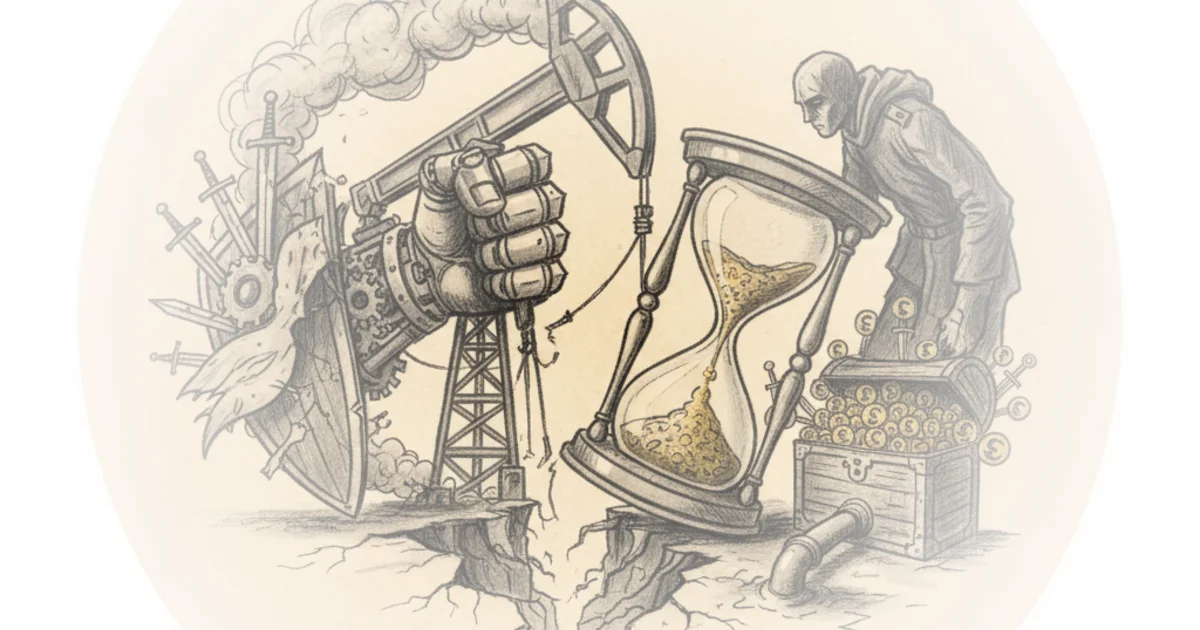
The author explains that Russia's initial boom was not a sign of health, but a result of activating massive idle capacity. Before the war, factories sat dormant and workers were unemployed. The state injected money into these unused resources, creating jobs and production without immediate inflation. "New money spent on unemployed workers that are now working in factories that were previously idle means that there is now more money in the economy. but also increased production," Schasfoort notes. This mirrors the rearmament booms seen in Nazi Germany and the United States before World War II. The economy grew because it was finally being forced to work at full capacity, not because the sanctions were failing.
"The most likely reason [analysts] have been trained to understand peacetime economies, but not war economies."
Critics might argue that this initial boost is unsustainable and that the long-term costs of destruction will inevitably outweigh the short-term GDP gains. Schasfoort acknowledges this but insists we are currently in the "easy phase" of mobilization, where the pain has not yet fully hit the average citizen.
The Fortress Strategy and Capital Controls
The core of Schasfoort's argument rests on how Russia navigated the monetary trilemma—the economic impossibility of having a stable currency, free capital movement, and independent monetary policy all at once. Pre-war Russia tried to maintain all three, building a "war chest" of foreign reserves. However, when the West froze these assets, the strategy collapsed. It was here that Russian central bank governor Elvira Nabiullina made a pragmatic pivot that saved the economy from immediate ruin.
Instead of trying to restore free capital flows, she imposed strict capital controls, effectively trapping money inside Russia. "The fact that she now directly controlled money flowing out of Russia enabled the Russian government to fully activate the Russian economy without collapsing the ruble," Schasfoort explains. This move was revolutionary in a modern context where capital controls are often viewed as relics of the past. By preventing Russians from fleeing the currency, the state ensured that domestic spending could continue even as the country was cut off from global markets.
This intervention allows Russia to avoid the most common cause of economic collapse: sudden capital flight. Schasfoort lists the four historical ways economies fail: capital flight, import blockades, excessive debt, and public revolt. He argues Russia has now ruled out the first two. "Russia has essentially ruled out this type of economic collapse when it introduced capital controls," he writes. With abundant natural resources and reliable partners like China and India, a blockade is unlikely, and with low household debt, a credit bubble burst is improbable.
"In the modern world, foreign currencies held by a central bank are not bars of gold in a vault anymore, but rather financial assets issued by other countries like US treasury bonds or deposit in European banks."
The Inevitable Shift to Phase Two
If Russia has secured its financial stability, what is the cost? Schasfoort warns that the country is now transitioning from the "happy" first phase of the war economy to a more destructive second phase. In this new stage, the state must stop relying on idle capacity and start cannibalizing the civilian sector to feed the military. The author draws stark parallels to the Soviet Union and Nazi Germany, where price controls and wage freezes were used to suppress inflation as military spending skyrocketed.
The author poses a series of rhetorical questions that highlight the grim trade-offs ahead: "Do you really need movie theaters? Do you really need coffee shops? Not enough fuel available for tanks? Do you really need people to go on vacation?" The answer, in a true war economy, is a resounding no. Resources will be forcibly diverted from civilian consumption to military production. This is where the "race" mentioned by US Treasury Secretary Scott Bessent becomes critical. "We are in a race now between how long can Ukrainian military hold up versus how long can the Russian economy hold up," Schasfoort quotes.
"Russia's war economy is just getting started."
The author suggests that while inflation is rising and growth is slowing, the structural barriers to collapse remain high. The Russian government has not yet hit the ceiling of its spending capacity, which remains significantly lower than that of the US during the Vietnam War or the Nazis during World War II. The danger is not a sudden financial crash, but a slow, grinding erosion of living standards that the state can manage through authoritarian control.
Bottom Line
Joeri Schasfoort's analysis is a sobering reminder that economic resilience in a war economy looks nothing like prosperity in a peace economy; it looks like the forced mobilization of every remaining resource. The strongest part of his argument is the historical comparison, which effectively debunks the idea that sanctions alone will cause a rapid implosion. However, the biggest vulnerability in this view is the assumption that the Russian population will tolerate the transition to "Phase Two" without a political breaking point, a factor that is notoriously difficult to model. Readers should watch not for a sudden crash in the ruble, but for the introduction of strict price and wage controls as the true signal that the war economy is fully entrenched.