Nate Silver argues that the National Football League has undergone a fundamental structural shift, moving from a predictable, low-scoring past into a chaotic "Scorigami Era" where bizarre final scores are becoming the norm. This is not merely a statistical curiosity; Silver presents evidence that the very physics of the game—field position, kicking mechanics, and quarterback decision-making—have been rewritten, rendering decades of traditional analysis obsolete.
The Death of the Standard Score
Silver begins by dismantling the nostalgic archetype of football scores. He notes that in the league's early days, "77 percent of final scores were one of the following: 0, 3, 6, 7, 10, 13, 14, 17, 20, 21, 24, 27, 28, 31 or 34 points." These were the safe, linear combinations of touchdowns and field goals. Today, that stability has evaporated. "Now, only slightly more than half of final scores are one of those totals," Silver writes, pointing to a proliferation of scores like 36-29 or 44-26 that would have been impossible in the "pastoral football childhoods" of previous generations.
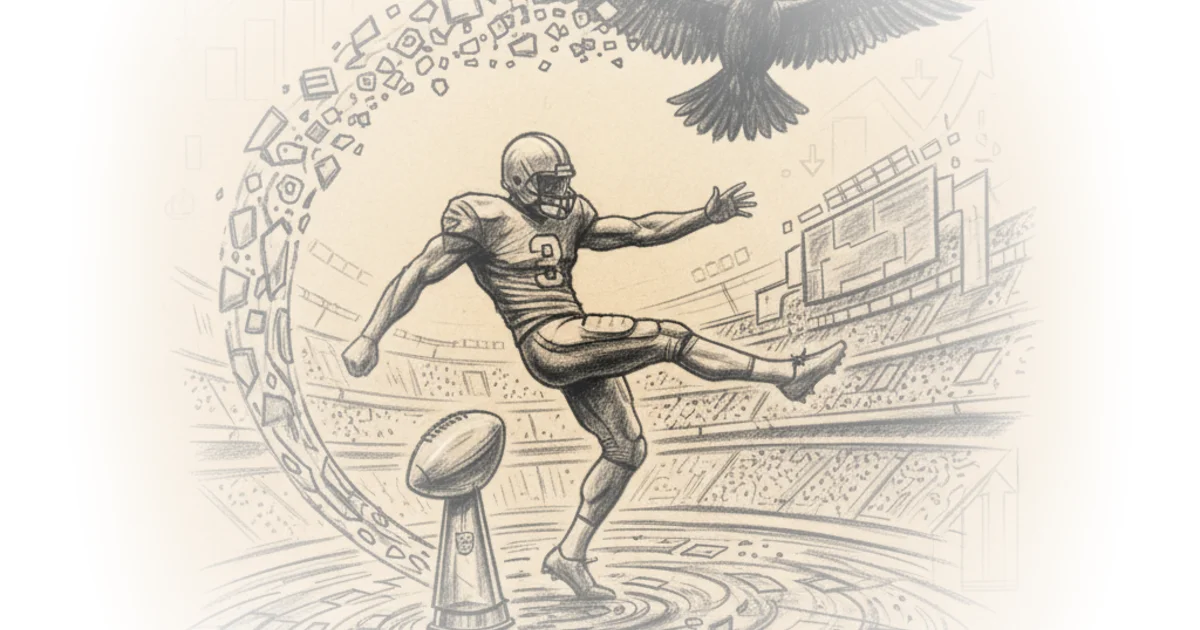
The author distinguishes between a capitalized "Scorigami" (a score that has never occurred in history) and a lowercase "scorigami" (any sufficiently weird score). He argues that the former is a "nonrenewable resource" that is being "strip-mined away," particularly since the introduction of the two-point conversion in 1994. However, the real story is the latter. "I'm here to expand and revise the definition of Scorigami," Silver declares, asserting that 2025 marks the dawn of an era where a score of 68-11 "wouldn't feel that weird."
This framing is effective because it uses a niche concept to illustrate a massive trend: the erosion of predictability. By invoking Jon Bois's term, Silver taps into a specific cultural lexicon to describe a statistical reality that casual fans might feel but cannot articulate.
Thus, I'm here to dub 2025 as the dawn of the Scorigami Era in the National Football League.
The Mechanics of an Offensive Explosion
The article's core strength lies in its granular breakdown of why scoring has skyrocketed. Silver identifies a "trick" that hides the true magnitude of the offensive explosion: the game clock. While total points are up, the number of possessions has dropped. "So far this year, each team is averaging 10.5 drives per game, compared to 12 drives per game as recently as 2013," Silver explains. Because successful drives consume more time, the net increase in final scores "considerably understates the gains in offensive efficiency."
He attributes this efficiency to a shortened field. The NFL's new dynamic kickoff rules have moved the average starting position downfield by about seven yards compared to a decade ago. "If you're starting at, say, the 33-yard line, you're now really only two first downs away from being within field goal range," Silver notes. This structural change has turned the end of the half into a high-stakes gamble, where a quick drive can result in a "59-yard field goal attempt... boom, game (probably) over."
Furthermore, kicking accuracy has reached absurd levels. Silver points out that the rate of field goal attempts from 55 yards or more has increased by 135 percent in four years, with makes tripling. He observes that "kickers are actually converting 64 percent of their attempts from super-long-range," a statistic that challenges the conventional wisdom that such kicks are mere Hail Marys.
Critics might argue that attributing this shift solely to rule changes ignores the natural evolution of athlete talent and coaching innovation. However, Silver's data on field position suggests that the rules are the primary accelerant, creating a feedback loop where offenses are forced to adapt to a shorter field.
The Precision of Modern Strategy
Silver also challenges the narrative that the quarterback is becoming less valuable due to a lack of gaudy passing numbers. He argues that quarterbacks are actually more efficient, opting for "shorter, safer routes with exceptionally high completion percentages and little risk of interceptions." The average yards per completed pass is at a historic low, yet the league's collective quarterback rating is at an all-time high.
"The value of quarterbacks, if anything, is a little bit understated by the conventional wisdom," Silver writes. He highlights that quarterbacks are now essential in the running game, averaging nearly twice the rushing yards of their counterparts from the 1980s and 1990s. This dual-threat capability is no longer an anomaly; it is the baseline requirement for success. "For the first time in NFL history, quarterbacks as a collective are gaining enough rushing yards to outweigh the yards they lose from sacks."
This precision extends to coaching decisions, particularly on fourth down. Silver notes that teams are finally "nailing intricate 4th-down and 2-point-conversion decisions," moving away from the conservative play-calling that defined the early 2000s. The result is a league that is both more prolific and more precise, a paradox that Silver captures by comparing the new NFL to origami: "the new NFL is precise."
The object of the game isn't strictly to maximize the number of points scored, but to score at least one more than the opponent.
Bottom Line
Silver's argument is compelling because it moves beyond surface-level observations of "high scoring" to reveal the mechanical underpinnings of a transformed sport. The strongest part of the piece is the connection between the new kickoff rules and the drastic shortening of the field, which explains why efficiency has outpaced possession counts. The biggest vulnerability is the assumption that this trend will hold; Silver himself admits to expecting "mean reversion" in kicking accuracy, which could dampen the Scorigami effect. Readers should watch whether the league adjusts its rules again to restore defensive balance, or if the "Scorigami Era" becomes the permanent new normal.
The remaining uncharted territory on the Scorigami map now requires dedication and creativity to reach.