Jeffrey Kaplan takes a 19th-century philosophical essay and strips away the academic dust to reveal a surprisingly modern insight: the words we use to label things are often just arbitrary marks, not descriptions of reality. In a field often bogged down by dense jargon, Kaplan's analysis of John Stuart Mill's "On Names" cuts through the noise to ask a fundamental question that still haunts artificial intelligence and linguistics today: does a name tell us what something is, or does it just point to it? This is not a dry history lesson; it is a necessary refresher on how language actually functions in a world where we constantly confuse our maps with the territory.
The Three Layers of Meaning
Kaplan begins by dismantling a common intuition: that when we speak, we are merely swapping mental images. He writes, "the meaning of a name is not an idea." Instead, he outlines a triad that separates the word itself, the physical object, and our internal concept of that object. Kaplan illustrates this with the sun, noting that "the sentence the sun is the cause of the day is not about our idea... it's saying that the Sun causes something."
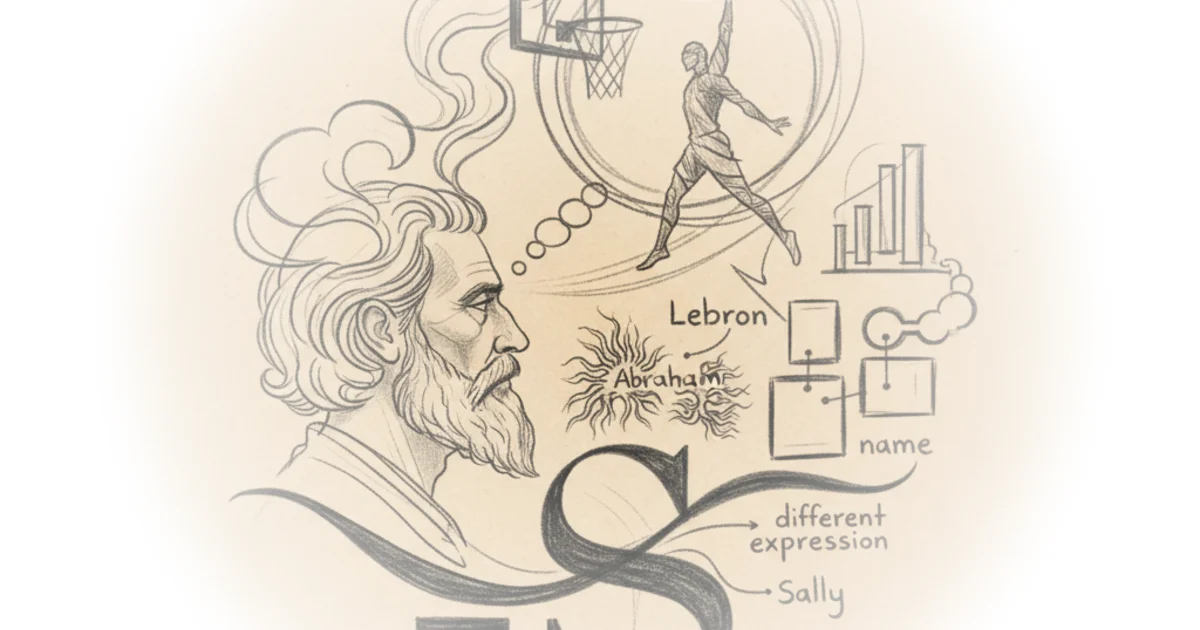
This distinction is vital. It prevents us from falling into the trap of solipsism, where we believe we are only discussing our own thoughts rather than the external world. Kaplan argues that Mill correctly identified that language bridges the gap between ink on a page and a "giant ball of fire in space 93 million miles away." By separating the label from the idea, Mill provides a framework for objective discourse. However, one might argue that in practice, our "ideas" are so deeply entangled with our definitions that separating them entirely is a theoretical exercise that rarely holds up in casual conversation.
The Illusion of the "Collective" Name
The commentary then pivots to a more contentious point where Kaplan challenges Mill's own logic. Mill attempts to distinguish between singular names (like "Garfield") and collective names (like "the 76th Regiment of the British army"). Kaplan, however, finds this distinction flawed. He paraphrases Mill's confusion, observing that "there's no such thing as a non-collective thing." Every entity, from a single cat to a human being, is a collection of molecules and cells grouped together and perceived as a unit.
"Mill is just genuinely confused when he introduces the notion of a collective name, but that's okay he was right about a lot of other things."
Kaplan's critique here is sharp and necessary. He points out that Mill introduced the category of "collective names" to solve a specific problem—how to treat a group as a single subject—but in doing so, created a category that applies to everything. If a cat is a collection of cells, and a regiment is a collection of soldiers, the distinction collapses. This is a brilliant moment of editorial intervention, showing that even the greatest philosophers can get tangled in their own definitions. It reminds us that language is a tool we build, not a perfect mirror of nature.
The Unmeaning Mark
The most provocative section of Kaplan's analysis concerns the difference between connotative and non-connotative names. He contrasts a title like "the chancellor of the University of North Carolina at Greensboro" with a proper name like "Frank Gilliam Jr." The former conveys attributes (the job, the responsibilities), while the latter, Kaplan argues, is merely a tag. He quotes Mill directly on this: "a proper name is but an unmeaning Mark which we connect in our minds with the idea of the object."
Kaplan expands on this with a vivid analogy involving robbers chalking houses. Just as a chalk mark signals a target without describing the house's architecture, a proper name signals a person without describing their attributes. "The name once given is independent of the reason," Kaplan explains, using the example of a town named "Dartmouth." Even if an earthquake moves the river mouth, the town remains Dartmouth. The name sticks to the object, not the description.
This is the core of Mill's argument, and Kaplan defends it well: proper names are rigid designators. They do not lose their referent if the object changes its properties. If the Chancellor retires, he is no longer "the Chancellor," but he remains "Frank Gilliam Jr." Critics might note, however, that in the digital age, names are rarely "unmeaning." A name like "Frank Gilliam Jr." immediately conveys lineage, and in an era of data, every name carries metadata. Mill's "unmeaning mark" is becoming harder to sustain as our naming conventions become increasingly descriptive and data-rich.
The Limits of the Label
Kaplan concludes by acknowledging that Mill's view, while foundational, is not the final word. He notes that later philosophers like Gottlob Frege would challenge the idea that names are purely non-connotative, suggesting that even proper names involve a "sense" or a mode of presentation. Kaplan writes, "it's going to turn out that this can't be exactly right... even proper names they have to involve something else."
This admission adds intellectual honesty to the piece. Kaplan does not present Mill as infallible but as a starting point. The argument holds up as a powerful tool for understanding the function of names, even if it fails to capture the full complexity of how we use them. The distinction between a label that points and a description that defines remains one of the most useful tools in the philosopher's toolkit.
"Proper names are attached to the objects themselves and are not dependent on the continuance of any attribute of the object."
Bottom Line
Jeffrey Kaplan's commentary succeeds by turning a dense philosophical text into a clear, actionable lesson on the nature of reference. His strongest move is exposing the absurdity of Mill's "collective name" category while simultaneously defending the utility of the "unmeaning mark." The piece's biggest vulnerability is its slight underestimation of how much modern context loads even the simplest names with meaning, but this does not undermine the core insight. For anyone trying to navigate a world of information overload, understanding the difference between a label and a description is not just academic—it is essential.