Then & Now delivers a startling historical diagnosis for our modern epidemic of narcissism, tracing the roots of today's self-obsession not to social media algorithms, but to a radical shift in how humans understood their own minds two centuries ago. The piece argues that our current cultural fixation on the "inner self" is a direct legacy of Romantic poets and philosophers who first dared to claim that truth resides within, rather than in divine will or external social roles. This is a crucial reframing for busy readers trying to make sense of why we are so consumed by personal branding and memoirs; it suggests the problem isn't just digital, but deeply philosophical.
The Birth of the Inner Universe
The commentary begins by contrasting the ancient and medieval world, where identity was largely imposed from the outside, with the explosive emergence of the internal self in the 19th century. Then & Now writes, "Before de Quincy's time we have to remember that knowledge traditionally speaking was not about what's in here endogenous but what's out there exogenous." This distinction is vital: for centuries, emotions were seen as forces placed upon us by gods or social structures, not generated by our own psychology. The author notes that even St. Augustine's famous Confessions were not about discovering a unique self, but about conforming behavior to "external rules of Christian teaching and God's greater will."
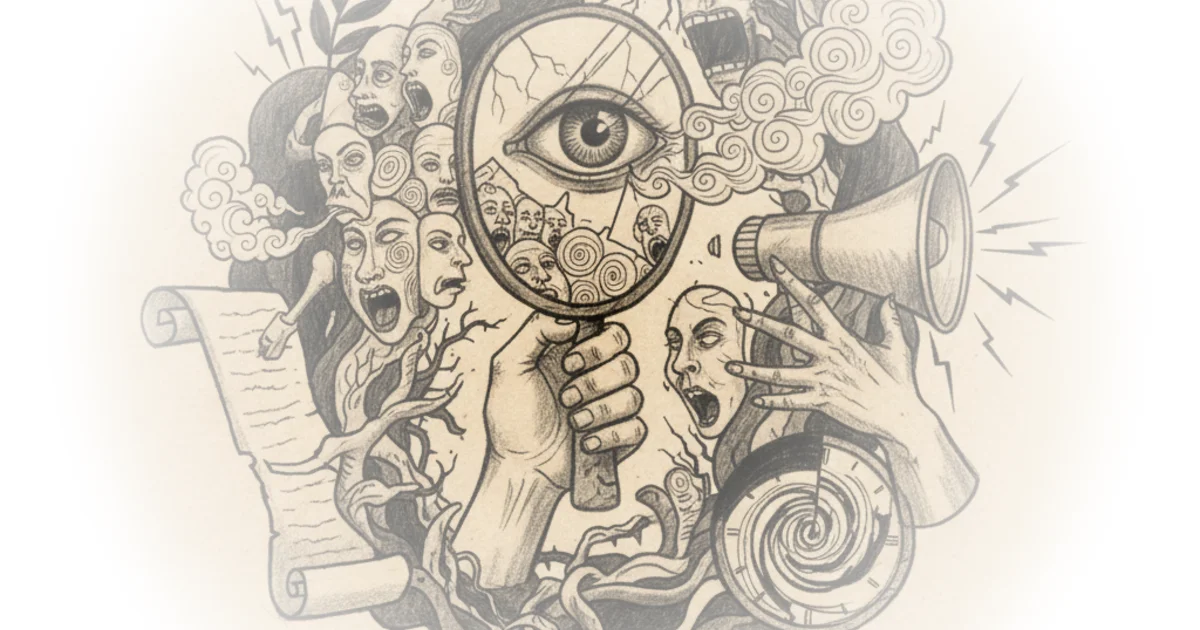
This historical context effectively dismantles the idea that self-exploration is a timeless human trait. Instead, Then & Now posits that the modern concept of personality is a relatively recent invention, born from a specific cultural moment. The argument gains traction when it highlights how the Romantics, particularly Jean-Jacques Rousseau, flipped the script. As Then & Now puts it, Rousseau realized that if "political systems and social norms around him those exogenous features that were oppressing Ordinary People," then truth could only be found "within the self." This was a revolutionary move that turned the gaze inward, creating the template for the modern autobiography.
The great originator turned into himself and found a world.
Critics might note that this narrative risks oversimplifying the complexity of pre-modern interiority, ignoring that figures like the Stoics or even certain mystics had rich inner lives long before Rousseau. However, the piece's strength lies in its focus on the public articulation of that inner life as a new cultural norm, rather than the private experience itself.
From Opium to the Ocean of the Mind
The centerpiece of the analysis is Thomas De Quincey's Confessions of an English Opium-Eater, which Then & Now frames as the first true modern exploration of the psyche. The author argues that De Quincey didn't just write about addiction; he used it to map the "abyss within." Then & Now quotes De Quincey directly to illustrate this shift: "I am the Quincy I dream and I create dreams out of the Opium pipe." The commentary highlights how De Quincey challenged the social taboo against revealing vulnerability, stating that "nothing indeed is more revolting to English feelings than the spectacle of a human being obtruding on our notice his moral ulcers or scars."
This is where the piece connects the 19th century to the present day with striking clarity. The author suggests that our current culture of "tell-all" interviews and reality TV is the logical, if distorted, endpoint of De Quincey's project. Then & Now writes, "He uses the experience of his addiction to explore psychologically and innovatively the abyss within what he called The Apocalypse of the world within me." The argument is compelling because it reframes our obsession with personal trauma not as a moral failing, but as the continuation of a literary and philosophical tradition that values the "apocalypse" of the self.
The piece also draws a parallel between the Romantic poets' focus on nature and De Quincey's focus on the urban, drug-induced landscape. Where William Wordsworth found the universal in a lake or a mountain, De Quincey found it in the "symbolic staircases" of his own mind. Then & Now observes, "He uses metaphors like translucent Waters and Shining mirrors and oceans and Waters wrathful and surging to describe his own inner life." This poetic analysis underscores how the language of the self became the primary language of modern identity.
The Double-Edged Sword of Self-Knowledge
The commentary concludes by examining the consequences of this inward turn. While the shift allowed for unprecedented individual freedom and the rise of democracy, it also sowed the seeds for the narcissism that plagues the 21st century. Then & Now writes, "The intense focus on the eye produced the narcissism and the obsessions with the self we see everywhere today." The author points out that we have moved from looking outward at the world to "spending a lot of time Naval gazing within."
This section offers a sobering critique of the modern condition. The author argues that the "autobiographical self"—the idea that we must constantly narrate and curate our own lives—has become a burden. Then & Now quotes psychologist Kai Wang to support this: "The autobiographical self is self-knowledge that builds upon our memories and orients us towards the future allowing our existence to transcend the Here and Now moment." Yet, the piece warns that this mechanism has been hijacked by a culture of performance, where everyone is expected to be the star of their own story.
The final argument is a call for balance. Then & Now suggests that the defining challenge of our time is "whether world within can be reconciled with the world without." This is a powerful synthesis of the historical analysis, moving beyond mere description to a prescription for the future. It implies that the solution to our self-obsession isn't to abandon the inner self, but to re-engage with the external world with the same intensity we currently apply to our own egos.
Bottom Line
Then & Now's most powerful contribution is linking the modern crisis of narcissism to the Romantic revolution, proving that our obsession with the self is a historical construct, not an inevitable human state. The argument's greatest vulnerability is its tendency to treat the "external world" of the pre-modern era as monolithic, potentially ignoring the rich, non-autobiographical ways people found meaning before the 18th century. Readers should watch for how this historical lens applies to the current algorithmic economy, which monetizes the very "inner universe" these poets first discovered. The piece succeeds not by offering a quick fix, but by revealing the deep roots of our current malaise.