This piece cuts through the noise of daily political theater to identify a single, structural threat that could silently dismantle American economic stability for a generation. While headlines focus on trade wars and deportations, Sarah Longwell, Tim Miller, and Bill Kristol argue that the administration's systematic assault on the Federal Reserve's independence is the true "sleeper issue" capable of triggering decades of high inflation. They bring a specific, terrifying clarity to the stakes: this isn't just about interest rates; it's about whether the United States will replicate the economic collapse seen in Venezuela or the stagflation of the 1970s.
The Political Incentive Trap
The authors begin by dismantling the assumption that politicians can be trusted with monetary policy. They explain that elected officials face a perverse incentive: they want the short-term "sugar rush" of cheap money to boost their approval ratings, even if it guarantees long-term pain. As Sarah Longwell, Tim Miller, and Bill Kristol write, "If politicians control interest rates—and therefore the supply of money sloshing around the economy—they will always have an incentive to reduce them." This framing is crucial because it shifts the debate from personal attacks on the Fed Chair to a fundamental conflict of interest between electoral cycles and economic health.
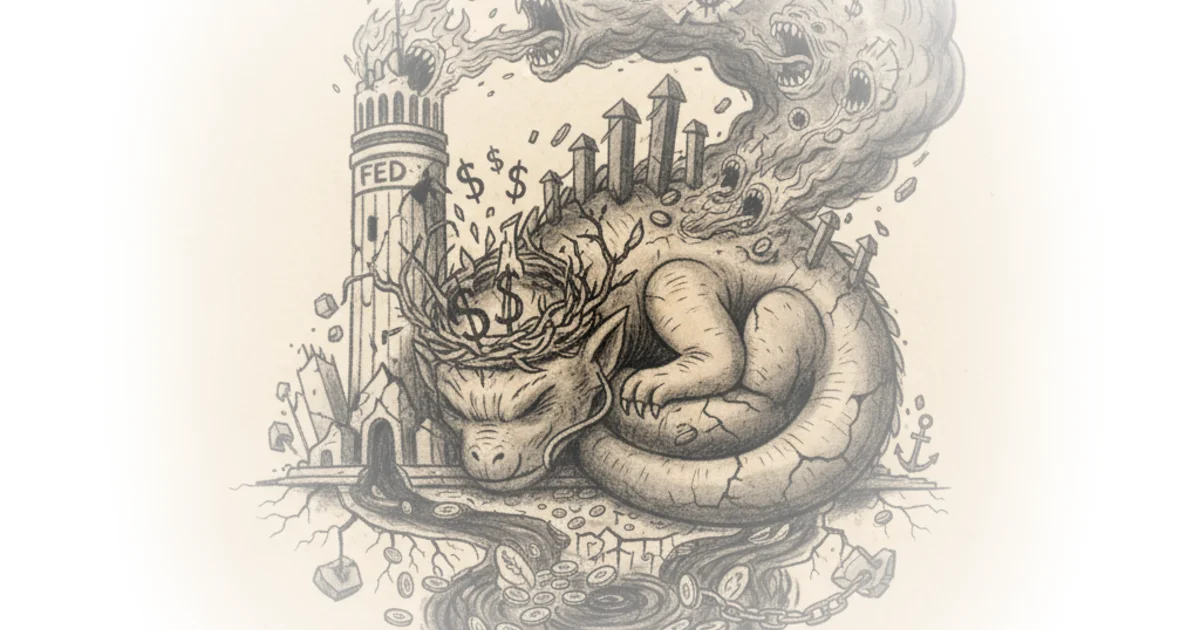
The commentary effectively uses historical precedent to ground this fear. The authors remind us that this isn't theoretical; it happened under Lyndon Johnson and Richard Nixon, leading to the painful 1970s stagflation. They cite a University of Maryland working paper to quantify the risk: if a president applies half the political pressure Nixon did for just six months, the U.S. price level could rise by 7 percent over the next decade. This data-driven approach gives weight to the warning, moving it beyond speculation into the realm of mathematical certainty.
"If Trump succeeds, he may doom the United States to high inflation for years, if not decades, to come."
Critics might argue that the current economic weakness actually necessitates lower rates, regardless of political pressure. However, the authors counter that the administration's motivation isn't economic necessity but a desire for an easy-money boom before the next election, ignoring the inflationary consequences that would follow.
The Purge of Independence
The coverage then pivots to the specific mechanisms the administration is using to seize control, moving from rhetoric to action. The authors note that while the public focused on threats to fire Jerome Powell, the real danger lies in a broader purge of the Federal Open Market Committee. They highlight the appointment of Steve Miran, who took a Fed seat while remaining on "unpaid leave" from the White House, stripping away any pretense of separation. "There's not even a pretense of independence," the authors observe, noting that Senate Republicans pushed this through without hesitation.
The piece also exposes the administration's legal gambit to overturn 90 years of precedent regarding independent agencies. By claiming they can fire officials without "cause," the executive branch is testing the Supreme Court's willingness to protect the Fed. The authors point out the irony that Justice Brett Kavanaugh, often seen as a conservative stalwart, expressed concern that ruling for the administration in a Federal Trade Commission case would inevitably compromise Fed independence. This suggests that even within the judiciary, the danger to the central bank's autonomy is recognized as a systemic threat.
Perhaps the most insidious tactic described is the attempt to reshape the regional Fed bank presidents. The authors detail a proposed residency rule that would disqualify nearly all current regional leaders, allowing the administration to install a compliant majority. "This would be the way Trump co-opts the Fed," they write, noting that the pretext is a bogus residency requirement that would have disqualified almost everyone if it had been in place earlier. This strategy is particularly effective because it avoids the political fallout of firing a sitting chair while achieving the same result: a board that will cut rates to please the White House.
The Human and Economic Cost
The authors do not shy away from the human cost of this institutional erosion. They quote Jerome Powell directly, recalling the "decade of very high and very volatile inflation" from the 1970s and the "extremely difficult" conditions for people on fixed incomes. This personal testimony from the Fed Chair adds a layer of gravity that policy papers often lack. The authors connect this to the broader global context, referencing the hyperinflation in Venezuela and the collapse in Argentina as cautionary tales of what happens when politicians seize the money supply.
They also highlight the market's reaction, noting that bond investors have already warned against the administration's preferred nominee, Kevin Hassett, due to his history of "egregious chart crimes" and his reputation for reverse-engineering results to fit political desires. "Investors worry he won't be independent," the authors state, suggesting that the financial markets are already pricing in the risk of a politicized central bank.
"If you're focused on the long-term health of the economy, rather than the next election, you'll be more willing to play bad cop and 'take the punch bowl away' before the collective party gets out of hand."
A counterargument worth considering is that the Fed has made its own mistakes recently, leading some to believe a reset is necessary. Yet, the authors argue that the solution to past errors is not political control, but a return to the very independence that allowed the Fed to correct course in the first place.
Bottom Line
The strongest part of this argument is its ability to connect abstract monetary policy to tangible, historical disasters, making the threat of inflation feel immediate and personal. The piece's biggest vulnerability is its reliance on the assumption that the administration will succeed in its legal and political maneuvers, though the evidence of their current strategy suggests the attempt is well underway. Readers should watch the February renewal of regional Fed bank presidents, as this will be the first concrete test of whether the administration can successfully co-opt the central bank's governance structure.