Kings and Generals challenges the Cold War narrative that the Soviet economy was a monolithic failure from its inception, arguing instead that it underwent distinct, sometimes surprisingly effective, evolutionary stages. This piece is notable for its refusal to treat the USSR as a static caricature of inefficiency, instead offering a granular look at how the regime oscillated between brutal centralization and pragmatic market mechanisms to survive. For a busy reader, the value lies in understanding that the Soviet collapse was not inevitable in 1917, but the result of specific political choices that abandoned economic flexibility for ideological rigidity.
The Ideological Roots and Imperial Legacy
The commentary begins by dismantling the binary view of the Cold War as merely a clash of guns and missiles, reframing it as a fundamental dispute over how to organize an industrialized society. Kings and Generals writes, "The root of this ideological division was the question of how modern human society should be transformed in an industrialized economy." This framing is crucial because it shifts the focus from military posturing to the structural mechanics that determined the USSR's lifespan. The author correctly identifies that while Western liberalism drew on 18th-century thinkers like Adam Smith, the Soviet alternative was a prescriptive attempt to reshape society to eliminate "bourgeois values" and move to the next step of civilizational evolution.
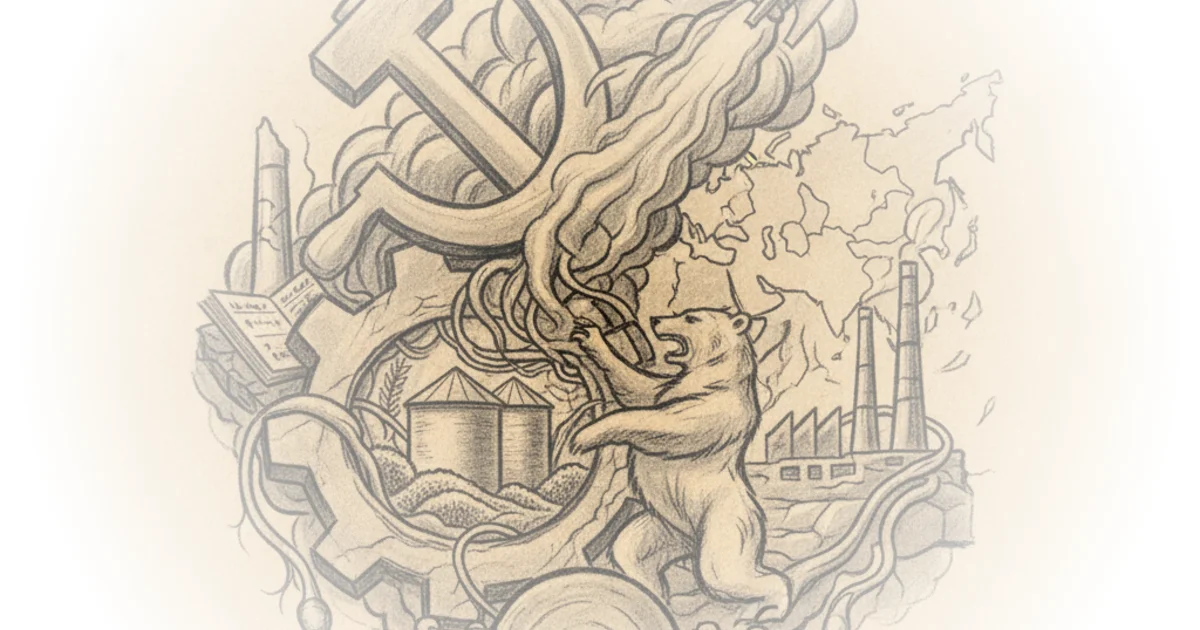
However, the piece makes a compelling, often overlooked point about the Soviet Union's starting line. The author notes that the Soviet economy was built on the foundations of the Russian imperial economy, which was "one of the last nations in Europe to modernize socially and thus economically." Kings and Generals explains that the Russian Empire was essentially a medieval state where constitutionalism was seen as "anathema to Russians continued survival." This context is vital; it suggests that the Soviet struggle was not just against capitalism, but against centuries of institutional stagnation. The author highlights that while Tsar Alexander II attempted modernization through the 1861 abolition of serfdom, these reforms came too late and were cut short by his assassination, leaving the nation playing catch-up.
"All of Marxist theory and Lenin's interpretations of that theory said that the Soviet economy should have been the envy of the world. And yet it became synonymous with dysfunction, inefficiency, brutality, and eventually collapse."
This stark contrast between theory and reality sets the stage for the piece's central thesis: the Soviet system had an ideological framework but lacked a concrete plan for implementation. The author argues that the USSR's fatal flaw was assuming that bourgeois institutions would "naturally wither away" without a transitional strategy, a miscalculation that would haunt the regime for decades.
War Communism and the New Economic Policy
The narrative then pivots to the Bolshevik seizure of power, driven by the economic collapse of 1917. Kings and Generals describes the initial response as "War Communism," a policy of full nationalization where the state controlled all facets of economic life. The author notes the brutal efficiency of this system: "War communism proved to be quite effective. Even though it was extremely brutal, it allowed the Bolsheviks to marshall their resources and defeat the whites." This is a nuanced take, acknowledging that while the policy was a humanitarian disaster, it was a strategic success in the context of civil war. The secret police, the Cheka, ruthlessly enforced these ordinances, arresting and executing "wreckers, spies, and profiteers."
However, the author points out that this system was unsustainable without an existential threat. Once the civil war ended, the Bolsheviks realized they could not maintain such pressure indefinitely. This led to a strategic retreat known as the New Economic Policy (NEP). Kings and Generals writes, "Lenin referred to the implementation of the new economic policy and the loosening of political control as undertaking a self-imposed Thermidor." This historical analogy to the French Revolution is a sophisticated touch, suggesting Lenin understood that radicalism must be tempered to ensure political survival.
Under the NEP, the Soviet Union effectively practiced a form of state capitalism. The author explains that while the government maintained a monopoly on foreign trade, "domestically, limited free enterprise was allowed to exist and even flourish at both the macro and microeconomic level." This period saw the rise of the "Nepmen," a new class of Russian capitalists who accumulated private capital. Kings and Generals notes that this era was marked by significant foreign investment, with firms from Great Britain, Germany, and the United States building factories in the USSR. The reintroduction of a gold-backed currency allowed for "massive deflation and economic stability," proving that the Soviet system could adapt.
"The Bolsheviks continued to maintain a monopoly on political power and Lenin, ever the political demagogue, continued to remove factionalism and consolidate authority. Thus, as the party entrenched its domination of the political sphere, it allowed itself to retreat from the economic sphere."
This observation highlights a critical tension in the Soviet model: the party was willing to compromise on economics to save the revolution, but only so long as it did not threaten its political monopoly. Critics might note that the author glosses over the human cost of the NEP's eventual reversal, focusing more on the macroeconomic mechanics than the suffering of the peasantry during the subsequent collectivization drives.
The Scissors Crisis and the End of Flexibility
The piece concludes by examining why the successful NEP was abandoned. The author identifies the "scissors crisis" of 1923, where falling agricultural prices and rising industrial goods prices created a dangerous imbalance. Kings and Generals writes, "This so-called scissors crisis led to shortages of goods and strikes. It also encouraged the government to assert more centralized economic control, especially over industry, in order to lower prices." This economic pressure provided the pretext for the political hardening that would define the Stalin era.
Politically, the crisis united opposition figures like Trotsky and Stalin against the NEP advocates. The author argues that Stalin emerged as the superior political operator, signaling to Nikolai Bukharin and other NEP proponents that he was willing to moderate his stance while actually moving toward total control. The piece suggests that the abandonment of the NEP was not just an economic decision but a political maneuver to consolidate power. By blaming the "Nepmen, speculators and peasants" for the crisis, Stalin was able to justify a return to centralized control, effectively ending the experiment with market socialism.
"The Soviet system was far from perfect, but it was also not always the deep quagmire it's often portrayed to be, and that it entered various stages of evolution throughout its history."
This final assessment encapsulates the piece's contribution to the historical record. It forces the reader to confront the reality that the Soviet Union was not a static failure but a dynamic entity that made specific, reversible choices. The tragedy, as Kings and Generals implies, was that the leadership chose the path of rigidity over the path of adaptation.
Bottom Line
Kings and Generals delivers a sophisticated analysis that successfully complicates the standard narrative of Soviet economic failure, proving that the regime was capable of pragmatic adaptation before political ideology overruled economic reality. The piece's greatest strength is its detailed examination of the New Economic Policy as a viable, albeit temporary, alternative to total centralization, while its main vulnerability is a slight underemphasis on the human suffering inherent in the transition between these economic models. Readers should watch for how this historical pattern of ideological rigidity overriding economic pragmatism continues to influence modern authoritarian regimes.
The Soviet system was far from perfect, but it was also not always the deep quagmire it's often portrayed to be, and that it entered various stages of evolution throughout its history.