In an era where the instinct to silence hate feels increasingly urgent, Yascha Mounk delivers a counterintuitive verdict: the very mechanism we rely on to protect ourselves from antisemitism is the one we must refuse to abandon. This piece is not a defense of hate speech, but a stark warning that surrendering the principle of free expression to the state or platforms offers a false security that historically has always ended in disaster.
The Historical Anchor
Mounk grounds his argument in a pivotal moment of American legal history that many have forgotten. He recounts how David Goldberger, a Jewish attorney and legal director for the ACLU of Illinois, defended the right of neo-Nazis to march through Skokie, Illinois, a town home to many Holocaust survivors. Goldberger was not a self-hating Jew; he simply understood a brutal truth. As Mounk writes, "the constitutional guarantees of freedom of speech and press would be meaningless if the government could pick and choose the persons to whom they apply."
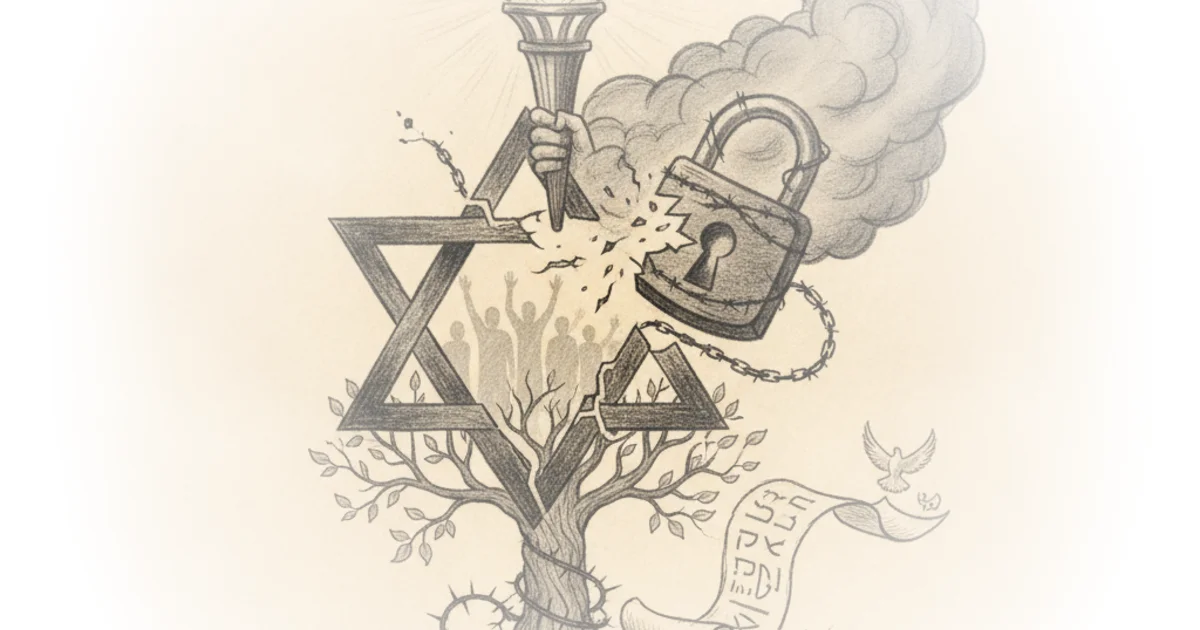
This framing is powerful because it shifts the debate from the morality of the speakers to the vulnerability of the listeners. Mounk argues that relying on the powerful for protection is a trap. He draws a direct line from the American experience to the ancient text of Exodus, noting that "a new king arose over Egypt who did not know Joseph," a shift in leadership that turned relative freedom into enslavement overnight. The lesson is clear: rights granted by the whims of a ruler are not rights at all; they are merely privileges waiting to be revoked.
Minorities often have good reasons to feel threatened. But whenever you look to the powerful for protection, you become dependent on their whims.
Critics might argue that this historical analogy is too abstract for a modern crisis where violence is immediate and tangible. However, Mounk's point is precisely that the mechanism of protection matters more than the specific threat at any given moment. If the state gains the power to ban the speech of neo-Nazis today, it retains the power to ban the speech of Jewish advocacy groups tomorrow.
The Europeanization of Fear
The article then pivots to a disturbing contemporary trend: the "Europeanization of American Jewry." Mounk observes that the unique safety American Jews once enjoyed is eroding, replaced by the fortified reality of European Jewish life. He describes the shift from a world where Jewish institutions needed little protection to one where "it is nearly as easy to spot a Jewish kindergarten in New York as it long has been in Paris or Berlin: both are marked by the presence of security guards."
This observation is not just descriptive; it is a diagnosis of a psychological rupture. Mounk suggests that the rise of antisemitic rhetoric on social media, amplified by figures with massive followings, has created a feedback loop of fear. The response from many communities has been a desperate desire for censorship, a trade-off where they are willing to discard free speech principles for a promise of safety. Mounk warns that this is a dangerous calculation. He argues that the belief that regulation can "drain the poison out of our politics" rests on three flawed assumptions: that regulators will be reasonable, that censorship will work, and that the problem is legal rather than technological.
The Illusion of Control
The core of Mounk's analysis dismantles the idea that we can simply legislate away bad ideas. He points out that in a polarized society, the people empowered to decide what is "verboten" are no longer neutral arbiters. "It is deeply naive to think that 'letting the government pick and choose' who enjoys the freedoms guaranteed by the Constitution would be a good idea," he writes. The institutions that once acted as gatekeepers have lost their power to the democratized, low-cost nature of digital communication.
Mounk highlights a paradox often ignored by those calling for stricter controls: censorship often fuels the very movements it seeks to suppress. He notes that the appeal of the forbidden fruit drives the success of many extreme media personalities, who thrive on the narrative of being silenced. "A substantial portion of the audience for people such as Nick Fuentes is as attracted to the frisson they derive from breaking the biggest possible taboos as they are to the actual claims that they make."
The smartest case for free speech has never turned on denying that some utterances are so vile that all of us would be better off if they somehow disappeared from the public sphere. Rather, it was always based on skepticism that any institution, private or public, would consistently make these determinations in a reasonable and selfless manner.
To bolster this, Mounk looks across the Atlantic. He points out that European nations already have strict laws criminalizing hate speech and Holocaust denial, yet these measures have not marginalized extremists or made Jews safer. In fact, extremists in Europe are often just one election away from power. The problem, he concludes, is structural, not legal. Short of the extreme censorship practiced by dictatorships, regulation cannot rein in the algorithms and the democratization of speech that define our current reality.
Bottom Line
Mounk's strongest argument lies in his refusal to treat free speech as a luxury that can be traded for safety; he correctly identifies it as the only durable shield against the arbitrary power of the state. The piece's greatest vulnerability is its reliance on the assumption that the public can endure the psychological toll of unregulated hate speech without a societal collapse, a gamble that feels increasingly risky as physical violence rises. Readers should watch whether the tension between the demand for safety and the defense of principle will force a redefinition of what "reasonable" censorship looks like in a polarized America.