Novara Media presents a startling claim from a former top US counterterrorism official: the war with Iran was launched on fabricated intelligence, and a key Trump ally was silenced for opposing it. The piece leverages a dramatic resignation letter and a Tucker Carlson interview to argue that Israeli officials bypassed US intelligence channels to manufacture a casus belli, while simultaneously hinting at a political assassination that official investigations have refused to probe.
The Intelligence Short-Circuit
The core of the argument rests on the testimony of Joe Kent, the former head of the National Counterterrorism Center. Kent asserts that the justification for conflict was entirely manufactured. "There was no intelligence that showed an imminent threat," Kent states, dismantling the premise of the war. "There was no intelligence indeed that showed they were trying to build a nuclear weapon." This is a damning indictment coming from a man who once coordinated the CIA, FBI, and Department of Defense.
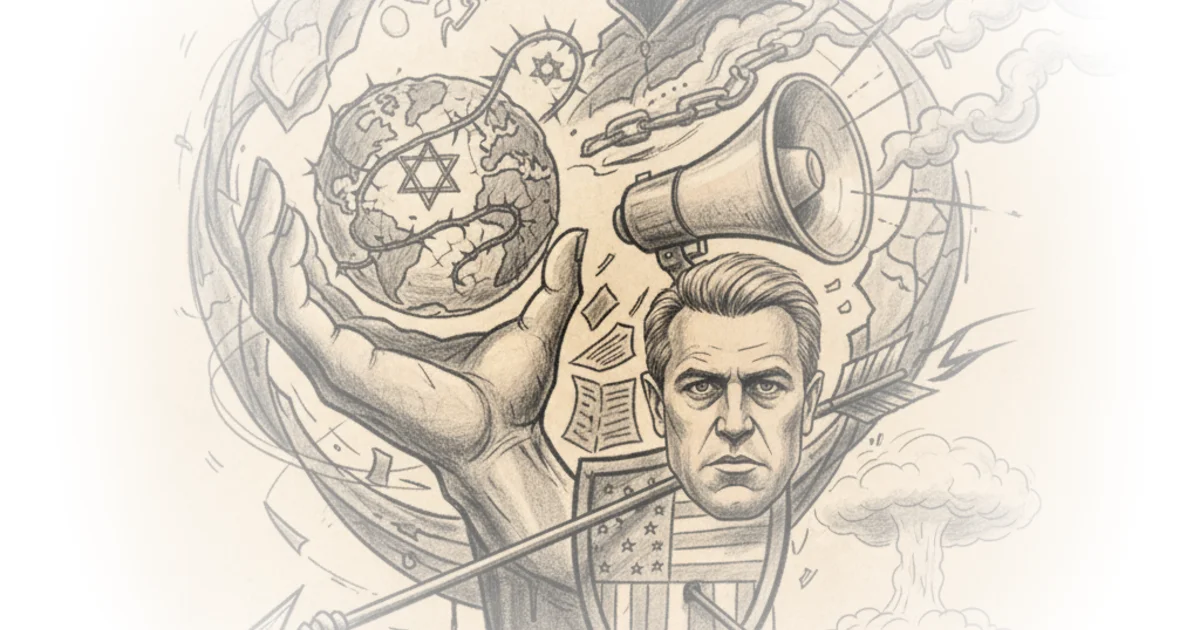
Novara Media highlights how this intelligence gap was exploited. The author notes that Israeli officials would bypass standard vetting processes, telling American policymakers, "Hey, I'm giving you a preview. It's not in intelligence channels yet, but here's what's going to happen." The commentary suggests this tactic effectively short-circuited the US government's own vetting mechanisms. "They'll say, 'Hey, this isn't in the intelligence channels yet.' Because it's it's going to take some time to get there," Kent explains, describing a pattern of feeding unverified narratives until one stuck.
This framing is particularly potent because it connects to a broader historical pattern of influence. The author draws a parallel to the 2026 Iran war context, noting how specific narratives about enrichment levels were used to sabotage negotiations. "The Iranians basically said like we're not going to negotiate if the if the whole starting point is no enrichment," the text recalls, illustrating how a diplomatic red line was moved to justify military action.
Critics might note that Kent is a political appointee with a history of controversial views, which could undermine the objectivity of his claims. However, the piece counters this by emphasizing his unique position within the intelligence community and the corroboration from other sources.
"The simple declaration that Iran was not an imminent threat... means the US has gone to war on a false pretense."
The Confirmation and the Silence
The argument gains further weight when the author brings in Tulsi Gabbard, the Director of US National Intelligence. The text points out that Gabbard confirmed the destruction of Iran's nuclear program in June of the previous year, rendering the threat of a new bomb non-existent. "As a result of Operation Midnight Hammer... Iran's nuclear enrichment program was obliterated," Gabbard stated, a fact the author argues makes the current war drive nonsensical.
The commentary then pivots to the most explosive element: the death of Charlie Kirk. The author describes Kirk as a close Trump adviser who was "single-minded" in his opposition to the war. "Joe, stop us from getting into a war with Iran," Kirk allegedly told Kent in the West Wing shortly before his death. The piece highlights the disturbing lack of a federal investigation into his killing. "We've been told that this individual is a lone gunman... but the investigation that I was a part of... we were stopped from continuing to investigate," Kent claims.
Novara Media acknowledges the speculative nature of the assassination claims but insists the procedural anomalies demand scrutiny. The author notes that while the FBI handed the case to state authorities, the National Counterterrorism Center was blocked from following up on "linkage" they needed to investigate. "There's some kind of justification in my mind that the Trump administration will have for getting their counterterrorism unit again for somebody who murdered somebody in politically," the author muses, questioning why a political murder would be removed from federal counterterrorism purview.
A counterargument worth considering is that the author admits there is "absolutely no evidence" of foreign involvement in Kirk's death, relying heavily on the absence of an investigation rather than positive proof of a conspiracy. The piece walks a fine line between reporting on a procedural failure and endorsing a conspiracy theory.
The Political Fallout
The final layer of the argument examines the domestic political cost for Donald Trump. With the war proving unpopular and the midterms approaching, the author suggests Trump is in a precarious position. "He's going against the US public on this," the text argues, noting that a Democratic flip of the House could leave him with a "lame duck presidency."
The author connects this to the broader ecosystem of media influence, where pundits repeat the same unverified narratives found in classified briefings. "The talking heads on TV... would say basically the exact same thing that night," the text observes, creating a feedback loop that isolates policymakers from contradictory intelligence.
"Up is down, down is up. Everything's insane, particularly in the US."
Bottom Line
Novara Media's coverage is strongest in its synthesis of Kent's insider testimony with Gabbard's official confirmation that the nuclear threat was already neutralized, creating a compelling case that the war lacks a factual basis. Its biggest vulnerability lies in the assassination claims, which, while raising valid questions about the scope of the investigation, rely heavily on speculation without concrete evidence of foul play. Readers should watch for how the Trump administration justifies the lack of federal involvement in Kirk's death as the midterms approach.