Most observers assume the U.S. position on Taiwan is a simple matter of supporting one side or the other, but PolyMatter reveals a far more precarious reality: Washington is actively maintaining a "mutually enforced facade of resolution" that relies on linguistic ambiguity to prevent war. This piece is essential because it moves beyond the noise of daily diplomatic sniping to explain why a single deleted tweet featuring a flag icon could trigger a military crisis, exposing the fragile architecture of the status quo.
The Architecture of Ambiguity
PolyMatter begins by dissecting a seemingly trivial incident where the White House deleted a tweet listing vaccine donors because it included a flag icon for Taiwan. The author argues that this reaction was not about the flag itself, but the terrifying precision of diplomatic signaling. "So fragile is this issue that merely tweeting an icon of a flag might be interpreted as a change in policy or even as a recognition of statehood," PolyMatter writes. This highlights a critical insight: the U.S. strategy is not just about what it says, but what it can afford to imply.
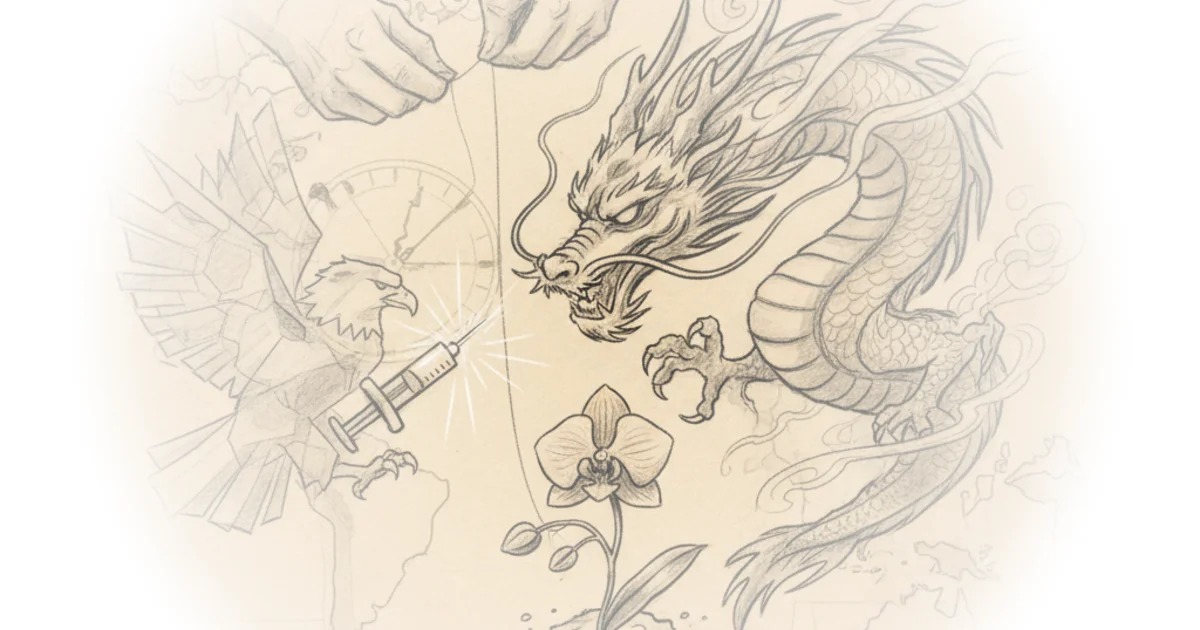
The commentary then pivots to the historical roots of this confusion, tracing the 1979 Joint Communique where the U.S. recognized the People's Republic of China. PolyMatter points out a crucial semantic distinction that most headlines miss. "It recognizes the PRC as the sole legal government of China but doesn't define what China is," the author notes. This is the core of the American strategy: using the word "acknowledge" rather than "accept" or "recognize" to satisfy Beijing's demands without legally binding Washington to a specific definition of sovereignty. The argument lands effectively because it exposes how both sides have exploited this vagueness for decades.
"The American position then and now is to obfuscate, to narrowly satisfy China's stringent demands while giving up as little as possible in the process."
Critics might argue that this deliberate obfuscation is a dangerous game that invites miscalculation, yet PolyMatter suggests it is the only thing preventing a direct conflict. The author emphasizes that the U.S. does not adhere to China's "One China Principle" but rather its own "One China policy," a distinction that is often lost in translation. As PolyMatter puts it, "When China accuses another country of violating the one China principle it's really only saying that it disagrees with the action, not that the other country has broken a promise."
The Domestic Reality in Taiwan
Moving beyond Washington and Beijing, the piece offers a nuanced look at Taiwan's internal politics, challenging the binary narrative of "pro-unification" versus "pro-independence." PolyMatter explains that both major political camps—the KMT and the DPP—actually agree that maintaining the status quo is the best short-to-medium-term strategy. "Both sides agree that maintaining the status quo is the best short to medium term strategy and neither side except for a few radicals advocates unification or independence," the author writes. This reframing is vital for understanding why Taiwan has not declared independence despite its vibrant democracy.
The author supports this with polling data showing that the vast majority of Taiwanese citizens prefer to "maintain the status quo" in various forms, rather than risking war by declaring independence or submitting to unification. "Ironically it's most often Americans halfway across the globe who panic when China flies fighter jets through Taiwanese airspace, not the Taiwanese public for whom such shows of intimidation have become mundane," PolyMatter observes. This contrast between external anxiety and internal resilience adds a layer of depth often missing from Western coverage.
However, the piece acknowledges that this stability is eroding. As younger generations develop a distinct Taiwanese identity, the pressure to change the status quo grows. "The 2014 Sunflower movement demonstrated how determined young people are," PolyMatter writes, noting that recent events in Hong Kong have only accelerated this shift. The author suggests that while the U.S. and Taiwan both support the status quo, "everyone agrees it's untenable in the long term."
The Countdown to Crisis
The final section of the commentary addresses the shifting balance of power. While the U.S. has maintained the status quo for over forty years, the author warns that time may no longer be on the side of the defenders. "China may believe time is on its side that the balance of power will only shift in its favor," PolyMatter writes, pointing to Beijing's growing military and economic strength. The piece concludes that the current arrangement is a "historically unprecedented limbo" that cannot last forever.
"Taiwan is stuck in a historically unprecedented limbo, a weird in-between state in which it can enjoy freedom only if it pretends not to."
The author's analysis of the "red lines" is particularly sobering. China has stated that a refusal to ever consider negotiating unification would trigger an attack, yet the U.S. opposes a unilateral declaration of independence by Taiwan. This creates a paradox where the U.S. must prevent Taiwan from declaring independence to avoid war, while simultaneously ensuring China does not force unification. PolyMatter notes that when Taiwan's president proposed a referendum on independence in 2003, the U.S. had to "reiterate indirectly but unequivocally that it did not support independence," sending a clear message that the line had been crossed.
Bottom Line
PolyMatter's strongest contribution is its dissection of the linguistic gymnastics that have kept the peace for decades, revealing that the "One China" policy is a carefully constructed illusion rather than a settled fact. Its biggest vulnerability is the assumption that the status quo can be maintained indefinitely despite the accelerating demographic and geopolitical shifts that are making it increasingly untenable. Readers should watch for how the U.S. navigates the coming decade as the window for this delicate ambiguity inevitably closes.