The McCarthy Lineage
On February 9, 1950, a junior senator stood before the Republican Women's Club of Wheeling, West Virginia, waved a piece of paper, and launched a political strategy that would outlive him by decades. Heather Cox Richardson traces the genealogy of American political fear-making from Joseph McCarthy's Communist accusations through the Great Replacement theory to today's immigration politics. The thread is continuous: make wild claims, grab headlines, stay ahead of fact-checkers, and let the damage outlast the debunking.
The Wheeling Speech
McCarthy claimed he held "a list of 205—a list of names that were made known to the Secretary of State as being members of the Communist Party and who nevertheless are still working and shaping policy in the State Department." He never produced the list. Secretary of State Dean Acheson dismissed the speech as "the rambling, ill-prepared result of his slovenly, lazy, and undisciplined habits." But the Chicago Tribune put it on the front page, and McCarthy telegraphed President Truman with a warning: "Failure on your part will label the Democratic party as being the bedfellow of international Communism."
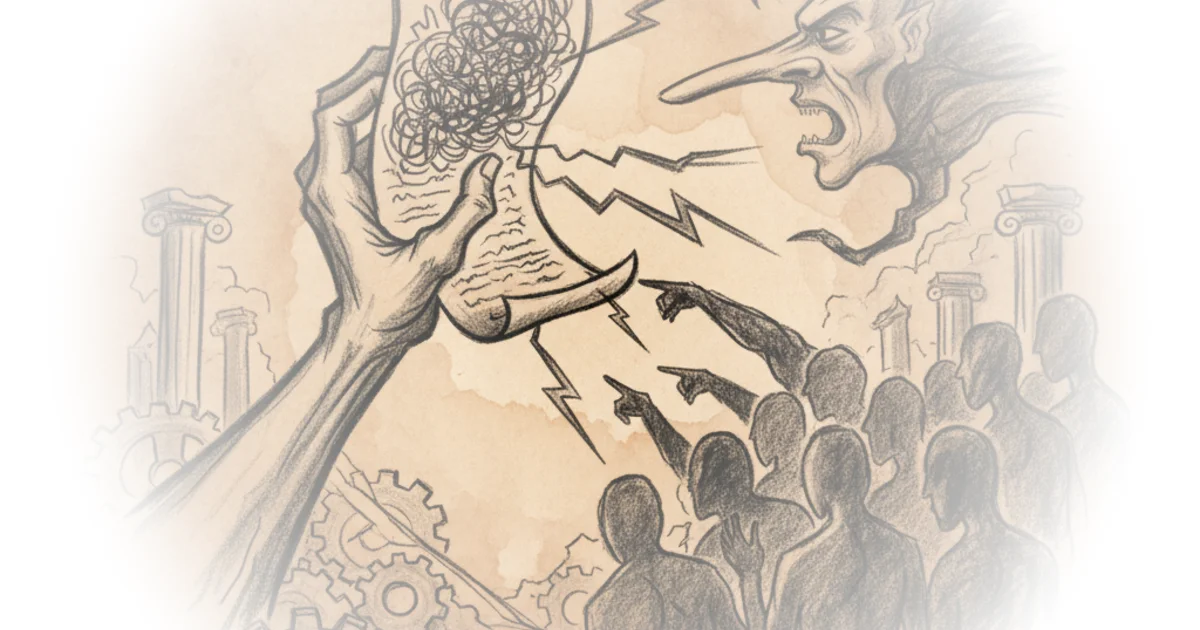
Heather Cox Richardson writes, "He perfected the art of grabbing headlines and then staying ahead of the fact-checkers." By the time reporters called out his lies, they were already old news, and the fact-checking got buried deep in the papers. The front page would have McCarthy's newest accusation.
"Using his lies to gain power, McCarthy rampaged across the next years, ruining lives through lies and innuendo."
Critics might note that McCarthy's tactics were not unique to him—they fit a broader pattern of political opportunism that predates and postdates him. The Wheeling speech worked because it tapped into genuine postwar anxiety, not because McCarthy invented fear-making.
From Communism to Replacement
The Korean War stoked anticommunism, and McCarthy's warning that there was a secret plot among Democrats to make America communist gained traction. In the midterm elections of 1950, every candidate he endorsed won. His star fell abruptly in May 1954, when Americans watched him lie and berate witnesses in televised hearings. But that same month, the Supreme Court's decision in Brown v. Board of Education opened a different avenue for far-right extremists to argue that Democrats were undermining American society.
Reaching back to racist tropes of Reconstruction, they claimed that federal protection of Black equality before the law was socialism because enforcing civil rights required government personnel who could be paid only through taxes. Heather Cox Richardson puts it plainly: those calling for equality were, in this formulation, "redistributing money from taxes levied on hardworking white taxpayers to undeserving Black people."
The idea that a secret group was undermining America evolved. In the 1980s, films like Red Dawn told stories of everyday Americans fighting communists collaborating with the government. The film so inspired a group of young men that in 2003, when leaders in the Bush administration decided to search for Saddam Hussein, they named the effort Operation Red Dawn. The soldiers began by looking in two sites they dubbed Wolverine 1 and Wolverine 2.
The Great Replacement
With the economy weighted toward the wealthy, warning that Democrats are trying to usher in socialism became a hard sell. The Great Replacement theory says that elites—often a code word for Jews—are deliberately replacing white European populations with nonwhite immigrants using mass migration and white birth rates that are lower than those of migrants.
Heather Cox Richardson traces the intellectual lineage to 1916, when lawyer Madison Grant wrote The Passing of the Great Race, arguing that the "Nordic race" was superior and being overwhelmed by immigrants from "inferior" white races. Grant advocated for an end to immigration and "selection through the elimination of those who are weak or unfit" through sterilization. His ideas were instrumental in justifying state eugenics laws and the 1924 Immigration Act. Adolf Hitler quoted often from Grant's book and wrote to Grant, describing the book as "my bible."
The modern theory emerges from the 2011 publication of Le Grand Remplacement by French writer Renaud Camus, who claims that Muslims in France are destroying French culture. On August 11, 2017, the theory's influence on Americans burst into public awareness when racists, antisemites, white nationalists, Ku Klux Klan members, neo-Nazis, and alt-right groups met in Charlottesville to "Unite the Right." They chanted "you will not replace us" and "Jews will not replace us." They gave Nazi salutes and carried Nazi insignia.
Immigration as Policy
In January 2024, Republicans refused to pass a bipartisan immigration reform measure hammered out by Senate negotiators over months. The bill appropriated funds for border security, increased immigration judges, sped up asylum processes, and closed the border during high-traffic periods. It did not include a path to citizenship for Dreamers, making the measure skew toward Republican demands. Nonetheless, the former president urged his supporters to kill it, and they did.
Heather Cox Richardson writes that the administration and its allies "are making the idea of purging Brown and Black people from the United States central to federal policy both at home and abroad." At the United Nations General Assembly, the former president told European nations that "the unmitigated immigration disaster" is "destroying your heritage." He warned, "If you don't stop people that you've never seen before, that you have nothing in common with, your country is going to fail."
McCarthy's supporters in the 1950s claimed that his lies were necessary for keeping Republicans in power: the ends justified the means. Neither journalists nor politicians could figure out how to counter McCarthy's tactics. It was the American people who finally destroyed his career, turning against him when they realized he was hurting decent people and lying to them to gain power. Wisconsin voters elected Democrat William Proxmire to replace him. Proxmire told voters that McCarthy was "a disgrace to Wisconsin, to the Senate, and to America."
Critics might note that immigration policy is genuinely complex—border security, asylum processing, and economic impacts are real challenges that demand serious debate. The risk is that conspiracy theories replace policy discussion entirely.
Bottom Line
Heather Cox Richardson's piece maps a seventy-year arc from McCarthy's Communist list to modern replacement theory, showing how political fear-making evolves while its core mechanics remain unchanged. The verdict: tactics that grab headlines and stay ahead of fact-checkers work until the public sees the human cost—and McCarthy's fate suggests that seeing takes time, but it does happen.