The Physicist Who Split the Atom and Was Erased
Maria Popova's piece stands out because it restores a stolen chapter of scientific history. The discovery of nuclear fission changed everything — warfare, energy, the atomic age itself. Yet the physicist who made sense of the breakthrough was written out of the record, excluded from the Nobel Prize, and left to carry the injustice silently for decades.
A Life Built Against Barriers
Lise Meitner's career was an act of defiance against institutional exclusion. Born in Vienna in 1878, she showed mathematical gift early but faced a system that denied women formal education. Austrian universities began admitting women in 1901. Meitner obtained her high school certification at twenty-three, compressing eight years of study into twenty months. She received her Ph.D. in 1905 — one of a handful of women worldwide with a doctorate in physics by that point.
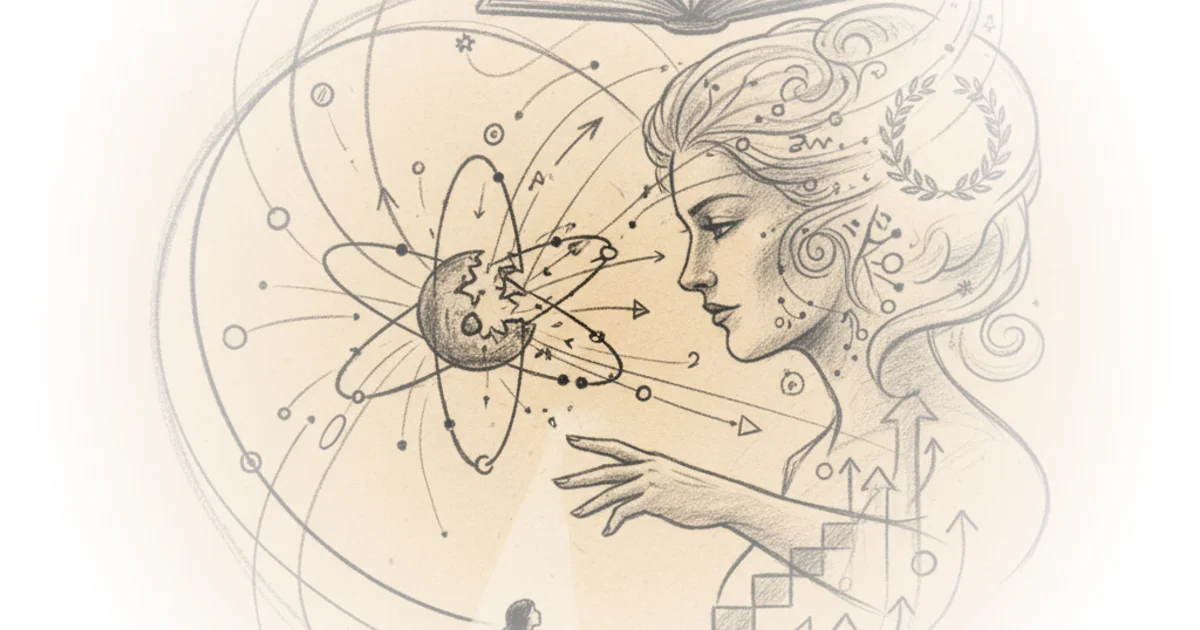
Maria Popova writes, "The history of science, like the history of the world itself, is the history of unreasonable asymmetries of power, the suppressive consequences of which have meant that the comparatively few women who rose to the top of their respective field did so due to inordinate brilliance and tenacity."
When Meitner traveled to Berlin to study with Max Planck, German universities still barred women. She had to ask for special permission to attend lectures. She met Otto Hahn in 1907, a chemist equally interested in radioactivity and willing to collaborate with women. But women were forbidden from entering Berlin's Chemical Institute. They worked in a converted carpentry shop in the basement. Hahn could climb upstairs. Meitner could not.
Maria Popova captures the metaphor: "a hard fact that fringes on metaphor."
The Discovery That Changed Everything
In 1938, Hahn and Fritz Strassmann bombarded uranium atoms with neutrons. They ended up with radium, which acted chemically like barium — an element with nearly half the atomic weight. The results made no physical sense. Hahn contacted Meitner, who had fled Nazi Austria to Sweden. She told him unequivocally that his chemical reaction made no sense on physical grounds and urged him to repeat the experiment.
The epiphany arrived on Christmas day during a walk with her nephew Otto Robert Frisch. Maria Popova relays Frisch's memoir: "We walked up and down in the snow, I on skis and she on foot (she said and proved that she could get along just as fast that way)." In making sense of the nonsensical results, Meitner and Frisch came up with nuclear fission — a word used for the very first time in their paper.
The nonsensical empirical results were Hahn's, but what extracted meaning from them was Meitner's interpretation — she had dis-covered, in the proper sense of uncovering something obscured from view, the underlying principle that made sense of the grand perplexity.
The Nobel That Never Came
In 1944, the discovery of nuclear fission was awarded the Nobel Prize in Chemistry — to Hahn alone. Ruth Sime's biography makes clear this was a discovery to which Meitner contributed from beginning to end. But Nazi racial policies had driven Meitner out of Germany, making it impossible for her to be part of Hahn and Strassmann's publication and dangerous for Hahn to acknowledge their continuing ties.
Maria Popova writes, "Hahn's dishonesty distorted the record of this discovery and almost cost Lise Meitner her place in its history."
Meitner wrote to her brother: "I have no self confidence… Hahn has just published absolutely wonderful things based on our work together … much as these results make me happy for Hahn, both personally and scientifically, many people here must think I contributed absolutely nothing to it — now I am so discouraged."
She received countless accolades in her lifetime. A chemical element, meitnerium, was posthumously named after her. But the Nobel slight was never righted. Maria Popova notes, "she considered the Nobel omission that most irredeemable sorrow of her life."
The Weapon She Refused to Build
Nuclear fission proved one of the most powerful and dangerous discoveries in human history. It became central to the atomic bomb. Later in life, Meitner was cruelly referred to as "the Jewish mother of the atomic bomb," even though her discovery was purely scientific, predated the weapon by many years, and she adamantly refused to work on the bomb once she saw its destructive application.
Maria Popova quotes Meitner's bittersweet lamentation: "One could love one's work and not always be tormented by the fear of the ghastly and malevolent things that people might do with beautiful scientific findings."
Counterpoints
Critics might note that Popova's framing leans heavily into victimhood narrative without fully exploring Meitner's own agency in remaining silent. Meitner did not campaign on her own behalf, did not write an autobiography, and almost never spoke of her forced emigration or broken friendships. Some historians argue she chose scientific integrity over public grievance — a choice that deserves its own respect rather than pity.
Others might observe that the piece, while powerful, risks reducing Meitner's legacy to the Nobel injustice rather than her fifty-six published papers between 1921 and 1934, her pioneering work in radioactivity, and her role as one of the great experimentalists of her day. Einstein called her "our Marie Curie." That recognition should stand alongside the erasure.
Bottom Line
Maria Popova has recovered a stolen chapter of scientific history with precision and moral clarity. Lise Meitner's story is not just about exclusion — it is about interpretation as a creative act, about the intellect that makes sense of nonsense, about the woman who walked through snow while her male colleague skied and still arrived at truth first. The Nobel committee's failure cannot be undone. But Popova's restoration of Meitner's place in the record is a form of justice.