In a rare display of judicial unity, the Supreme Court has struck down a federal ban on gun ownership for marijuana users, delivering a verdict that forces the executive branch to confront the limits of its regulatory power over the Second Amendment. Reason reports that this unanimous decision in United States v. Hemani does more than just protect cannabis consumers; it exposes a fundamental flaw in how the government attempts to categorize entire groups as inherently dangerous without proof of individual risk.
The Historical Mismatch
The piece argues that the administration's defense relied on a shaky historical foundation, attempting to equate modern marijuana use with colonial-era "habitual drunkard" laws. Reason notes that Justice Gorsuch, writing for the Court, dismantled this comparison by pointing out that early American laws targeted only those so incapacitated they could not manage their affairs, not merely those who consumed intoxicants regularly. The article highlights a striking historical reality: "Had habitual drunkard laws applied to those who simply drank regularly, many notable early Americans could have faced trouble," citing John Adams' daily cider and James Madison's pint of whiskey.
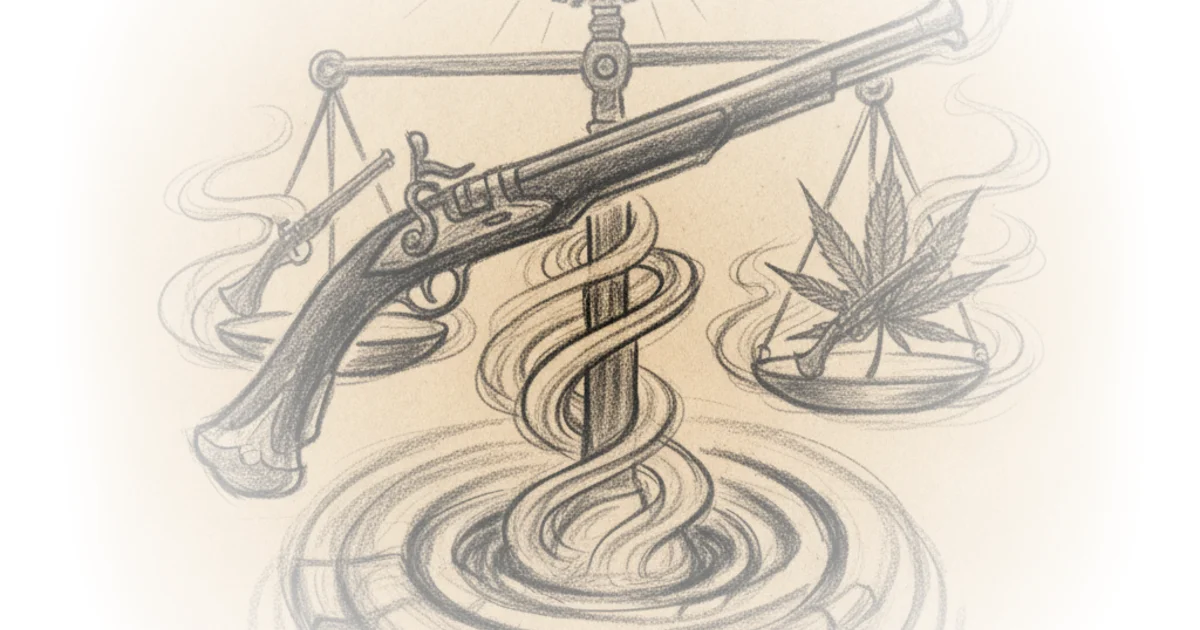
This historical context is crucial because it reveals that the government's analogy collapses under scrutiny. The Court found that the federal statute sweeps in people regardless of whether their substance use renders them violent or incapacitated. As Reason reports, "The law... does not require [the government] to show that a particular individual is regularly incapacitated, much less incapable of conducting his affairs or a threat to himself or others." This distinction matters deeply; it shifts the burden back to the state to prove actual danger rather than allowing them to disarm citizens based on a broad, undifferentiated label.
Critics might argue that this ruling creates ambiguity for individuals who are currently intoxicated while possessing firearms, but the Court was careful to limit its holding. The decision does not address possession while high, only the categorical ban on users. This nuance is vital for understanding the scope of the victory: it protects legal rights without endorsing reckless behavior.
"Affording the government that kind of 'broad power to designate any group as dangerous and thereby disqualify its members from having a gun' would risk allowing it to 'quickly swallow' the Second Amendment."
Beyond Marijuana: A Broader Constitutional Warning
The commentary emphasizes that while the case centers on marijuana, the logic extends far beyond cannabis. Reason points out that the administration's theory would logically allow the disarmament of anyone using any federally restricted substance, including prescription medications taken off-label or without authorization. The piece illustrates this absurdity by noting the government's position "extends equally to a husband who regularly takes his wife's prescription Ambien to sleep and a college student who routinely uses a friend's Adderall to cram for exams."
This expansion of the argument underscores the danger of categorical bans. If the government can strip rights based on the mere act of using a substance, regardless of its effect on the individual, then no class of users is safe from disarmament. The article suggests that this approach ignores the reality that "marijuana consumption is increasingly common in this country," with states legalizing it and federal enforcement largely tolerating compliant businesses.
The piece also touches on a fascinating judicial dynamic: the joint concurrence by Justice Alito and Justice Kagan, a pairing rarely seen. While they agree with the outcome, their reasoning highlights that the government failed to identify a regulatory principle justifying disarmament for non-incapacitated users. This reinforces the idea that the ruling is not about marijuana per se, but about the constitutional requirement for a direct link between conduct and danger.
The Limits of Historical Analysis
While the majority opinion relies heavily on the "history and tradition" test established in Bruen, the commentary notes a dissenting critique from Justice Jackson. She argues that this framework is flawed when applied to modern problems, suggesting instead a "means-ends scrutiny." Reason acknowledges this tension, noting that historical analogies can be insufficient for novel laws addressing contemporary threats.
The article suggests a middle ground, referencing legal scholars who argue courts should evaluate whether gun regulations "unduly obstruct" the right to self-defense rather than relying solely on 18th-century precedents. This perspective adds depth to the ruling, suggesting that while the outcome is correct, the methodology remains a subject of intense debate among jurists.
Bottom Line
The strongest part of this argument is its successful exposure of the government's failure to prove that regular marijuana use equates to the incapacitation required by historical precedent. The decision serves as a critical check on executive overreach, preventing the state from designating entire groups as dangerous without individualized evidence. However, the biggest vulnerability lies in the ongoing tension between rigid historical tests and modern regulatory realities, leaving future cases uncertain until courts can better define what constitutes a reasonable restriction on the right to bear arms.