Dave Borlace cuts through the technical fog of the latest IPCC special report to reveal a startling truth: the path to a stable climate isn't just about swapping coal for solar panels, but about fundamentally rewiring how we eat, how we manage our soil, and how we accept change in our own backyards. While most coverage fixates on the grim math of temperature targets, Borlace argues that the most potent tools for survival are already here, provided we can overcome the psychological and political inertia blocking their deployment.
The Economics of Acceptance
Borlace begins by dismantling the assumption that renewable energy is solely a technological challenge. He points out that the dramatic growth in solar and wind is driven by cost, not just policy, noting that "solar energy and both onshore and offshore wind energy have had dramatic growth trajectories." The real breakthrough, he suggests, is economic accessibility for the developing world. He highlights that "19 million people in Bangladesh now have solar battery electricity in remote villages," a shift that replaced dangerous kerosene lamps with clean power. This isn't just about carbon; it's about immediate human safety and health.
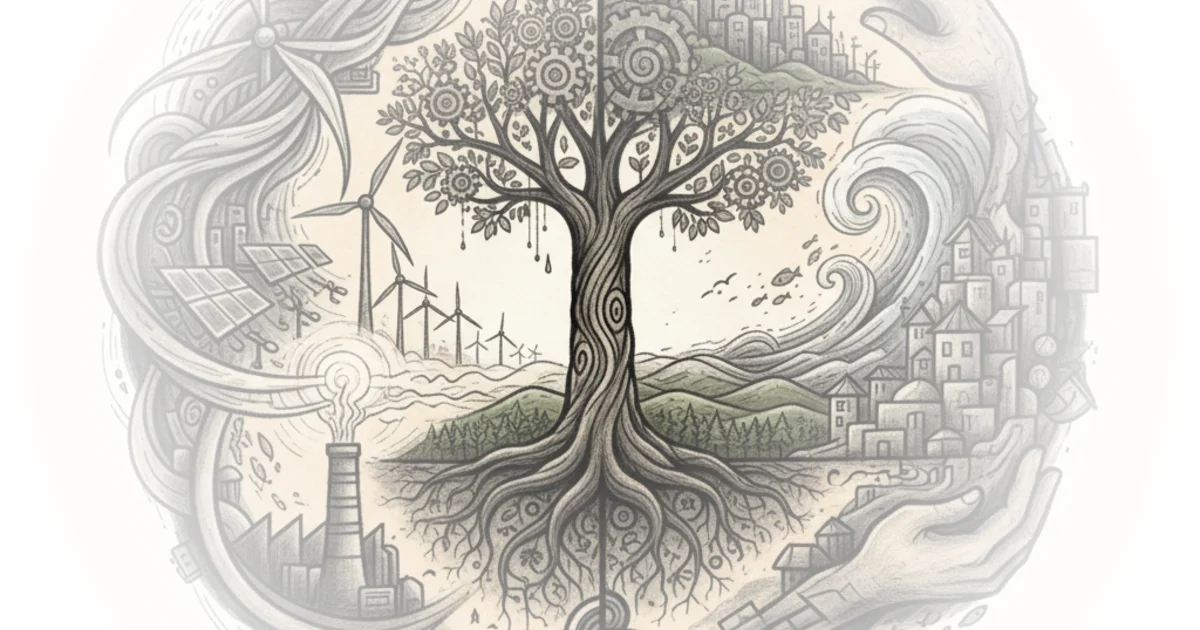
However, the author pivots to the human element, arguing that technology alone fails without community buy-in. He writes, "public acceptance remains an important factor in the feasibility of renewable technologies," specifically citing the "NIMBY instinct of not in my backyard." Borlace's analysis here is sharp: resistance melts when communities are given a financial stake. "If you can watch your electricity bill plummet to virtually zero then you're quite likely to very quickly grow to love the elegant silhouette of three blades turning gently at the top of a tower on the horizon." This reframing of the "eyesore" argument into a "savings" argument is a crucial strategic insight often missed in top-down policy discussions.
Critics might argue that financial incentives alone cannot overcome deep-seated aesthetic or cultural objections to industrial infrastructure, but Borlace's data on community engagement suggests a viable path forward.
"If you can watch your electricity bill plummet to virtually zero then you're quite likely to very quickly grow to love the elegant silhouette of three blades turning gently at the top of a tower on the horizon."
Resilience Over Reliability
Moving beyond generation, Borlace tackles the fragility of our current grid in the face of extreme weather. He uses the devastation of Hurricane Maria in Puerto Rico as a case study for why centralization is a liability. The core of his argument is that "the implementation of controllable and islandable micro grids including the use of residential batteries can increase resiliency especially after extreme weather event." He envisions a future where energy flows from millions of tiny inputs rather than a single massive central power plant, allowing someone in Boston to cook dinner using solar power generated in Lisbon hours earlier.
This vision of a distributed, smart grid is presented not just as an efficiency upgrade, but as a survival mechanism. Borlace notes that "systems that take advantage of an array of sources will by definition be more able to cope with climate impacts." The shift from a monolithic grid to a networked one is essential, yet it requires a massive overhaul of existing infrastructure designed for a different era.
The Thorns of Biomass and Carbon Capture
The commentary takes a critical turn when addressing the "saviors" of the climate models: biomass and carbon capture. Borlace does not shy away from the contradictions. He describes biomass as a "thorny one," warning that "sustainable deployment at this or higher levels envisioned by 1.5 degrees Celsius consistent pathways may put significant pressure on available land food production and prices." The risk is clear: if we clear forests to grow fuel crops, we defeat the purpose. He calls biofuels a "sub optimal choice," a candid admission that challenges the optimism often found in industry reports.
Similarly, he scrutinizes Carbon Capture and Storage (CCS), noting that the technology is "very difficult to achieve in any kind of economical way." The scale of the problem dwarfs the current solution. Borlace points out that while two CCS projects captured 2.4 million tons of CO2, human beings emit "40,000 million tons of carbon dioxide emitted by human beings every year." The gap is staggering. He then introduces Bioenergy with Carbon Capture and Storage (BECCS), a theoretical negative emissions technology, but leaves the reader to grapple with the sheer scale of the land and resources required to make it work.
The Food System Elephant
Perhaps the most provocative section of Borlace's analysis concerns the food system. He identifies livestock as the "massive elephant in the room," responsible for 7.1 billion tons of CO2 equivalent annually. He argues that "a dramatic decrease in our red meat intake... has a big an impact if not a bigger impact on climate change than eradicating all the fossil fuels from our road vehicles." This is a bold claim, but he backs it with the report's finding that "dietary shifts could contribute one fifth of the mitigation needed to hold warming below two degrees Celsius."
Borlace acknowledges the cultural inertia here, noting that "eating meat is still seen as a sign of economic progress in third world countries." He also highlights the staggering inefficiency of waste, stating that "around a third of the food produced all over the planet is not consumed." While he touches on biotechnologies like CRISPR and lab-grown meat as potential game-changers, he remains skeptical of their immediate scalability, noting that "there's insufficient real-world evidence of public perception and uptake."
"A mass global move towards plant-based diets would eradicate 20% of the climate change problem overnight."
Bottom Line
Borlace's strongest contribution is his refusal to treat climate solutions as purely engineering problems; he correctly identifies that the hardest barriers are behavioral, economic, and social. His biggest vulnerability lies in the reliance on technologies like BECCS and lab-grown meat that remain largely theoretical at the scale required. The reader must watch for how quickly these "sub-optimal" solutions move from models to reality, as the window for relying on them is closing fast.