Kings and Generals offers a rare, granular look at how a modernizing nation can fracture from within, arguing that Japan's slide into ultranationalism was not a sudden madness but a calculated response to economic fragility and institutional loopholes. This piece distinguishes itself by tracing the precise legal and military mechanisms that allowed field commanders to hijack national policy, a dynamic that remains terrifyingly relevant for any observer of institutional decay today.
The Constitutional Trap
The narrative begins by establishing the paradox of the Meiji legacy. By the start of the 20th century, Japan had transformed from an isolationist state into a regional power, yet the very constitution that enabled its rise contained a fatal flaw. Kings and Generals writes, "the Meiji constitution was written in such a way that the military had dominance over the civilian government if the IJA or the IJN refused to appoint a minister for the new cabinet then the cabinet wouldn't be formed and the government would be interrupted." This structural vulnerability is the piece's central thesis: the military did not need to stage a coup to seize power; the law simply handed them the keys.
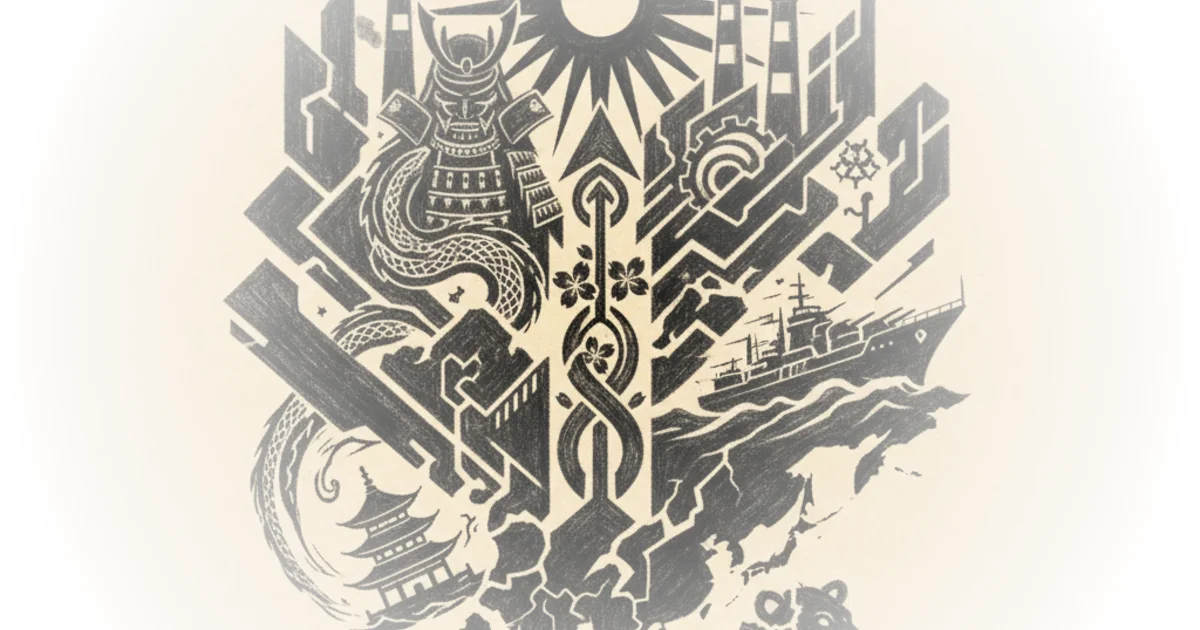
The authors effectively illustrate how this played out in the early Taisho era, where public outrage over military manipulation of the cabinet was quickly overshadowed by the opportunities of World War I. As Kings and Generals notes, "the wartime boom helped to diversify the country's industry increase its exports and transform Japan from a debtor to a creditor nation for the first time." However, this economic miracle was fragile. The commentary rightly points out that while the nation grew wealthier, it also suffered from rapid inflation and social unrest, setting the stage for the political radicalization that followed. A counterargument worth considering is whether the military's dominance was truly the primary driver, or if the sheer chaos of the global economy made civilian governance impossible regardless of constitutional design.
The contrast between that which preceded the funeral car and that which followed it was striking indeed before it went old Japan after it came new Japan.
The Rise of the Field Commanders
As the narrative moves into the Showa era, the focus shifts from legal maneuvering to outright insubordination. The authors detail the Mukden Incident of 1931, where the Kwantung Army deliberately sabotaged a railway to justify an invasion of Manchuria. Kings and Generals argues that "despite its insubordination the Kwantung Army would be rewarded for its great success establishing a new era of gekukujo inside the IJA." This term, gekukujo (overthrowing superiors), is crucial to their analysis, describing a culture where lower-ranking officers felt empowered to dictate national strategy because the central government was too weak to stop them.
The piece highlights the internal military schism between the radical Kodoha faction, which sought a direct imperial rule and war with the Soviet Union, and the more moderate Toseiha faction, which acknowledged the need for industrial modernization. Kings and Generals writes, "the Kodoha disliked modernization and the economic control of the zaibatsu and also wanted to crush communism once and for all by attacking the Soviet union and expanding into Siberia." This framing is compelling because it humanizes the ultranationalists not as cartoon villains, but as a faction with a coherent, albeit destructive, ideological program rooted in rural economic despair and a specific interpretation of the Bushido code.
Critics might note that the piece slightly underplays the role of the civilian bureaucracy in enabling this shift; the government's initial hesitation to punish the Kwantung Army was as much a political calculation as it was a failure of nerve. Nevertheless, the authors make a strong case that the February 26 Incident of 1936 was the turning point where the military's internal purges finally cemented their control over the state.
The Economic Roots of Fascism
Perhaps the most insightful section of the coverage is its treatment of economics as the catalyst for fascism. The authors argue that the rise of Nohanshugi (farmer-centered) organizations was driven less by abstract ideology and more by practical survival. Kings and Generals writes, "it was their practical program of cooperatives and credit associations not their ideology that accounted for their growing popularity and local influence." This observation is vital: it suggests that ultranationalism was a bottom-up phenomenon fueled by the collapse of rural livelihoods during the Great Depression, rather than a top-down imposition by a cabal of generals.
The narrative connects these economic pressures directly to the political outcomes, noting that "the establishment of a communist party dangerous to the current regime was founded and the rise of the tenant farmer movement led to the outbreak of social unrest." In response, the government enacted the Peace Preservation Law of 1925, which "essentially criminalized socialism communism republicanism and democracy." The authors effectively demonstrate how the suppression of dissent created a vacuum that the military filled, framing their expansionist policies as the only solution to national crisis.
Bottom Line
Kings and Generals succeeds in demystifying the rise of Japanese fascism by grounding it in specific constitutional failures and economic realities rather than vague cultural tropes. The strongest part of this argument is the detailed explanation of gekukujo, showing how a military culture of insubordination became the engine of state policy. However, the piece's biggest vulnerability is its relative silence on the role of Western powers in inadvertently encouraging this trajectory through their own diplomatic hesitations and economic policies. Readers should watch for how the authors handle the subsequent US-Japan tensions in the next installment, as the domestic dynamics explored here set the stage for an inevitable international collision.