More Perfect Union exposes a hidden economic trap: the clothes in your closet aren't just cheaper; they are structurally designed to fail, turning a once-durable necessity into a disposable plastic good. The piece distinguishes itself by moving beyond the usual moralizing about fast fashion to dissect the precise mechanical and financial engineering that forced even mid-tier retailers to abandon quality. For the busy professional, this is a necessary audit of why your wardrobe feels like a gamble and how global trade policy quietly dismantled the American standard of living.
The Death of the Seasonal Cycle
The argument begins by dismantling the nostalgia of the 1980s and 90s, not to romanticize the past, but to highlight a fundamental shift in risk management. More Perfect Union writes, "In the '80s and '90s stores only had new clothes a couple times a year... designers would start working on each collection up to 9 months in advance." This long lead time forced manufacturers to invest in high-quality materials and precise tailoring because a single design had to sell for an entire season. The stakes were high; if a style flopped, the retailer was stuck with massive inventory losses.
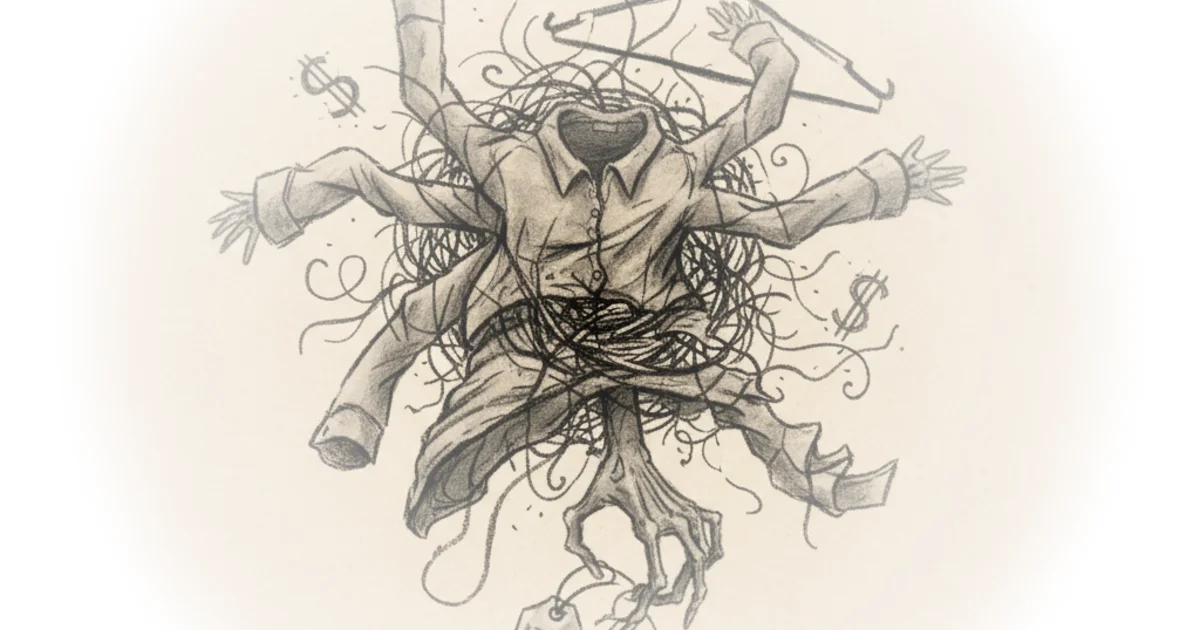
The commentary here is sharp because it reframes quality as a byproduct of risk. When retailers had to "place two huge bets per year," they had no choice but to ensure those bets were solid. This logic held even for discount stores. As the author notes, "even one of the cheaper suits on the market was still pretty high quality," a stark contrast to today's $200 suit that falls apart in a year. The piece effectively argues that the current degradation of quality is not an accident of inflation but a deliberate strategy to lower the cost of failure.
"Instead of losing money on clearance sales or throwing away unsold goods, Zara's styles often sell out quickly. The designers don't have to predict trends a year in advance; they can just respond to fashion trends as they emerge."
This shift, pioneered by Zara's "gray goods" system, allowed for a 15-day turnaround from design to store. While this reduced inventory risk, it also decoupled production from durability. The author points out that this speed came at a cost: the ability to copy high-fashion designs in weeks rather than months. Critics might argue that this democratization of style allowed the 99% to access runway trends previously reserved for the wealthy. However, the piece counters that this accessibility was a Trojan horse for a system that prioritizes volume over value, turning clothing into a rapid-fire consumption loop.
The Policy Pivot and the Race to the Bottom
The narrative then pivots to the regulatory changes that enabled this explosion. More Perfect Union identifies the North American Free Trade Agreement (NAFTA) and the expiration of the Multifiber Arrangement as the true accelerants. "President Clinton signed NAFTA... which made it cheaper to make clothes in Mexico," the author explains, followed by the normalization of trade with China. These moves opened access to "the largest pool of cheap labor in human history" while stripping away protections that once limited imports.
The analysis is particularly compelling when it connects these macro-policy decisions to the micro-experience of the shopper. The 2008 financial crisis acted as a catalyst, forcing middle-class consumers toward cheaper options just as retailers were desperate to cut costs. More Perfect Union describes the resulting strategy: "Let's say this dress costs $40 to make and retailed for $100 in 2007... in 2010... they'll only spend let's say $15 to make it." This "pennies game" explains why a $100 dress today feels like a $15 product. The author details how this manifests physically: replacing wool with polyester, swapping metal zippers for plastic, and eliminating pockets to save fractions of a cent.
"The vintage pair weighs a hefty 761 grams and is 100% cotton... The new pair weighs less at 720 grams and is a cotton elastane blend... putting elastane in jeans shortens the lifespan pretty significantly."
This specific comparison of denim is the piece's strongest evidence. It moves the argument from abstract economics to tangible reality. The inclusion of elastane, a plastic fiber, is a perfect example of a trade-off: better stretch and fit for a short-term consumer, but a garment that degrades rapidly with every wash. The author notes that this is not just about material; it's about the "death spiral" where retailers, often saddled with debt by private equity firms, are forced to prioritize immediate margins over long-term product integrity.
The Shein Effect and the Minimus Loophole
The final section escalates the critique to "instant fashion" with the rise of Shein. The author contrasts Shein's model with Zara's, noting that while Zara took 15 days, Shein can do it in three. "Shein is not just fast fashion; it's instant fashion," More Perfect Union writes. The scale is staggering: Shein releases 35,000 new items in a couple of weeks, a volume that Zara achieves in a year. This is achieved by treating factories like gig workers, using software to dictate production in real-time based on social media trends.
Perhaps the most critical insight for a policy-minded reader is the explanation of how Shein avoids tariffs. The piece highlights the "de minimis" exemption, a rule originally designed for tourists bringing back a rug or a lamp. "Since packages valued at under $800 can enter the US duty-free, Shein merchandise is pretty much always exempt from consumer goods tariffs," the author explains. This regulatory gap allows Shein to bypass the very taxes that protect domestic industries and fund infrastructure, creating an uneven playing field where speed and evasion trump quality and compliance.
"50 years of fast fashion and ultra-fast fashion has completely changed our relationship with clothes. Instead of being something to cherish and care for, they're now just another cheap and disposable plastic consumer good."
The argument here is that the problem is no longer just about cheap clothes; it's about a systemic collapse of the value chain. The pressure from social media, where influencers need a "totally unique never-before-seen outfit every single day," feeds this cycle, making the disposable nature of clothing a feature, not a bug. A counterargument worth considering is that consumer demand drives this; without the desire for constant novelty, the supply chain wouldn't exist. Yet, the piece suggests that this demand is manufactured by an algorithmic system that rewards volume and punishes longevity.
Bottom Line
More Perfect Union delivers a damning indictment of the modern fashion industry, successfully tracing the decline of quality from high-level trade policy to the fraying seams of a $20 t-shirt. The strongest part of the argument is the demonstration that poor quality is a calculated financial strategy, not a failure of manufacturing. Its biggest vulnerability is the difficulty of reversing a system so deeply embedded in global supply chains and consumer psychology. The reader should watch for legislative efforts to close the de minimis loophole, as that is the only lever capable of slowing the race to the bottom.