Stefan Milo opens with a cinematic flourish — scenes from a 1914 film called Brute Force, depicting Neanderthals as hunched, simple-minded creatures battling dinosaurs. It's a playful frame, but Milo's point is serious: the reputation of Homo neanderthalensis has undergone a century of revision. "Our view of Neander tals has changed significantly," he writes. "They created sophisticated tools they interbred with Homo sapiens they were our ancestor and dare I say had rituals which is just the most human characteristic of all."
This is the core of Milo's argument: that the 35 skulls uncovered from Quina Desua Cave in Spain represent something beyond mere subsistence. Not just eating — but meaning.
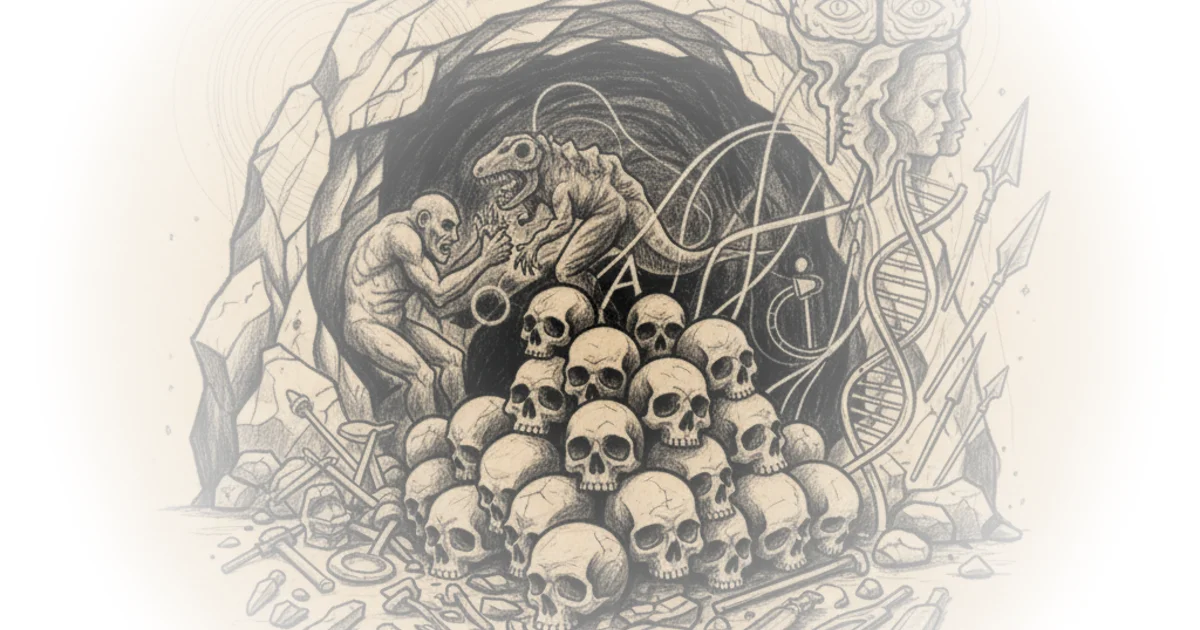
The Skull Accumulation
The cave sits north of Madrid, a beautiful region where Milo confesses he met his wife. The layer of interest dates to between 74,000 and 53,000 years ago — a cooler period, likely caused by the Toba super eruption. And what happened there is strange: 35 crania recovered from just 27 square meters, almost all horned animals — bison, deer, rhinos — with their antlers or horns still attached.
The most telling detail? These skulls lack lower jaws and teeth. "You can't help but wonder what happened to the rest of these animals," Milo observes. "Why basically just the skulls strange it's strange it's strange."
This is some sort of trophy room it's almost like this is a skull cult for neander tals I know that's quite a big statement but it's a serious possibility.
The author acknowledges the boldness of this claim. But he's not done yet — there's more evidence to pile on.
The Symbolic Case
Milo addresses the obvious counterargument head-on: these skulls could simply be — nutrition — the brains being eaten. He admits freely: "I've eaten brains too I've eaten pig brains so I'm not judging them they are definitely eating the brains of these animals." But then he pivots to what makes a ritual different from mere consumption.
He uses an analogy that feels genuinely clever: Thanksgiving dinner in America. "For you Americans let's say Thanksgiving dinner each Thanksgiving whenever it is in November Americans of all different backgrounds gather with their families they're probably going to eat a turkey they might have a kind of a specific set of side dishes." The point is that the same food — turkey — has entirely different meaning when eaten at a specific time, in a specific place, for a specific reason. It's not just calories.
"with these skulls why not just eat them where the rest of the animal is being processed," he asks. "Why move them to this cave it's getting odd come on it's starting to get a little bit symbolic guys."
The fire evidence deepens the mystery. Some skulls were placed directly atop hearths. And one rhino skull was positioned on a flat rock outside the cave — a metamorphic rock with nice patterns, likely brought there specifically. "neither The Rock nor the Oro skull started in this cave cave and they both ended up on top of each other is this what you would do just for subsistence just for calories with no meaning behind it whatsoever that's what you would do with your lunch doesn't seem likely to me."
This lands hard because it's a simple question: why transport only skulls, without the rest of the animal? Why transport them to a cave where they were processed elsewhere? The asymmetry demands explanation.
The Counter-Sites
Milo broadens his case by comparing Quina Desua to other Neanderthal sites. Grot de Prince in France shows similar skull accumulations with goat remains — though that site was excavated in 1905, so "you kind of have to take the conclusions with a little bit of a pinch of salt." Then there's Tesic Tash in Uzbekistan, where a Neanderthal child was buried surrounded by five pairs of ibex horn cores. The site's name translates as "Large Horn Stone" — and outside the cave are horn-shaped rocks. Is that relevant? Milo isn't sure: "probably not let's say probably not it's just my simple ape brain making connections."
The humor is self-deprecating, but he's genuinely uncertain whether the pattern holds.
The Symbolic Thinking
Perhaps the strongest evidence comes from Laasa Cave in northern Spain — no skulls, but something more creative. Neanderthal paintings on cave walls, dated to at least 64,000 years old: "this rectangular panel the dots this strange looking thing some sort of helicopter bird pirate I don't know." These pigments represent something beyond functional tool use — symbolic expression.
The dating method is worth noting: because these are mineral pigments rather than charcoal, archaeologists used calcium carbonate crusts formed by water percolating through rock. If the calcite formed on top of the painting, the painting must be older. The result: 64,800 years old.
What This Means
Milo's argument rests on a threshold case: at some point, the pattern of behavior — transporting only skulls to a cave, placing them near fires, positioning them on decorative rocks — crosses from nutrition into meaning. He's not claiming Neanderthals had religion in any Christian sense. But he's asking whether they had something like Thanksgiving: gathering at specific times, eating specific foods, because those actions carry symbolic weight.
Critics might note that the evidence is thin — 35 skulls could still be explained by differential consumption patterns, preservation biases, or simple coincidence. The fire and rock placements are intriguing but ambiguous. And dating methods for such sites remain imprecise.
But what makes this piece compelling is its willingness to take the question seriously. The old film Brute Force portrayed Neanderthals as hunched simpletons. Milo suggests we revise that view — carefully, with caveats — toward something far more interesting: ancient minds capable of ritual, meaning, and perhaps even something like symbolic thought.
They were our ancestor and dare I say had rituals which is just the most human characteristic of all
Bottom Line
The strongest part of Milo's argument is his analogical reasoning — Thanksgiving as a template for understanding symbolic behavior in prehistory. His biggest vulnerability is that he often admits uncertainty without resolution, leaving the reader hanging between "meaning" and "maybe not." The evidence at Quina Desua remains suggestive rather than conclusive. But if you're looking for a serious exploration of what ancient skulls might tell us about Neanderthal minds — with humor, humility, and genuine intellectual stakes — this is it. The film version of Neanderthals has been wrong for a century. Milo suggests we may finally be getting closer to the truth.