Then & Now delivers a harrowing but essential dissection of how ordinary Americans transformed into executioners, arguing that the lynchings of the Jim Crow era were not merely acts of rage but calculated performances of social control. The piece's most striking claim is that these atrocities were fueled by a "moral and cultural vaccine" of propaganda that convinced perpetrators they were the victims defending a threatened way of life. This analysis is vital now because it moves beyond the horror of the act itself to expose the psychological machinery that makes such violence thinkable to the public.
The Anatomy of a Mob
The narrative begins with the 1899 burning of Sam Hose in Georgia, a case that Then & Now uses to illustrate the speed at which rumor and racial panic could mobilize a community. The author notes that newspapers immediately inflated the story, claiming Hose had assaulted a white woman and murdered her child, even before he was caught. Then & Now writes, "The Atlanta Constitution informed its readers that when Hose's body cooled he will be either lynched and his body riddled with bullets or he will be burnt at the stake." This framing is crucial: it shows how the press did not just report the crime but actively curated the punishment, turning a judicial process into a public spectacle.
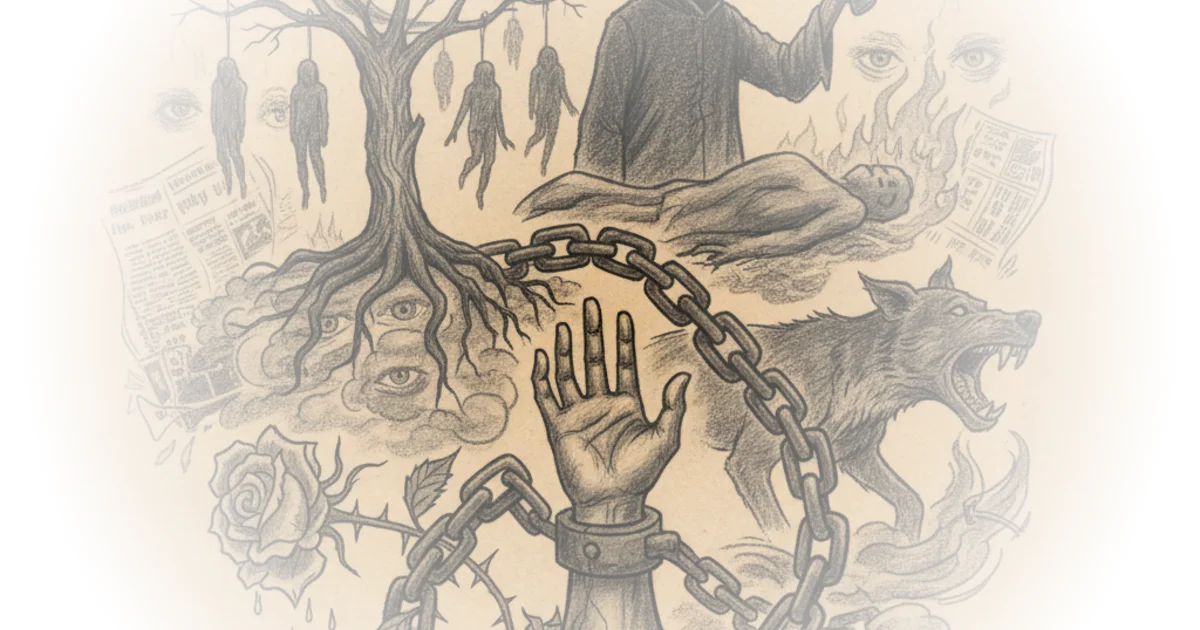
The author details the grim efficiency of the event, where a special train was organized to bring spectators from across the state, treating the murder as a Sunday outing. Then & Now observes that "one reporter noted the contortions of Sam Hose's body as the flames rose distorting his features causing his eyes to bulge out of his sockets." The commentary here is chillingly effective because it refuses to look away from the specific, dehumanizing details that defined these events. It forces the reader to confront the reality that these were not chaotic riots but organized community rituals.
"What caused such pride and violence between 1889 and 1930 there were around 3,700 known lynchings in the US."
The Psychology of Victimhood
The core of Then & Now's argument is that the perpetrators of this violence viewed themselves as the true victims. The author traces this back to the post-Civil War era, where the loss of the Confederacy created a pervasive sense of defeat and fear among white Southerners. Then & Now explains that "defeat after the war lent itself to a sense of fear of being under siege of almost being ruled by a foreign power." This psychological reframing is the piece's most sophisticated insight: it suggests that racism was not just about hatred, but about a desperate need to reclaim a lost status.
The author highlights how this fear was weaponized through the creation of the "black brute" stereotype, a caricature of a man driven by animalistic lust and violence. Then & Now cites Senator Ben Tillman, who described Black men as "a fiend a wild beast seeking whom he may devour." This rhetoric, the author argues, was not fringe; it was mainstream propaganda disseminated through schools, churches, and literature. By internalizing these stereotypes, white citizens could justify extreme violence as a necessary defense of the "natural order."
Critics might note that focusing so heavily on the psychological state of the perpetrators risks absolving the institutional structures—like the courts and the police—that actively facilitated these lynchings. While the psychology explains the why, the legal and political complicity explains the how. Then & Now touches on this but prioritizes the cultural narrative.
The Machinery of Propaganda
The piece then zooms out to examine the specific mechanisms of propaganda that sustained this culture of terror. Then & Now writes, "Propaganda uses the language of virtuous ideals to unite people behind otherwise objectionable ends." The author details how children's books, novels, and even advertisements reinforced the idea that Black people were incapable of self-government and required white supervision.
A particularly damning example cited is the medical and scientific racism of the era, which claimed that Black people possessed "sexual madness" and different physiological traits that made them inherently dangerous. Then & Now quotes a 1903 medical journal that claimed the problem was "the large size of the black man's penis and the lack of the sensitiveness of the terminal fibers which exists in the caucasian." This pseudoscience provided a veneer of intellectual legitimacy to the mob's actions, allowing ordinary people to believe they were acting on scientific fact rather than prejudice.
The author also points to the role of nostalgia, noting that the "Lost Cause" mythology painted a picture of a harmonious past where Black people were grateful and subservient. Then & Now writes, "These stereotypes also existed alongside others creating a culture of expectations around how black americans should act and how whites should construct their own views." When Black Americans inevitably failed to meet these impossible, contradictory expectations—being too subservient or too ambitious—the resulting "disappointment" was used to justify further violence.
"The entire race is destitute of character."
The Legacy of Terror
Finally, Then & Now connects these historical events to the present, arguing that understanding this "psychology of racism" is the only way to recognize similar patterns today. The author describes how children in the 1930s would speak of lynchings "almost as joyously as though the memory were of a christmas morning or of the circus." This anecdote underscores the author's main point: the violence was normalized to the point where it became entertainment.
The piece concludes by suggesting that the goal of this historical excavation is to find a "moral and cultural vaccine." Then & Now writes, "The purpose is to search for a kind of moral and cultural vaccine an inoculation that learns from some of the worst events in the past to try to understand how we can recognize the warning signs in the present." This is a bold, necessary aspiration. It challenges the reader to look beyond the surface of current events and identify the same psychological triggers—fear of loss, the dehumanization of the "other," and the use of propaganda to justify cruelty.
Bottom Line
Then & Now's strongest contribution is its refusal to treat lynching as an aberration, instead framing it as the logical outcome of a specific, manufactured psychology of victimhood. The piece's greatest vulnerability is its heavy reliance on historical testimony, which, while powerful, sometimes lacks the granular data on the economic incentives that often drove these mobs. However, the argument remains a vital tool for understanding how ordinary people are radicalized into committing extraordinary evil.