This excerpt doesn't just tell a story about a woman painting stones; it weaponizes the history of embryology to dismantle the very idea of a fixed self. Justin E. H. Smith introduces a narrative where the biological truth of the egg—specifically the necessity of an air pocket for survival—becomes a metaphor for the creative and existential void required for life to emerge. For the busy reader seeking intellectual density without the fluff, this piece offers a rare synthesis of 17th-century philosophy and modern grief, suggesting that the only way to preserve a fresco is to let the grass grow wild through it.
The Architecture of Void
Justin E. H. Smith frames the central tension of the excerpt through the protagonist Léna's encounter with Diderot's philosophy. The author writes, "Do you see this egg? With this you can overthrow all the schools of theology, all the churches of the earth." This is not merely a historical footnote; it is the narrative engine. Smith uses the egg to argue against predestination, suggesting that life is not a preformed blueprint waiting to be revealed, but a chaotic, dynamic process of becoming. The text paraphrases Diderot's radical claim that matter itself is capable of developing sensitivity through heat and motion, a concept that stands in stark contrast to the rigid theological views of the era.
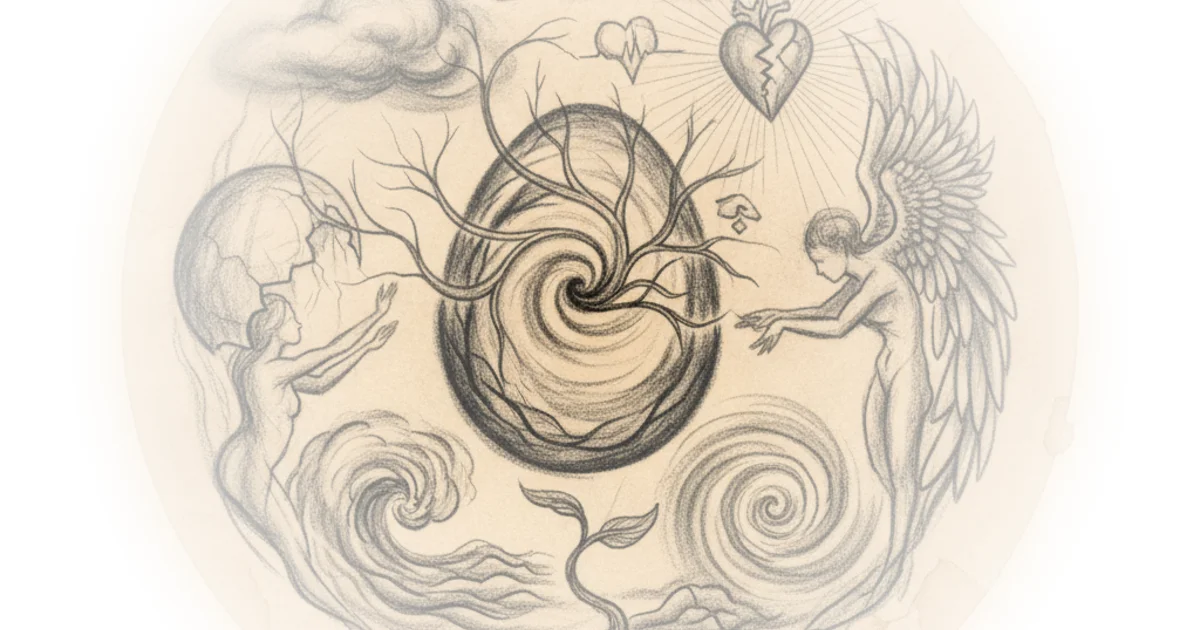
The commentary here is effective because it anchors abstract philosophy in the visceral reality of a broken heart. Léna finds Diderot's words while grieving her father and her failed relationship, turning the "unperceiving mass" of the egg into a mirror for her own shattered identity. As Smith puts it, "What is this egg? It is dynamism… disguised as inertia." This line captures the essence of the piece: the appearance of stillness often masks a violent, necessary transformation. The author skillfully weaves in the historical context of William Harvey and Girolamo Fabrici d'Acquapendente, noting that their dissections laid the foundations of modern embryology by proving that "to be female was above all to bear eggs." Yet, Smith quickly pivots to the limitation of their view, pointing out that by Diderot's time, the living being had become "transformation itself, exposed to the contingencies of its own growth."
What is this egg? It is dynamism… disguised as inertia.
The Paradox of the Air Pocket
The narrative shifts from historical exposition to a tense dialogue between Léna and her employer, Ondré. Here, Smith introduces a biological fact that serves as the story's moral core. Ondré corrects Léna's assumption that a "full" egg is the ideal state, explaining, "A full egg would be unviable. It has to contain an air pocket so that the chick can breathe during the final twenty-four hours before hatching; otherwise it would suffocate." This biological necessity becomes a profound metaphor for human resilience. The argument suggests that completeness is not the goal; rather, the presence of a void, a space for breath and uncertainty, is what allows life to proceed.
Smith's framing of this exchange is particularly sharp. He juxtaposes Ondré's "iceberg-stare" and rationalism with Léna's intuitive understanding of loss. The author writes, "The symmetry of the embryo during its first thirty-five hours is broken by the appearance of the heart, which determines the orientation of the head." This scientific detail is used to illustrate how life requires a break in symmetry, a disruption of the status quo, to move forward. Critics might note that this biological determinism risks oversimplifying the complexity of human grief, reducing emotional trauma to a mechanical process of gestation. However, the text avoids this trap by emphasizing the emotional weight of the discovery rather than the cold mechanics of it.
The excerpt also draws a subtle parallel to Jakob von Uexküll's concept of the Umwelt, or the unique perceptual world of every living being. Just as von Uexküll argued that animals are subjects capable of volition within their specific environments, Léna begins to see her own life not as a fixed narrative but as a series of potential interactions. The author notes, "Though anyone hoping to catch life in the act within the egg can only fail," suggesting that the moment of life is too fluid to be captured or controlled, much like the act of writing or painting.
The Unfinished Fresco
The final section of the excerpt brings the philosophical argument to a practical, artistic conclusion. Léna proposes a radical idea to Ondré: to keep the grass growing between the stones of the garden fresco. "It will be a way of... bringing the fresco back to life," she argues, challenging Ondré's desire for a fixed, perfect image. Smith writes, "Keep the fresco from becoming fixed?" This question echoes the earlier biological argument: a static image is dead, while a living one is subject to the encroachment of nature and time.
The author's choice to end on this note of unresolved tension is masterful. It refuses to offer a neat resolution, instead leaving the reader with the image of a fresco slowly being reclaimed by the wild. As Smith puts it, "There may be times when you would rather leave it hidden." This suggests that the process of creation and survival is not about conquering chaos, but about learning to coexist with it. The text implies that the "reproduction" Léna seeks—whether in art or in life—requires a willingness to let the boundaries blur, to allow the "grass" of uncertainty to grow.
Bottom Line
Justin E. H. Smith delivers a compelling argument that the necessity of emptiness—the air pocket in the egg, the grass in the garden—is the very condition for life and art to exist. The piece's greatest strength lies in its seamless integration of embryological history with personal narrative, turning a scientific fact into a profound meditation on grief. Its vulnerability is a slight over-reliance on the metaphor of the egg, which, while powerful, may feel heavy-handed to readers seeking a more grounded narrative. The reader should watch for how this theme of "dynamic inertia" plays out in the full novel, particularly in how it challenges the modern obsession with control and perfection.