Hamilton Nolan cuts through the exhaustion of endless "fix the Democrats" essays with a startlingly specific proposition: that the path to breaking Republican dominance lies not in national third-party runs, but in a labor-led insurgency within the reddest states of the union. The piece is notable for its cold, hard arithmetic, moving beyond ideological wishful thinking to demonstrate that the raw human capital of union members in states like Wyoming and Mississippi already exceeds the volunteer thresholds needed to win elections. For the busy strategist or the weary activist, this is a reminder that the resources for a political revolution are not missing; they are simply dormant, waiting for a vehicle that doesn't require voters to swallow the Democratic brand.
The Arithmetic of Insurgency
Nolan begins by acknowledging the fatigue of the progressive left, admitting that "a stupid portion of my career has been spent writing things in the category of 'The Democratic Party should do X.'" He argues that this cycle has produced little return, urging a shift toward a more tangible strategy: a Labor Party that operates independently in states where the two-party system has already failed working people. The core of his argument rests on the distinction between national and state-level viability. He notes that while a third party at the presidential level is often counterproductive in a winner-take-all system, the state level offers a different battlefield.
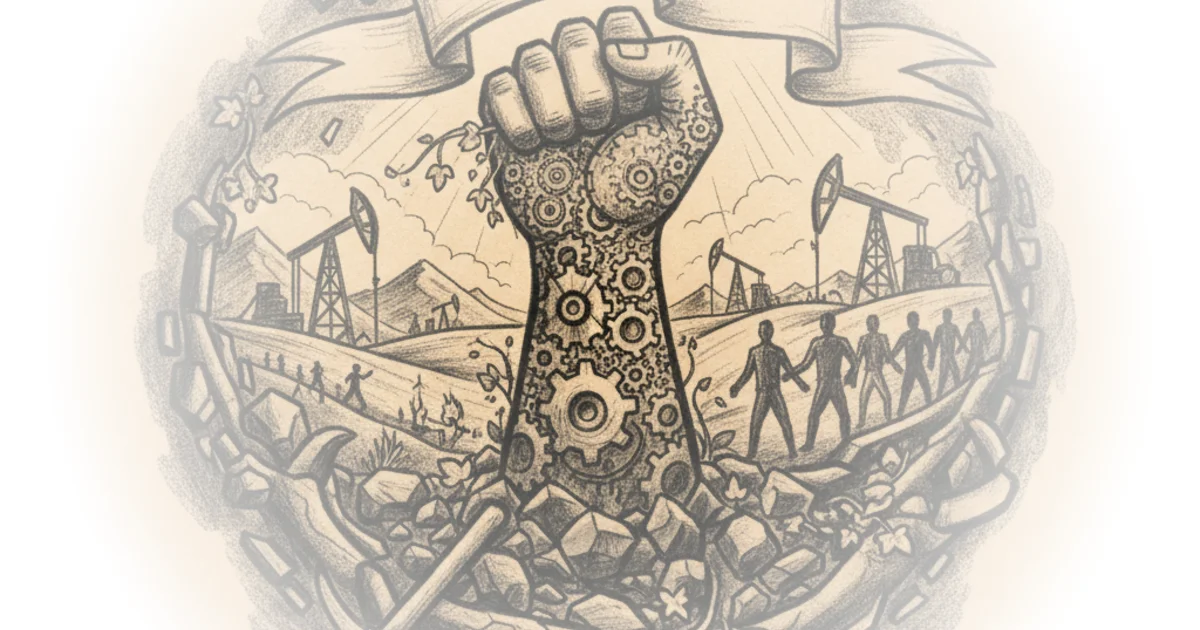
He draws a sharp parallel to historical precedents, noting that the Minnesota Farmer–Labor Party once successfully broke the two-party stranglehold in the early 20th century by focusing on local and state power rather than trying to immediately unseat the national establishment. Nolan suggests we need a similar, modern iteration. "If organized labor or anyone else wants to form an effective third party on the national level, they must first tackle the underlying issue of our winner-take-all electoral system," he writes. "They must fight for proportional representation... Until then, it is probably more effective in the real world to focus on pulling the Democrats left. However! There are other places, on the state and local levels, where a Labor Party or something similar, could be effective."
This pivot is the piece's strongest move. It avoids the trap of demanding the impossible (national proportional representation) while offering a concrete, immediate alternative. The argument gains traction when Nolan points to recent victories, such as Zohran Mamdani's win in New York, as proof that organized people can defeat organized money. "The most fundamental lesson of Zohran's victory, to me, is the ability of very well organized campaigning, a candidate with genuine beliefs, and a set of policies focused on actually helping working people to defeat well-funded establishment opponents," Nolan argues. This lands because it shifts the focus from the candidate's personality to the infrastructure of the campaign.
The most fundamental lesson of Zohran's victory, to me, is the ability of very well organized campaigning, a candidate with genuine beliefs, and a set of policies focused on actually helping working people to defeat well-funded establishment opponents who have the support of establishment pillars like the business world and the mainstream media.
The Red State Paradox
The article's most provocative section challenges the assumption that red states are political deserts for labor. Nolan presents a detailed breakdown of twelve states where the former administration secured over 60% of the vote, juxtaposing their high Republican margins with their total union membership numbers. He asks a simple, devastating question: Could an independent pro-worker candidate recruit a number of volunteers equal to half a percent of the total population of the state? His data suggests the answer is an emphatic yes.
In Wyoming, for instance, where the vote share was 72%, union members number 14,000—far exceeding the 2,935 volunteers needed to hit the benchmark. Nolan writes, "That in every single one of the reddest, most Republican states in America, the number of union members far exceeds the number of people that would be necessary to form a volunteer base sufficient to propel an outsider or anti-establishment candidate to victory." He uses this data to dismantle the cynicism that often plagues labor organizers in these regions.
He anticipates the objection that these union members are Republicans, but reframes it as a failure of choice rather than a lack of conviction. "Yes, many red state union members are Republicans. But they are Republicans in a two-way contest, without any independent Labor Party to consider," Nolan explains. He posits that these voters have never been offered a candidate who explicitly identifies as a union member fighting for their specific economic interests without the baggage of the Democratic Party. "They are here to give you universal health care and living wage jobs and to tax the fuck out of the rich, like your boss, and make them pay," he writes, capturing the raw, unfiltered appeal of a class-based platform.
Critics might note that this analysis underestimates the potency of culture war messaging, which has successfully decoupled economic self-interest from party affiliation for millions of voters. Nolan acknowledges this, arguing that "the one thing that you cannot propagandize people about is their own lives." He believes that the visceral reality of low wages and high costs will eventually override cultural conditioning if presented with a credible alternative. This is a bold claim, but it is grounded in the historical reality that economic desperation often trumps cultural alignment when the choice is stark enough.
Freed from the taint of the Democratic Party brand, there is no reason to think that a candidate leaning on these issues could not attract support in a red state full of low-income working class people.
A New Infrastructure for Power
Nolan concludes by outlining the mechanics of this potential Labor Party. It would not be a top-down project but a movement "led by, primarily funded by, and explicitly arises from the labor movement." He envisions a structure that is unencumbered by the "toxic Democratic Party brand" and focused solely on winning in the states where Democrats are effectively marginalized. This approach avoids the spoiler effect that plagues third parties in competitive swing states, instead concentrating resources where the two-party system has already collapsed for the working class.
He suggests that major unions could fund this effort simply by redirecting a portion of the money they currently give to the Democrats. "This would have the salutary effect of motivating the Democrats to be more pro-worker by creating competition for union support," Nolan writes. This creates a dynamic where the Democratic Party is forced to compete for labor votes rather than taking them for granted. The strategy is not about replacing the left wing of the Democratic Party but about breaking the Republican stranglehold on half the country.
The argument is compelling because it treats political power as a resource that can be reallocated, not just a sentiment to be expressed. "As long as the Labor Party strictly focused its efforts on red states where Democrats cannot win anyhow, it would not fall into the trap of splitting the liberal vote in competitive three-way races," he notes. This strategic discipline is what separates a viable political project from a protest movement.
This kind of central organization, with organized labor organizing campaigns to organize voters, is a necessary ingredient of beating organized capital.
Bottom Line
Hamilton Nolan's argument is at its strongest when it moves from abstract theory to the hard math of volunteer recruitment, proving that the human capital for a red-state labor insurgency already exists. The piece's biggest vulnerability lies in its assumption that economic self-interest will automatically override deep-seated cultural and partisan identities without a massive, sustained investment in messaging and community organizing. However, the proposal offers a necessary, concrete roadmap for breaking the current political deadlock, shifting the question from "why can't we win?" to "where are the resources we need already hiding?".