More Perfect Union has uncovered a disturbing nexus where presidential pardons, cryptocurrency speculation, and foreign diplomacy converge into what they term a "corruption economy." The piece argues that the administration sudden embrace of the crypto industry—after years of denouncing it as a scam—is not merely a political pivot but the foundation of a parallel financial system designed to enrich the First Family while bypassing all anti-money laundering safeguards. This is not standard political reporting; it is a forensic audit of how influence is now being bought at the speed of light, with the President himself as the primary beneficiary.
The Great Pivot
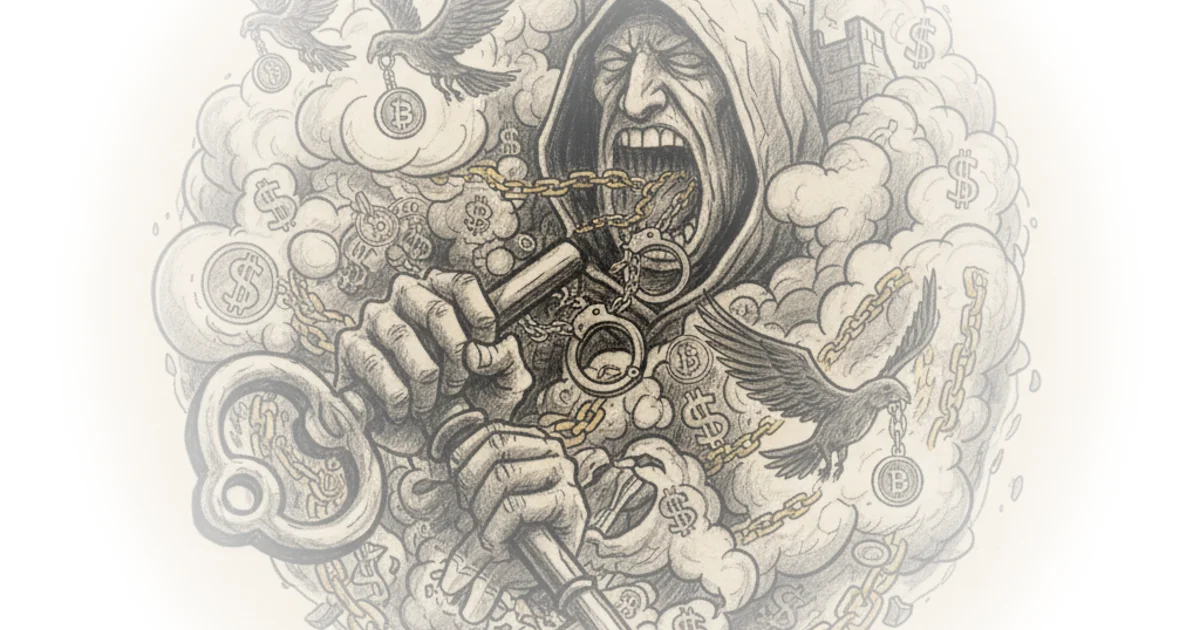
The narrative begins by highlighting the stark contradiction in the administration's public stance. The author notes that while the president has long claimed to be a "tough on crime" administration, he has selectively pardoned high-profile figures in the crypto world who were convicted of serious financial crimes. More Perfect Union writes, "President Trump has issued pardons to the three co-founders of the Bitcoin Merkantile Exchange... and Ross Olrich, the creator of a dark web marketplace named Silk Road." This selective clemency is framed not as judicial mercy, but as a transactional reward. The author points out that the president once called Bitcoin a "scam" and claimed it competed with the dollar, yet now he is deeply entangled with the very industry he mocked. The shift is explained not by a change in ideology, but by a change in financial incentive. As the piece argues, "It reveals a covert arrangement of bribery, shadowy companies, foreign influence, and it might just be Trump's ticket to becoming one of the richest people in not just the country, but the world in only a matter of years."
Critics might argue that political alliances often shift based on changing economic landscapes, and that engaging with a growing sector is a pragmatic move rather than a corrupt one. However, the author's evidence suggests the timing and the specific nature of the pardons point to something far more calculated than mere pragmatism.
The Architecture of Influence
The core of the investigation centers on "World Liberty Financial," a crypto venture launched by the the president family in October 2024. The author details how this company serves as the vehicle for the alleged scheme. More Perfect Union explains, "They promised to build the financial system of tomorrow and marketed themselves as a decentralized financial company that like so many other crypto companies was somehow going to bring financial empowerment to the masses." But the reality, according to the text, is a system designed to strip away the regulatory friction that exists in traditional banking. The author uses a powerful analogy: traditional finance is a slow process where money is inspected at every stop for compliance, whereas World Liberty Financial offers a "non-stop journey" where "Money laundering, sanctions, not a concern here."
This parallel system allows the the president family to profit directly from the fees generated by the tokens. The author states, "Any money exchanged for USD1 is held by World Liberty Financial, which they then get to invest in things like short-term Treasury bonds, which generates income for the Trump family." The innovation here is not technological; it is the removal of accountability. More Perfect Union writes, "The innovation is now anyone anywhere in the world at any time has a way to buy influence with the president of the United States. Permissionless, mostly unttrackable with plausible deniability." This framing is particularly effective because it moves the conversation from abstract policy to a tangible mechanism of corruption.
The relatively slow speed of traditional finance is a feature, not a bug. By removing it, we have removed the only thing standing between criminal capital and the highest office in the land.
The Global Transaction
The piece then connects these domestic financial maneuvers to international diplomacy, citing a specific deal involving the United Arab Emirates and Binance. The author describes how a $2 billion investment from an Emirati sovereign wealth fund was routed through World Liberty Financial. More Perfect Union notes, "Instead of just sending $2 billion to Binance, the UAE... decided to involve World Liberty Financial. So what they did was they sent $2 billion US to World Liberty Financial. In return, they got $2 billion worth of USD1 stable coins." The implication is a classic quid pro quo: the investment in the the president family's crypto token was followed by the dropping of legal cases against Binance and the granting of access to advanced US AI chips. The author identifies Steve Witkoff, a close friend of the president and his diplomatic envoy, as the broker of this deal, noting that Witkoff "is potentially directly profiting off of these both diplomatic and crypto deals." The text concludes that "If it's not a quid pro quo, I don't know what one is."
The investigation also highlights the involvement of Justin Sun, a crypto entrepreneur with a history of SEC fraud charges, who invested $75 million and subsequently saw his legal troubles disappear. The author describes a "rogues gallery of strange and potentially criminal people surrounding World Liberty Financial," including a mysterious entity called Aqua 1 Foundation that sent $100 million with no clear corporate existence. More Perfect Union writes, "We don't know what they want, what they expect in return, or even where that money might have come from, but they definitely sent it." This lack of transparency is presented as the ultimate feature of the new system, allowing foreign actors to bypass US sanctions and laws entirely.
Bottom Line
The strongest element of this piece is its ability to demystify the abstract concept of cryptocurrency into a concrete mechanism for selling government access, effectively arguing that the "Genius Act" and similar legislation have legalized a new form of bribery. The argument's vulnerability lies in its reliance on circumstantial timing between investments and policy changes, which, while highly suggestive, stops short of proving a direct criminal conspiracy in a court of law. Readers should watch for how the administration defends the legitimacy of World Liberty Financial as the regulatory scrutiny inevitably intensifies.