Brad Skow delivers a harrowing, character-driven excavation of the Nuremberg trials, stripping away the myth of the 'evil genius' to reveal a collection of desperate, lying, and often pathetic men. Rather than a dry legal history, the piece offers a psychological autopsy of how ordinary human frailty enabled unprecedented atrocities, arguing that the true horror lies not in the monsters' inhumanity, but in their terrifying humanity.
The Illusion of Evil
Skow immediately dismantles the post-war narrative of the Nazi leadership as paragons of pure malice. He writes, "The Nazi leaders were evil men; they have become paradigms of evil. But after the war, in prison and on trial at Nuremberg, they became something else: pathetic, and all-to-human." This reframing is crucial; it forces the reader to confront the banality of the perpetrators. Skow illustrates this through Hans Frank, a man who believed his own propaganda enough to think his diary would save him. Frank convinced himself that his anti-Semitism was merely "lip service" required to keep his job, a delusion that crumbled when American troops beat and spat on him. The author notes that Frank's attempt to minimize his role in the murder of millions by focusing on his "improvement of the lives of the Poles" was a desperate, failed gamble. This exposes a dangerous cognitive dissonance: the belief that bureaucratic compliance can absolve one of moral responsibility for mass death.
"Slippery slopes are real. Take care how you price seemingly-minor compromises of your principles. Even small bites of the apple will send you to hell."
Skow's analysis of Hermann Goering further complicates the picture. While Goering remained the only defendant who retained his arrogance, admitting he rearmed Germany until it "bristled," the author points out that even his defiance was fractured. Goering's attempt to lead a unified defense failed because the other defendants, unlike him, were willing to defect to save their own skins. This suggests that the regime's collapse was as much a result of internal cowardice as external military defeat.
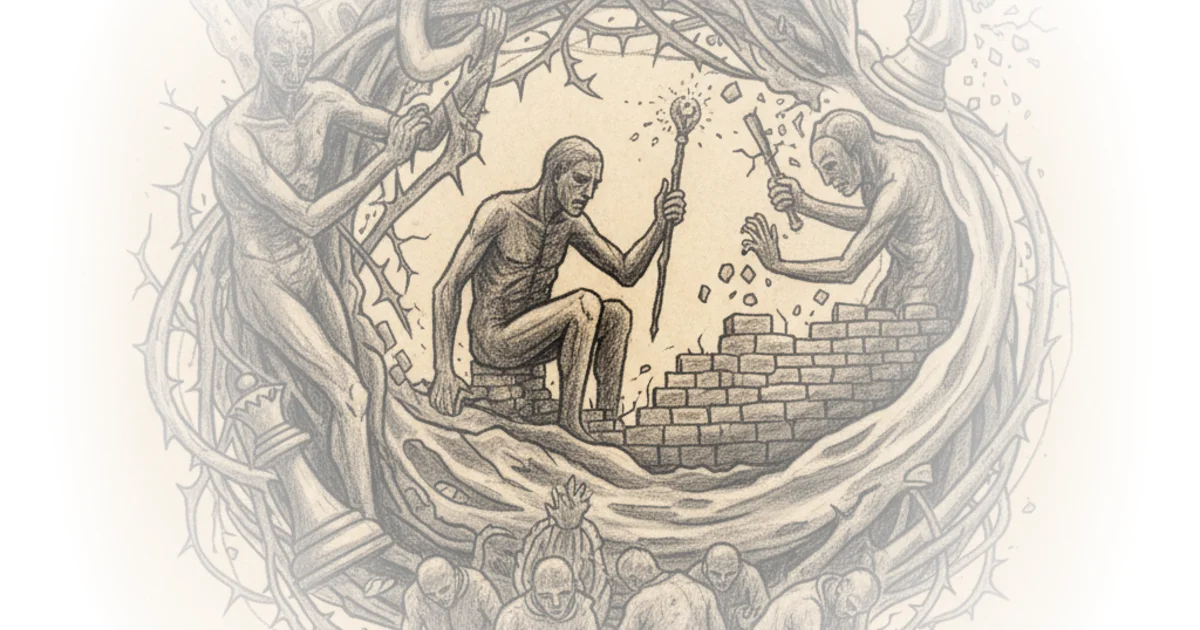
The Theater of Justice
The piece shifts to the procedural oddities of the tribunal, revealing how political maneuvering dictated the roster of the accused. Skow explains that Hans Fritzsche, a minor propaganda figure, was included not because of his crimes, but because the Soviet Union insisted on having their own prisoners indicted to balance the American captives. The Tribunal found Fritzsche not guilty, a verdict that highlights the arbitrary nature of who stood trial. Skow writes, "The answer was politics," a blunt reminder that even in the pursuit of justice, great power dynamics often override pure legal logic.
The commentary then turns to the psychological evaluation of Rudolf Hess, offering a stark critique of the psychiatrists involved. While American experts concluded Hess was insane, the prison commandant, Colonel Burton Andrus, correctly identified that Hess was feigning madness to avoid the trial's isolation. Skow describes the psychiatrists' reaction to Hess's sudden "cure" as a prime example of "motivated reasoning," where the experts doubled down on their initial error rather than admit defeat. He notes that psychologist Gustav Gilbert, who had access to the defendants, viewed Nuremberg as "history's most perfectly controlled experiment in social pathology." Skow rightly calls this delusional, questioning how one can study the causes of Nazism by listening to the "defensive lies told by Nazis on trial for their lives."
Critics might note that while the psychiatrists were flawed, their attempts to understand the psychology of the defendants were unprecedented and necessary for the historical record, even if their methods were compromised by the defendants' manipulation.
The Banality of Speech and Silence
One of the most chilling sections focuses on Julius Streicher, whose crime was not military command but the incitement of hatred through his newspaper, Der Stürmer. Skow details Streicher's grotesque claims about Jewish blood poisoning and his insistence that he was merely stating "facts." The author poses a provocative legal question: would Streicher's rhetoric count as incitement under modern First Amendment precedents like Brandenburg v. Ohio? The answer, Skow suggests, is likely no, highlighting the tension between free speech absolutism and the prevention of genocide.
The piece also explores the tragic irony of the defense lawyers, many of whom were Nazis themselves, who failed to understand the adversarial system they were fighting in. Skow writes, "The German lawyers did not understand the legal system they were operating under, which had been Frankensteined specially for the trial." In a moment of black comedy, a defense witness for Ribbentrop admitted that her boss's chief aim was to "enjoy Hitler's confidence," a statement no prosecutor could have improved upon. This incompetence underscores the chaos of the proceedings, where the very mechanism designed to ensure a fair trial was undermined by the defendants' inability to navigate it.
Finally, Skow touches on the chilling normalcy of Rudolf Hoess, the commandant of Auschwitz, who told psychologist Gilbert, "I am entirely normal. Even while doing this extermination work, I led a perfectly normal family life." This juxtaposition of domestic poetry and industrial murder serves as the piece's most disturbing evidence that evil does not require a monster's face; it can wear the mask of a neighbor.
Bottom Line
Skow's greatest strength is his refusal to let the reader off the hook with the easy comfort of viewing Nazis as inhuman monsters; instead, he forces a confrontation with their pathetic, lying, and terrifyingly normal humanity. The piece's biggest vulnerability lies in its occasional reliance on anecdotal humor to describe atrocities, which risks trivializing the suffering of the victims even as it exposes the absurdity of the perpetrators. Ultimately, this is a vital reminder that the capacity for evil resides in the willingness to compromise one's principles, not in the possession of some supernatural malice.