Perun delivers a sobering diagnosis of American naval decline, arguing that the cancellation of the Constellation-class frigate isn't a single procurement failure but the latest symptom of a systemic inability to build ships at scale. While other nations stumble, the author contends that the United States is uniquely vulnerable because it has lost the industrial patience required to sustain a fleet, turning a strategic advantage into a slow-motion collapse.
The Cost of Impatience
Perun opens by dismantling the idea that warship construction is merely a matter of writing checks. "Designing and building warships is a tricky business, and it's abundantly clear that most nations out there don't get it perfect all the time." He illustrates this with a global tour of failures, from Canadian ships with misplaced decimal points to North Korean destroyers that tip over on the slipway. The point, he argues, is that for major powers, occasional failures are survivable. The problem arises when those failures become a pattern. "Its program for advanced next generation stealthy destroyers and potentially cruisers, what gave us the Zumalt class, ultimately produced far fewer ships than planned at a higher per unit cost than planned that weren't ideal for the modern Navy's needs."
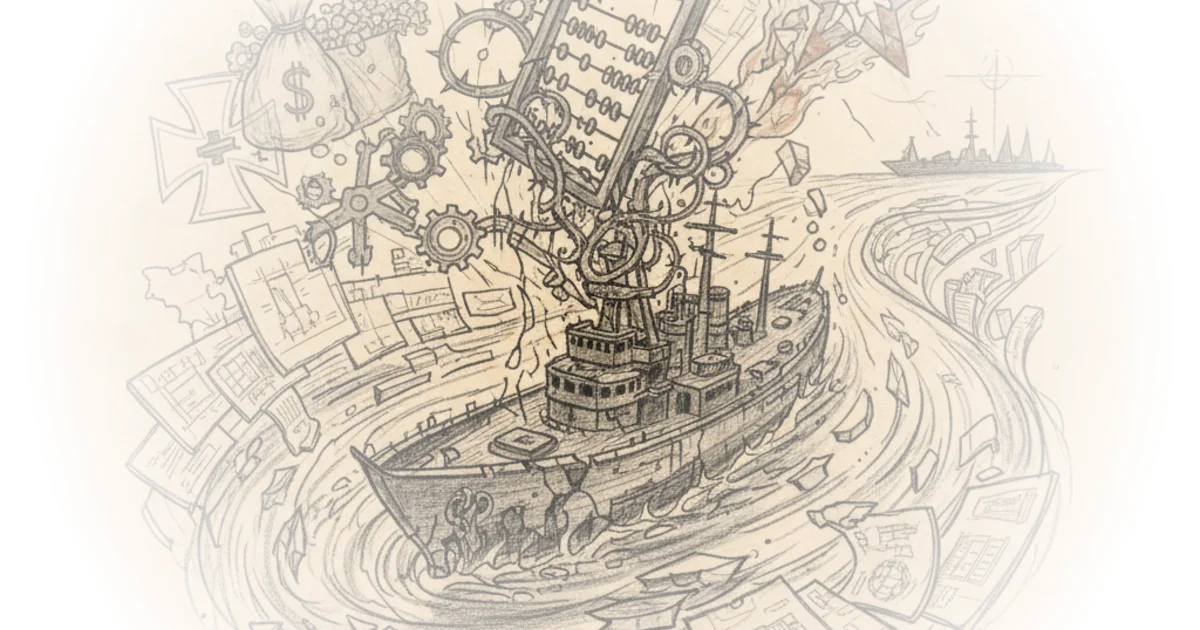
The author's analysis of the Constellation program is particularly sharp. The initial strategy was sound: adapt a proven international design to avoid reinventing the wheel. "The idea this time was to play it safe. Take an existing internationally successful frigate design, adapt it a bit for United States service, and come up with something the US could crank out affordably and in huge numbers." Yet, the execution betrayed the strategy. "The ship was morphed and altered until it barely resembled the base design. cost blew out, delays mounted." This highlights a critical weakness in the US approach: the inability to resist over-engineering even when the mandate is simplicity. Critics might note that the US Navy faces unique security requirements that justify some customization, but Perun's evidence suggests these demands have become a shield for inefficiency.
Naval strategy is built strategy. That saying encapsulates a lot of things. that ships are expensive, that they take a long time to build, that the infrastructure to build them takes even longer.
The Industrial Mismatch
Perun draws a stark contrast between land and sea warfare to explain why the US Navy's struggles are so dangerous. He notes that ground forces can mobilize quickly, often improvising with civilian technology like Starlink or commercial drones. "It may not be fantastic training, but we've seen both sides sometimes push new recruits through basic in a couple of weeks." In contrast, naval power cannot be improvised. "Being caught unprepared for a protracted ground war then is clearly a big deal and a terrible idea, but if you can hold on long enough and industrially mobilize hard enough, you can potentially dig your way out. With navies, from an industrial perspective, the consequences of everything flow through much more slowly."
This section is the essay's intellectual core. The author argues that the US Navy is suffering from a "slow burning fuse" because it stopped investing in the industrial base decades ago. "If you take your foot off the production pedal, it might take years or decades before you start to really feel the impact and keep running the ships that you already have." The danger is that the gap between investment and output is widening, leaving the fleet with no replacement strategy. A counterargument worth considering is that the US relies on its allies for some of this capacity, but Perun's focus on the sheer scale of the Chinese naval buildup suggests that alliance networks cannot fill the gap left by domestic stagnation.
The Ghost of the 600-Ship Navy
To understand the current crisis, Perun takes readers back to the peak of US naval power in the late Cold War. "The recent peak of US warship numbers, the so-called 600 ship navy of the late 1980s." He details how this force was a patchwork of new construction and reactivated old hulls, including the Iowa-class battleships and the USS Midway, a carrier designed for a different era. "The absolute grandpas of the late Cold War force, for example, were the Iowa class battleships... they were big, intimidating, had lots of propaganda value."
The author uses this historical context to show how the US Navy once managed to stretch resources by keeping old ships relevant, even if they were chronologically diverse. "You could also say a chunk of the US destroyer force was also in a similar boat. The first of the old Charles FA Adams class destroyers had first been commissioned back in the 1960s." The problem today is that the US no longer has the option of reactivating old hulls because the industrial base to maintain them has eroded. "And so in November, the axe finally fell with the US announcing that far from spamming out the new constellation frig. The Navy would be cancelling all of the ships except for the two that were already in construction."
Bottom Line
Perun's strongest argument is that the cancellation of the Constellation class is a predictable outcome of a system that prioritizes short-term fixes over long-term industrial capacity. The piece's biggest vulnerability is its assumption that the US political will can ever be marshaled to reverse decades of defunding, a hurdle that may be insurmountable. Readers should watch for whether the Navy can pivot to a simpler, cheaper design before the gap between its fleet and China's becomes unbridgeable.