In an era where genetic determinism is often wielded to justify the status quo, Brad DeLong delivers a devastating takedown of the idea that our social hierarchy is written in our DNA. Drawing on fresh, rigorous studies that finally control for family environment, he reveals that the "genetic signals" for traits like intelligence and income are not just small—they are statistically negligible. For anyone tired of the fatalistic argument that inequality is inevitable, this analysis offers a scientifically grounded reason to fight for a better society.
The Collapse of the Genetic Warrant
DeLong opens by identifying a persistent ideological dream: the hope that biology will eventually provide a scientific warrant for social hierarchy. He traces this lineage from Francis Galton to modern proponents like Charles Murray, noting that the argument has remained remarkably stable despite changing statistical tools. "The rich and powerful are inevitable," DeLong writes, summarizing the core appeal of this worldview. "There is a very strong sense in which their wealth and powerful are 'natural'."
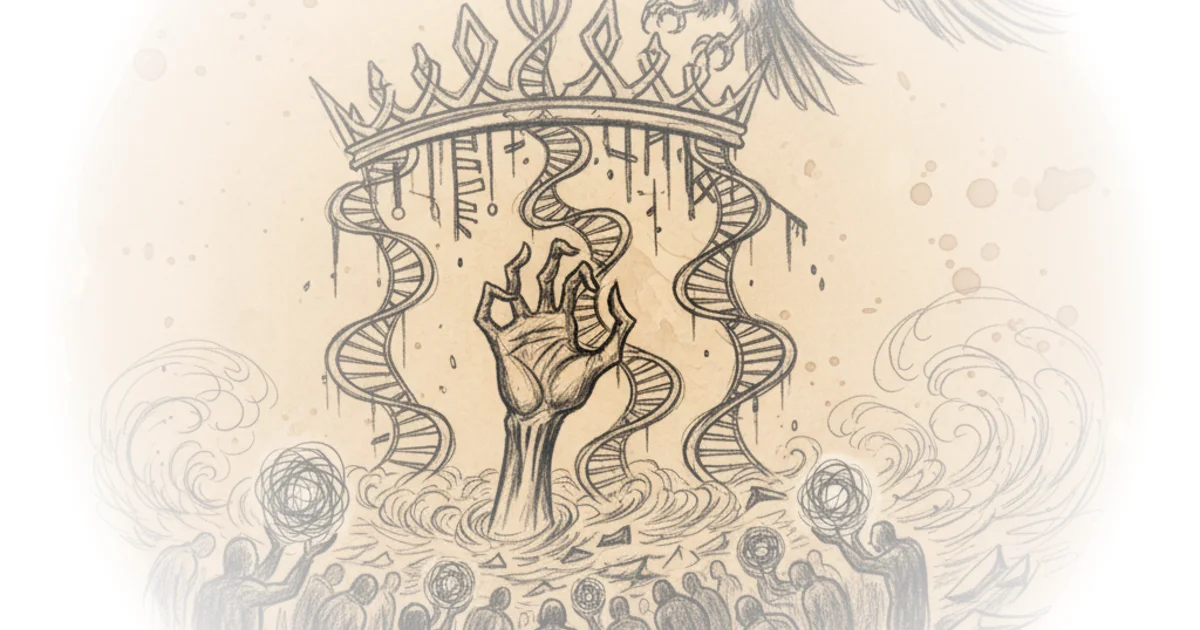
This framing is crucial because it exposes the motivation behind the science, not just the science itself. The drive to find a genetic basis for inequality is often a search for moral exoneration for the current order. DeLong argues that the latest wave of research, specifically the work of Eric Turkheimer and Sasha Gusev, shatters this hope. By utilizing within-family designs—which compare siblings who share the same parents, neighborhood, and school but differ in their genetic lottery—researchers can finally isolate direct genetic effects from environmental confounders.
The results are stark. DeLong points out that while older twin studies suggested heritability for behavioral traits was 50% to 80%, the new within-family estimates drop to a median of about 5%. "The celebrated behavioral traits that used to have twin-study heritabilities of 50%-80% turn out, in this stricter sense, to be only very weakly 'genetic'," he notes. This is not a minor adjustment; it is a fundamental dismantling of the predictive power of polygenic scores.
1% is noise noise noise. 0.1% is noise noise noise noise noise. And to pay any attention to it at all is to mount a cognitive-destruction attack on your interlocutors and yourself.
DeLong's use of repetition here is rhetorically powerful, driving home the point that these tiny effect sizes are practically useless for policy or prediction. He emphasizes that a polygenic index explaining 0.1% of the variance in educational attainment is "noise," rendering it irrelevant for school counselors or credit-scoring algorithms. Critics might argue that even small genetic effects matter at the individual level, but DeLong correctly identifies that the leap from "genes matter somewhat" to "social inequality is genetic" is where the logic breaks down.
The Illusion of Population Differences
The second prong of DeLong's argument tackles the issue of population stratification, a statistical artifact that has misled researchers for decades. He explains how Genome-Wide Association Studies (GWAS) often mistake environmental differences between groups for genetic ones. If a specific allele is slightly more common in a wealthy, well-schooled population, the study may incorrectly attribute the group's success to that gene, ignoring the fact that the gene is just a marker for the environment.
DeLong illustrates this with a striking example involving height and brain size, where earlier claims of rapid selection were later shown to be artifacts of uncorrected stratification. "You have not discovered deep biological essence," he writes regarding these flawed studies. "You have simply learned to reconstruct the existing social geography." This is a profound insight: the data isn't revealing a biological hierarchy; it is merely reflecting the map of current inequality.
He further demonstrates this with an ADHD study where the apparent genetic ordering of continents could be reversed simply by changing the statistical weights used. "A machine in which you can reverse the apparent 'genetic ordering' of continents by changing which noisy, confounded set of weights you use... is a Rube Goldberg machine for re-expressing social structure," DeLong observes. This metaphor effectively strips the mystique away from complex genetic modeling, revealing it as a mirror of social bias rather than a window into biology.
The Return of the Environment
Ultimately, DeLong argues that we are returning to a commonsense understanding that was obscured by a century of methodological obsession. He invokes the legacy of Erasmus Darwin to suggest that the most accurate view of human difference has always been that genes and environment are inextricably tangled. "Two hundred years of methodological ingenuity, and we are back where Grandpa Darwin would have started: genes and environment both matter in some hard-to-untangle way," he concludes.
This brings the focus back to policy and history. DeLong points out that the massive shifts in health, education, and income observed over recent decades—such as the improvements for racial minorities after civil rights legislation or the entry of women into the workforce—occur far too quickly to be driven by genetic changes. "The environment turns out to be the margin on which policy and history operate, and on which inequality is produced and can be mitigated," he asserts. This is the most liberating part of the argument: if inequality is not genetic, it is political, and therefore changeable.
The environment turns out to be the margin on which policy and history operate, and on which inequality is produced and can be mitigated.
DeLong's synthesis of Turkheimer's and Gusev's work creates a "pincer movement" against genetic determinism. While he acknowledges that individuals have innate talents, he firmly rejects the notion that group disparities are a result of inherited cognitive potential. The evidence suggests that the "gloomy prospect" for eugenic ideology is actually "excellent news" for democracy, as it removes the scientific alibi for inaction.
Bottom Line
Brad DeLong's commentary is a masterclass in cutting through statistical noise to reveal the ideological stakes of genetic research. His strongest move is the clear distinction between within-family and between-family effects, which definitively shows that the predictive power of polygenic scores for social traits is effectively zero. The argument's only vulnerability is the potential for bad-faith actors to ignore these methodological corrections and cling to older, flawed studies, but the scientific consensus is now firmly against them. For the busy reader, the takeaway is clear: the future of human potential is not written in our genes, but in our policies.