Most discussions on love treat it as a mysterious force of fate, but evolutionary anthropologist Anna Machin, as presented by Peter Singer in his latest podcast commentary, reframes it as a high-stakes biological algorithm designed to bypass our survival instincts. This piece is notable not for romanticizing connection, but for exposing the deliberate neurological blind spots evolution installs when we fall in love, suggesting that our most cherished feelings are actually calculated risks to our reproductive future.
The Biological Algorithm of Attraction
Singer introduces Machin's core thesis: the "spark" we feel in seconds is not magic, but a rapid-fire sensory calculation. "We put it into an algorithm, in our brain, which runs a little calculation of the biological market value of the person you've met," Machin explains. Singer highlights how this mechanism relies on ancient mammalian traits, where visual cues, voice pitch, and even scent are processed subconsciously to determine reproductive viability. This framing is effective because it strips away the mystique of "love at first sight" and replaces it with a tangible, evolutionary function. It forces the listener to confront the idea that their deepest emotions are driven by a biological market, a perspective that feels both grounding and slightly unsettling.
"The mentalizing area of the brain deactivates in the first stages of a relationship. So not only are we reducing your ability to detect risk, but we're also shutting down the bit of your brain that detects someone who's going to do you wrong."
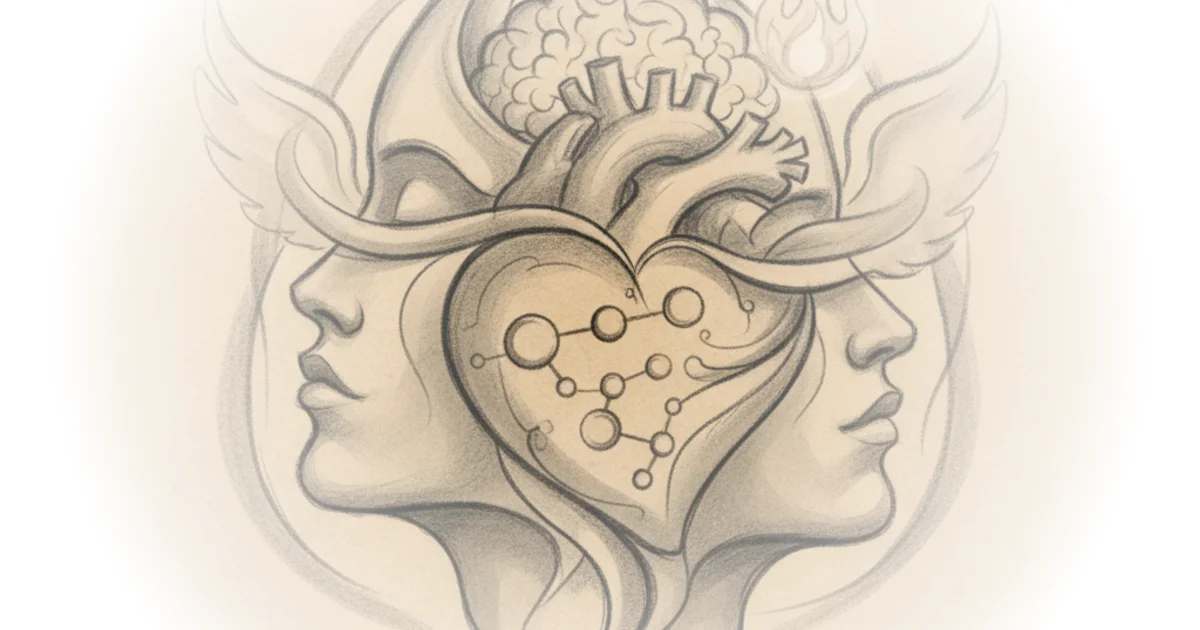
The most striking argument Singer relays is the evolutionary trade-off involved in falling in love. Machin posits that for love to take root, the brain must suppress the amygdala (risk detection) and the mentalizing center (intention reading). Singer notes that this creates a dangerous vulnerability where individuals cannot see red flags, a state Machin describes as necessary for the "risk of love." Critics might argue that this biological determinism overlooks the role of conscious agency and cultural conditioning in modern relationships, yet the evidence regarding neurochemical suppression remains compelling. It suggests that the very mechanism that makes us vulnerable to bad partners is the same one that allows us to form the deep bonds necessary for species survival.
Cultural Constructs vs. Biological Reality
Singer then pivots to the tension between our biological drives and our cultural narratives. Machin clarifies that while the drive to pair bond is universal, the concept of "romantic love" as a singular, all-conquering force is a Western invention. "Romantic love means something very specific to those of us who study love. It's something cultural, Western, and rooted in the idea that there is one love - the most powerful love - and the love that overcomes all obstacles," she states. This distinction is crucial for understanding why modern relationships often feel so fraught; we are trying to fit ancient, fluid biological imperatives into rigid, culturally constructed boxes of monogamy.
When addressing monogamy, Machin dismantles the myth of human exclusivity with hard data. She points out that true monogamy—both sexual and social—exists in only 0.0015% of species. "In most species, we have social monogamy, where we see pair bonding occurring in a species. But since the advent of DNA testing of offspring, it's very, very clear that quite often the offspring are not the product of both those people," she argues. Singer uses this to contextualize the high rates of infidelity in the West, framing them not as moral failings but as a clash between our social contracts and our biological reality. This aligns with historical understandings of pair bonding, where social stability often took precedence over sexual exclusivity, a dynamic that has shifted dramatically in the modern era.
"We are not that; in fact, only 0.0015% of species are truly monogamous."
The Evolutionary Logic of Jealousy and Parenting
The commentary further explores the darker emotions that accompany love, specifically jealousy. Machin reframes jealousy not as a sign of deep affection, but as a cold calculation regarding reproductive status. "That's not really to do with love, though. That's to do with jealousy, which is related to a threat to your reproductive status," she asserts. Singer elaborates on how this manifests differently for men and women: men fear the loss of reproductive opportunity, while women fear the diversion of resources and investment. This biological explanation offers a stark, unromantic view of human conflict, suggesting that our most painful emotional reactions are rooted in the survival of our genes.
Singer also highlights the unique evolutionary role of fathers. Unlike 95% of mammals, humans have investing fathers, a trait that shapes how parents interact with children. Machin notes that while mothers often lead with nurture, fathers tend to provide stimulation and challenge. "They fit together like a jigsaw puzzle, ensuring that developmental input is spread between the parents," she says. This perspective challenges the notion of interchangeable parenting roles, suggesting that evolution has optimized distinct contributions from each parent to maximize offspring survival. It adds a layer of complexity to the conversation about family dynamics, moving beyond gender roles to evolutionary strategy.
"Having a healthy social network is the number one factor in your health—your mental and physical health, your longevity, and your happiness."
The Ultimate Secret to Living Well
Ultimately, Singer and Machin converge on a conclusion that transcends the mechanics of attraction: the centrality of social connection to human survival. Machin argues that nurturing relationships is more critical than diet, exercise, or avoiding smoking. "It's more important than all of the things governments tell you to do... It's bigger than all of that because it's fundamental to your health," she declares. Singer emphasizes that this is not just about romantic love, but about the broader social capital required for a healthy life. This ties back to the broader context of human evolution, where the ability to form complex social bonds was the key to our species' dominance. The argument lands with significant weight because it elevates social connection from a lifestyle choice to a biological imperative.
Bottom Line
Singer's coverage of Machin's work succeeds by stripping away the romantic veneer to reveal the stark, functional machinery of human connection. The strongest part of the argument is the reframing of love as a biological risk-management strategy that deliberately blinds us to danger, a concept that challenges our most cherished self-narratives. However, the piece's biggest vulnerability lies in its heavy reliance on evolutionary determinism, which may underplay the profound impact of individual choice and cultural evolution in shaping modern relationships. Readers should watch for how these biological imperatives interact with the rapidly changing landscape of human social structures in the coming decades.