This piece cuts through the hype of artificial intelligence to expose a brutal engineering bottleneck: the cost of making models actually think is not just about buying more chips, but about synchronizing them perfectly. Dylan Patel argues that the current explosion in coding assistants and reasoning capabilities hinges on a hidden infrastructure problem—matching the speed at which models generate code with the speed they can learn from it. For leaders watching the $100 billion market for AI tools rush toward maturity, this is not just technical trivia; it is the difference between scaling profitably or burning cash on idle hardware.
The Three-Act System
Patel reframes reinforcement learning (RL) not as a monolithic training run, but as a delicate dance between three distinct actors: the generator, which creates responses; the environment, which tests them in a sandbox; and the trainer, which updates the model's brain based on the results. He writes, "Unlike pre-training, which maximizes the log-likelihood, RL training maximizes the expected reward." This distinction is critical because it shifts the focus from raw data volume to the quality of feedback loops.
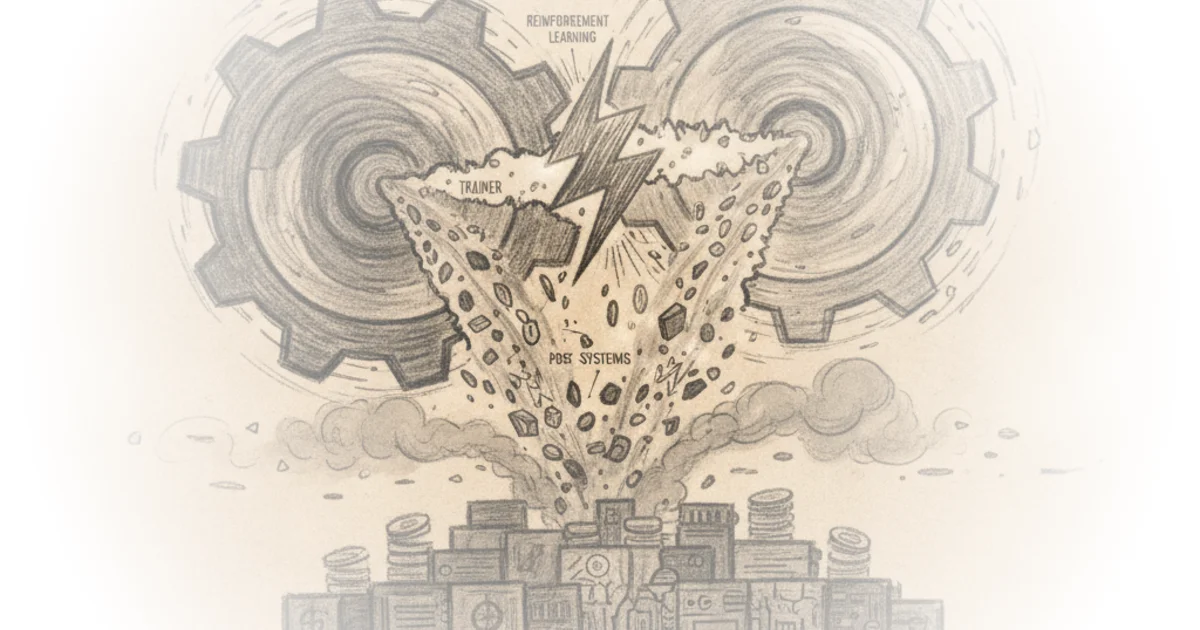
The author breaks down why this matters for capability. While pre-trained models provide the base intelligence, it is post-training that unlocks complex behaviors like debugging code or solving math problems. Patel notes that "Dario Amodei, Anthropic's CEO, has described RL as showing the same kind of scaling pre-training once did, where performance climbs log-linearly with how long you train." However, he immediately counters this optimism with a hard constraint: "That scaling is enormously expensive, which makes RL system efficiency critical."
This framing is effective because it moves the conversation away from vague promises of "AGI" and toward the gritty reality of compute economics. If the system cannot generate training data as fast as the model can learn from it, that log-linear growth stalls. Critics might argue that algorithmic breakthroughs will eventually render these hardware constraints moot, but Patel's analysis suggests we are currently hitting a wall where software efficiency is the only lever left to pull.
"System efficiency comes down to matching trainer and generator throughput."
The Staleness Trap
The most compelling part of Patel's argument addresses the conflict between speed and accuracy in asynchronous training. In older, synchronous systems, the trainer had to wait for every single generated response before updating the model, leading to massive idle time. To fix this, engineers adopted "PipelineRL," which allows the generator to keep working while the trainer updates weights. But Patel warns of a hidden tax: policy staleness.
He explains that with in-flight weight updates, "each sample is generated by a mixture of old and new policies." If the gap between the version of the model generating the code and the version learning from it gets too wide, the training signal degrades. As Patel puts it, "Samples too stale degrade model learning." This is a nuanced insight often missed in broader AI coverage; it suggests that raw speed isn't always better if it corrupts the learning process.
The author draws on historical context here, noting how this mirrors challenges seen in earlier deep reinforcement learning experiments where asynchronous updates led to instability. The solution, he argues, is not to stop asynchrony but to cap it. "PipelineRL is a throughput-matching scheme with bounded policy staleness," he writes, effectively turning a software bug into a managed system parameter. This reframing turns a technical limitation into an engineering design choice, giving operators a clear metric to optimize rather than just hoping for faster hardware.
The Sandbox Bottleneck
Beyond the algorithms, Patel shines a light on the often-overlooked infrastructure of the "sandbox"—the secure container where code is executed and tested. This is where the rubber meets the road for coding assistants. He observes that "Sandbox service companies like Modal optimize the startup latency with techniques like content-addressed caching," highlighting how milliseconds in startup time can compound into hours of wasted compute at scale.
The analysis deepens when discussing the unpredictability of these environments. A model might try to crash a sandbox by creating a million files, forcing the system to detect and recover from failures mid-training. Patel notes that "Sandbox orchestration needs to be able to detect and recover from those system failures." This adds a layer of operational complexity that pure software theorists often ignore. The environment isn't just a passive judge; it's an active participant that can fail, lag, or be overwhelmed by the very model it is testing.
"The interaction latency between the generator and the RL environment is critical to the end-to-end rollout latency."
This section is vital for understanding why scaling reasoning models is harder than scaling chatbots. In a chatbot, the "environment" is just a human reading text. In coding or math, the environment must run code, check outputs, and handle errors. Patel's breakdown of how task difficulty affects reward distribution—where tasks that are too easy or too hard produce zero learning signal—is a stark reminder that model behavior dictates system design. If a model solves everything instantly, there is no data to learn from; if it fails everything, the same applies. The "curriculum" must be curated to keep the solve rate in a productive middle band.
Bottom Line
Patel's strongest contribution is demystifying the "magic" of reasoning models by revealing them as throughput-limited engineering systems rather than purely algorithmic miracles. His argument that efficiency is now the primary constraint on capability growth holds up well against current industry trends, where compute costs are skyrocketing while marginal gains diminish. However, the piece underestimates how quickly new hardware architectures might disrupt these specific latency constraints. The reader should watch not just for better algorithms, but for infrastructure providers who can solve the sandbox startup and staleness problems first, as they will likely dictate who wins the next wave of AI applications.