Modern security discourse is drowning in a shallow appropriation of antiquity, where complex historical realities are flattened into convenient slogans for contemporary geopolitics. Jordan Schneider, hosting a deep dive on ChinaTalk with Oxford historian Roel Konijnendijk, exposes how the "Thucydides Trap" and the pop-culture myth of Sparta are not just historically inaccurate, but potentially dangerous when they shape the ideology of the world's most powerful military. This conversation is essential for anyone trying to cut through the noise of current strategic debates, as it reveals that the narratives driving policy are often built on a recursive loop of modern military fantasies projected onto the past.
The Illusion of the Trap
Schneider and Konijnendijk dismantle the popular theory that a rising power inevitably clashes with an established one, a concept frequently invoked by global leaders to frame the current US-China dynamic. Konijnendijk points out that the theory, popularized by political scientist Graham Allison, is a modern invention that barely engages with the actual text of Thucydides. "He talks about Thucydides, but he doesn't have any examples from ancient history except for the Athens and Sparta thing," Konijnendijk notes, highlighting that Allison essentially mines the past for a slogan rather than studying the history itself.
The argument here is that the "trap" is a convenient label that obscures the messy, specific causes of the Peloponnesian War. Konijnendijk explains that the conflict wasn't driven by a simple fear of rising power, but by a host of specific grievances, such as Corinth being offended by Athenian naval encroachment. "If you were to read this a little bit more closely, you might decide that what you call the Thucydides Trap should be called something else," he argues. This is a crucial distinction for policymakers; relying on a simplified model ignores the unique diplomatic and local factors that actually trigger wars.
Critics might argue that even a simplified model serves a useful heuristic function for strategists, but the conversation suggests that these shortcuts lead to strategic blindness. Schneider and Konijnendijk push back against the idea that history repeats itself, emphasizing that "every single historical situation is different." To apply a fifth-century BC dynamic to the twenty-first century is to ignore the radical differences in the environment, the nature of the states, and the global order.
History never repeats itself. Every single historical situation is different.
The "High-T" Military and the Spartan Fantasy
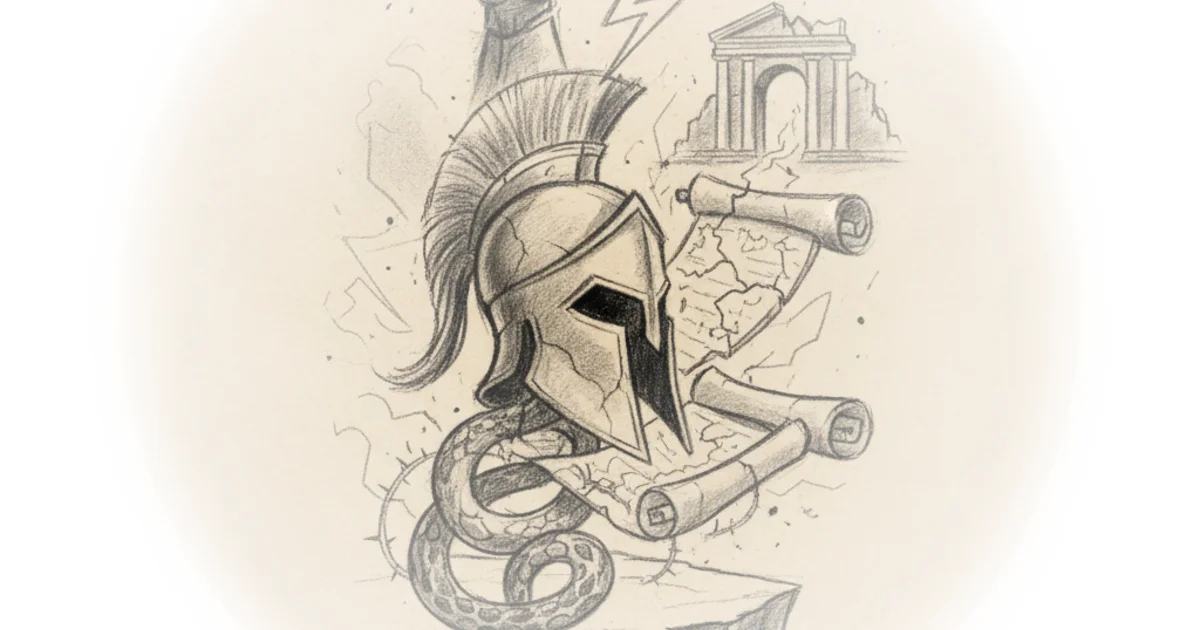
The discussion takes a sharp turn toward the cultural influence of pop culture on the modern Department of Defense, specifically focusing on the administration's recent interest in testosterone levels and the "high-T military." Schneider connects this to the enduring influence of the film 300 and the novel Gates of Fire, which have created a distorted view of ancient Sparta that now permeates military culture. Konijnendijk offers a scathing critique of this phenomenon, describing the movie not as history, but as "a study of masculinity" where the goal is not peace, but a perpetual state of dying.
The core of the argument is that this cultural feedback loop is dangerous. The modern military projects its own values onto the ancient Spartans, and then adopts those projected values as historical truth. "It's the USMC in fancy dress," Konijnendijk states, noting that the version of Sparta seen in 300 is a "recursive" product of modern American military training applied to the ancient world. This is not just an academic error; it shapes the ethos of soldiers who are told that their purpose is to embrace a "death cult" rather than to achieve strategic objectives and survive.
The implications of this are profound. If the military leadership, influenced by these narratives, believes that the pinnacle of achievement is to "live to die," it fundamentally alters the calculus of conflict. Konijnendijk warns that "you don't want soldiers thinking in these terms," as it glorifies a mindset where peace is a failure and endless conflict is the goal. This framing is particularly concerning when applied to real-world operations where the human cost of such a philosophy is borne by soldiers and civilians alike.
What the Sources Actually Say
To correct this narrative, the conversation turns to the actual ancient sources, which offer a far more pragmatic and less mythologized view of the Spartan way of life. Konijnendijk suggests looking at Xenophon's Constitution of the Spartans, a text that focuses on social organization and birth rates rather than the hyper-masculine warrior ethos of modern fiction. The reality was less about raw manliness and more about a society trying to manage its values and maintain a population in a hostile environment.
The contrast between the myth and the reality is stark. While the modern imagination sees a society of invincible warriors, the historical record shows a complex, often fragile social structure. "It's about a modern military, its ethos, its training methods, its attitudes, the whole vocabulary," Konijnendijk explains, noting that the ancient version is just "a little sauce over the top" to make it feel authentic. This realization forces a re-evaluation of how historical analogies are used in defense planning. If the foundational myths are flawed, the strategies built upon them are equally suspect.
Bottom Line
Schneider and Konijnendijk provide a necessary corrective to the lazy historicism that plagues modern strategic thought, demonstrating that the "Thucydides Trap" is a political slogan rather than a historical law and that the Spartan ideal is a modern fabrication that risks distorting military ethics. The strongest part of their argument is the exposure of the recursive nature of these myths, where the military creates a fantasy of the past and then tries to live up to it. The biggest vulnerability remains the political appeal of these simple narratives; as long as leaders prefer a clean story over a complex reality, the danger of policy driven by pop culture will persist. Readers should watch for how these cultural influences continue to shape defense spending and operational doctrine in the coming years.