What if the very act of thinking is something most of us actively resist? That's the provocative core of Derek Muller's Veritasium piece — and it's backed by some of the most counterintuitive evidence in cognitive psychology.
Muller opens with a claim that sounds simple but carries : "For most of us, thinking is at least somewhat unpleasant we try to avoid it where possible." This isn't abstract philosophy. It's observable behavior. He demonstrates it with the bat and ball problem — a toy store, a bat and ball together cost $110, the bat costs a dollar more than the ball — which 85% of college students get wrong. Not because they're stupid. Because they don't check their answer.
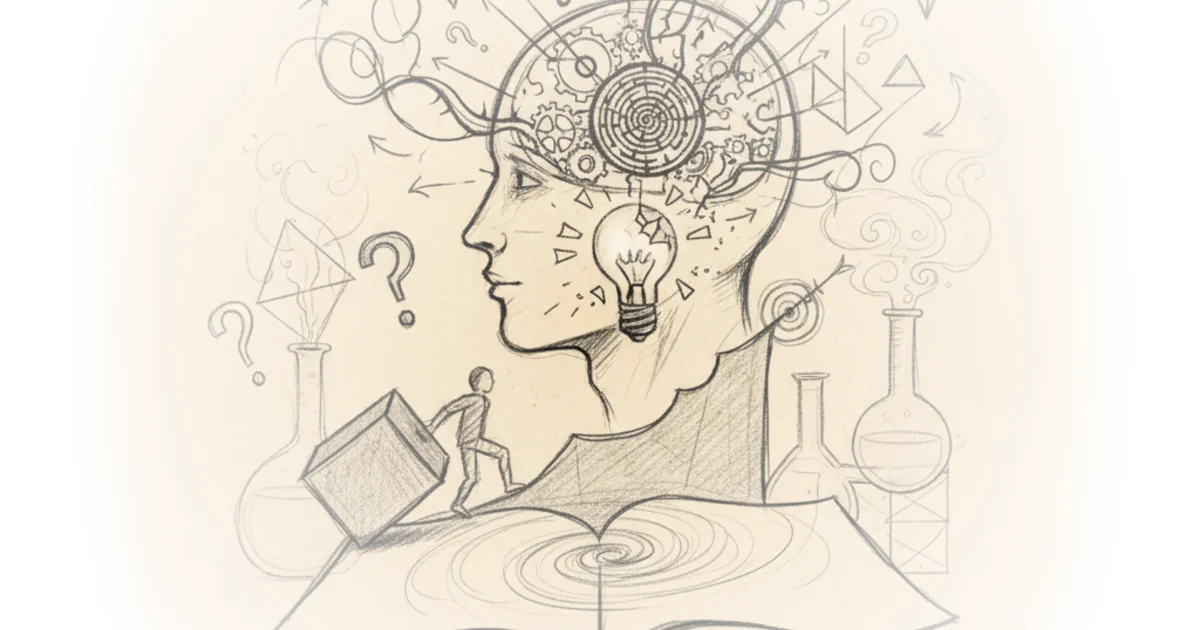
The Two Characters in Your Head
Muller introduces what psychologists call System 1 and System 2, but reframes them as characters Gun and Drew. This isn't just cute branding — it's a useful heuristic for understanding why we make the errors we make.
"Gun is incredibly quick," Muller writes, "which he needs to be since he's constantly processing copious amounts of information coming in through your senses." Gun works automatically, without conscious awareness. He fills gaps in reading, makes assumptions, and jumps to conclusions. Meanwhile, "Drew is lazy it takes effort to get Drew to do anything and he is slow but he's the careful one capable of catching and fixing mistakes."
The bat and ball error makes sense now: it's Gun who first perceives the key pieces of information — together the bat costs $110, the bat costs a dollar more than the ball — so "the ball costs 10 cents" immediately had an answer that he blurted out automatically. Meanwhile, "Drew without being consciously aware that the answer came from Gun endorsed the idea without checking it after all the answer sounded reasonable and Drew is lazy."
This lands because it explains something universal — why we make obvious errors — through a lens that's actually quite illuminating. Most self-help writing about thinking either mocks people for being stupid or offers vague advice like "think harder." Muller offers something structural: our brains are literally designed to avoid effort.
The Working Memory Bottleneck
One of the piece's most useful insights involves working memory. Muller notes that Drew exists entirely within working memory, so he's only capable of holding "four or five novel things in mind at a time." This isn't metaphor — it's a hard constraint from psychology.
"This is perhaps one of the best known findings from psychology," Muller writes, "that our capacity to hold and manipulate novel information is incredibly limited." The process of grouping things together according to prior knowledge is called chunking, and you can actually hold four or five chunks in working memory at once. Learning, then, is "the process of building more and bigger chunks by storing and further connecting information in long-term memory essentially passing off tasks from Drew to Gun."
This matters because it reframes learning as a literal transfer of cognitive load — from conscious effort to automatic processing. The implication is that expertise isn't about thinking harder; it's about creating enough patterns in long-term memory that short-term working memory doesn't need to hold as much.
The Font Experiment
But the piece's most compelling evidence involves something unexpected: font readability.
"When they gave out a clearly printed test including the bat and ball question to incoming college students 85% got at least one wrong," Muller reports, "but when they printed the test in a hard-to-read font with poor contrast the error rate dropped to 35%." A harder-to-read test resulted in more correct answers. The explanation is simple: since Gun can't quickly jump to an answer, he hands off the task to Drew who then invests the required mental effort to reason his way to the correct answer.
When something is confusing, Drew works harder — and when Drew works harder, you're more likely to reach the right answer.
This counter-intuitive finding has major implications. It suggests that making things easier to read might actually make us less likely to think correctly. The easy interface we design for learning might be producing lower-quality thinking.
The Advertising Upside
Muller extends this insight beyond education into advertising, using the UN campaign in Australia as his example:
"Gun is skilled at filtering it out it's automatic if I just saw another Insurance ad I never would have given it a second thought but something that doesn't make sense that's something Gun can't deal with so he hands it off to Drew." The confusing UN ads — unstress, unhassle, undrive through — work because they force the reader to engage. They make Drew work harder, and that effort translates into recall and processing.
This is a genuinely smart observation: confusing advertising isn't a bug in strategy, it's a feature. The old model of clear, easy-to-understand messaging may actually produce less engagement than deliberately difficult formats.
What This Means for Learning
The piece's conclusion draws the obvious implication:
"If you really want to learn and get better at anything have any chance of becoming an expert you have to be willing to be uncomfortable because thinking takes effort it involves fighting through confusion and for most of us that's at least somewhat unpleasant."
This is the thesis restated, but now it's grounded in all the evidence Muller has accumulated. The discomfort isn't a bug — it's the mechanism that signals we're actually doing real cognitive work.
Counterpoints
Critics might note that while the font study is compelling, it's also a single finding replicated in specific contexts. The leap to claiming that all education should be harder may overgeneralize from limited data. Additionally, equating learning with discomfort oversimplifies what are often more nuanced cognitive states — flow state, for instance, involves effortless engagement rather than effortful struggle.
Bottom Line
Muller's strongest argument is structural: thinking is uncomfortable because our brains are designed to automate as much as possible, and that design feature explains why we make errors we'd otherwise attribute to stupidity. His biggest vulnerability is strategic — the prescriptive leap from "thinking is hard" to "you should make things harder" is plausible but not inevitable. The piece succeeds because it doesn't just describe how we think; it gives us characters (Gun and Drew) that help us understand why our thinking fails in specific, predictable ways.
The takeaway isn't that you need more effort — it's that understanding which system is doing the work explains most of the bad decisions we make.