This piece from Asimov Press does something rare: it takes the humble earthworm and uses it as a lens to examine the most urgent ethical frontier of our time—the definition of consciousness itself. While most science reporting treats sentience as a binary switch, Asimov Press argues we are actually navigating a vast, murky gradient where the stakes range from the welfare of farm animals to the care of comatose humans and the ethics of artificial intelligence.
The Darwinian Pivot
The article opens by revisiting a moment in 1837 when Charles Darwin, already famous, chose to lecture on worms to the Geological Society of London. The author notes that while the Society expected grand geological theories, Darwin was "deeply fascinated by worms." This was not a trivial pursuit; it culminated in his final book, which Asimov Press highlights as a foundational text for understanding "bioturbation," or the reworking of soils by organisms. But the real breakthrough was Darwin's willingness to attribute an inner life to such a simple creature.
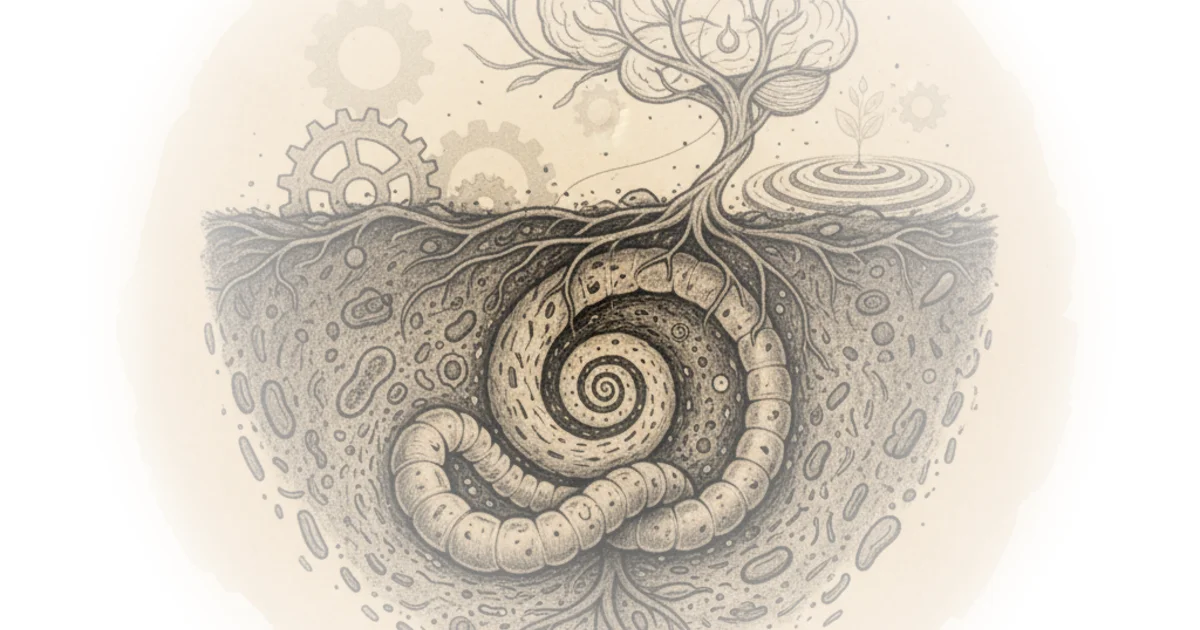
Asimov Press writes, "Judging by their eagerness for certain kinds of food, they must enjoy the pleasure of eating. Their sexual passion is strong enough to overcome for a time their dread of light." This observation was radical for its time, moving beyond anecdote to suggest that "attention indicates the presence of a mind of some kind." The author frames Darwin not just as a biologist, but as a forerunner to modern "borderline sentience" research. The shift in motivation is crucial: whereas Darwin was driven by curiosity, today's scientists are driven by the urgent need to "avoid causing gratuitous suffering in contexts such as agriculture and research."
Sentience is the combination of subjective experience and the capacity to evaluate sensation as good or bad.
The piece effectively traces how this scientific curiosity has translated into policy. In the UK, for instance, the recognition of octopuses and decapod crustaceans as "sentient" has legally mandated a ban on boiling crabs and lobsters alive. This is a tangible outcome of the abstract question: does this creature feel pain? The author argues that understanding these boundaries is not just about animals; it directly impacts how we treat humans in "prolonged disorders of consciousness," where up to a quarter of patients may retain awareness despite appearing unresponsive.
Defining the Indefinable
The core of the argument rests on a precise, two-part definition of sentience that separates it from mere consciousness. Asimov Press explains that sentience is a combination of "consciousness and valence." Consciousness is the subjective point of view—"something it is like to be that organism"—while valence is the capacity to feel that experience as pleasant or unpleasant.
The author illustrates this distinction with a compelling example: seeing a brick wall might be a conscious experience, but it lacks "significant valence" because it feels neither good nor bad. In contrast, a toothache or the feeling of quenching thirst are deeply valenced. This distinction matters because, as the text notes, "many (some would say all) practical decisions are ultimately about increasing positive experiences and decreasing negative ones." This framing elevates the discussion from philosophical musing to a practical guide for ethics. If we cannot determine if an entity has valenced experience, we cannot ethically decide whether to use it for research or discard it.
However, the article acknowledges the difficulty of this task. The spectrum of "borderline cases" is vast, ranging from human infants and brain-injured patients to insects, fish, and even lab-grown neural organoids. The author points out that while there is a consensus on mammals and birds, the debate rages elsewhere. Some scientists, like Edmund Rolls, restrict sentience to organisms with primate-like prefrontal cortices, while others, like Arthur Reber, argue even bacteria might be sentient. This divergence creates a "formidable challenge" for policymakers and ethicists who need clear lines to draw.
The Limits of Behavior
Perhaps the most sobering section of the piece addresses the failure of behavioral evidence. We often assume that if an animal pulls its paw away from a hot surface, it feels pain. But Asimov Press warns that "behaviors that provide evidence of sentience in creatures that are assumed to be capable of it can provide poor or misleading evidence in certain contexts." The author cites the "rat-grimace scale," a tool used to assess pain in rats by their facial expressions. The problem? These are reflexes. A nervous system can produce a grimace without the underlying experience of pain.
The article drives this point home with the tragic case of Kate Bainbridge, a woman diagnosed as being in a persistent vegetative state who later revealed she had been fully aware and terrified during painful medical procedures. "She reported that she had remained aware, deeply scared and uncomfortable, through much of the time that she was believed to be 'unconscious'." This story underscores the danger of relying on outward signs. A sleepwalker can navigate a house and make a snack without any awareness, just as a conscious person might. The ability to act does not prove the ability to feel.
Critics might note that the article leans heavily on the potential for AI and neural organoids to be sentient, a claim that remains highly speculative and controversial in the scientific community. While the author cites arguments that transformer networks satisfy indicators of consciousness, many neuroscientists argue that simulating the structure of a brain is not the same as generating the subjective experience of one. Nevertheless, the author's inclusion of these "non-human non-animals" forces us to confront a future where the definition of life and suffering may need to expand beyond biology.
Bottom Line
Asimov Press delivers a masterful synthesis of history, neuroscience, and ethics, arguing that the question of "what it's like to be a worm" is actually the key to how we treat the most vulnerable members of our own species. The piece's greatest strength is its refusal to accept behavioral reflexes as proof of feeling, a stance that demands we look deeper into the neural machinery of pain. Its vulnerability lies in the sheer uncertainty of the frontier; while the tools to map the brain are advancing rapidly, the fundamental mystery of subjective experience remains unsolved, leaving us to navigate a world where we might be causing suffering we cannot yet see.