The Hated One does something rare in tech journalism: instead of asking how secure email works, they ask why it matters when the political climate shifts. The piece reframes privacy not as a luxury for the paranoid, but as a survival mechanism rooted in Germany's recent history of state surveillance. This is not a product review; it is a warning that today's harmless data could be tomorrow's evidence of dissent.
The German Lens on Surveillance
The interview opens by grounding the entire conversation in historical trauma. The Hated One highlights Hannah's explanation that for Germans, privacy is not an abstract concept but a lesson learned from the Stasi and the 1980s census protests. "We as Germans are very very privacy centric because there's so much evidence from history how it can turn bad and for us it's recent history," the author notes, quoting the Tuta representative. This framing is crucial because it moves the debate from technical specs to human rights. The argument suggests that without this historical memory, users might not grasp the urgency of encryption.
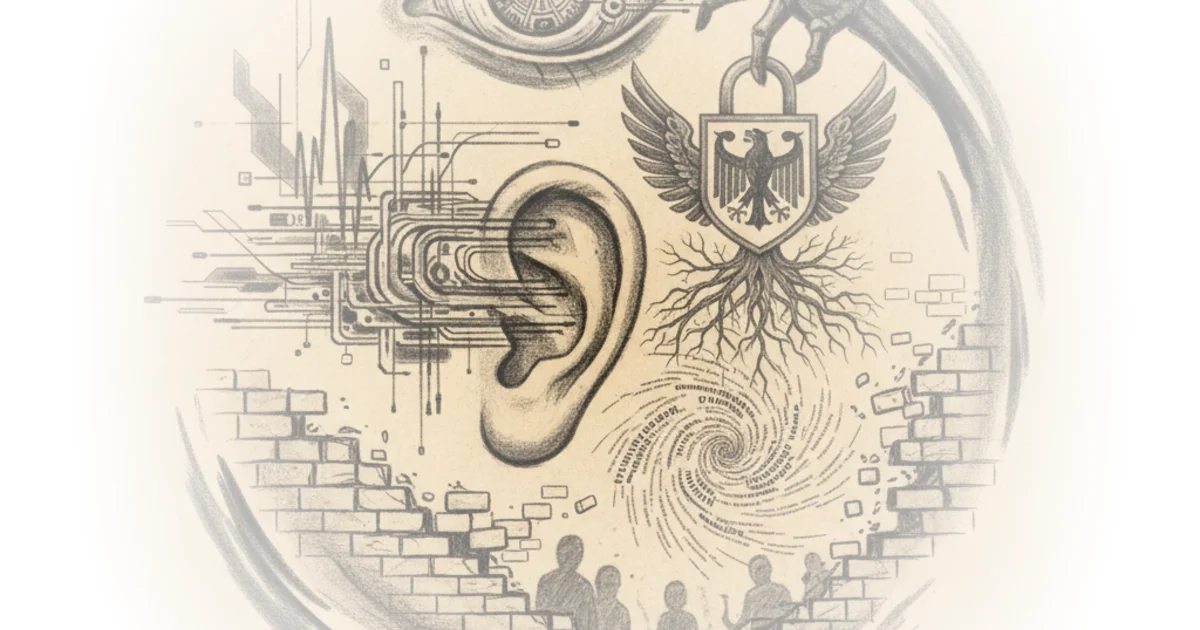
The Hated One effectively contrasts the labor-intensive spying of the past with the automated efficiency of the present. "Just imagine they had the tools that tech offers today," the author paraphrases, pointing out that agencies like the National Security Agency no longer need bugs in apartments; they simply tap phones and scrape data for keywords. This shift from targeted surveillance to mass data harvesting is the piece's central tension. Critics might note that the comparison to the Stasi can feel hyperbolic to readers in less repressive democracies, but the author uses it to underscore a specific vulnerability: data collected today can be weaponized later.
The Quantum Threat and Harvesting Now
The coverage then pivots to a technical but urgent threat: quantum computing. The Hated One explains that current encryption standards are already obsolete for long-term security because powerful actors are hoarding encrypted data today to crack it later. "Asymmetric encryption, as we use it in email, will be pointless if you don't have quantum safe encryption," the author writes, quoting the interviewee. This is a compelling argument for proactive security. The piece argues that waiting for quantum computers to arrive is a fatal error because the harvesting is happening right now.
"The NSA, the FBI, they are already harvesting encrypted data today in the hopes of being able to decrypt it in the future."
The Hated One connects this technical reality to political instability. The argument is that information deemed harmless today—sexual orientation, religious views, political leanings—could become dangerous if a totalitarian regime takes power. This forward-thinking approach is presented as Tuta's unique selling point. The author notes that the company refuses to take venture capital or run ads, ensuring they are not beholden to investors who might demand data access. "We prefer to take the difficult path," the author quotes, emphasizing the business model's integrity. A counterargument worth considering is that this anti-growth stance limits the company's ability to compete with free, ad-supported giants, potentially keeping privacy a niche product for the few.
The Dilemma of Backdoors and Legal Orders
The most gripping section addresses the inevitable conflict between encryption and government mandates. The Hated One brings up the UK's order to Apple to create a backdoor, using it as a case study for what Tuta would face. The author highlights the transparency of Tuta's open-source code as a defense mechanism. "Our encryption is open source... should we get such a notice, we couldn't simply change the code and snoop into the data because people would notice," the author paraphrases the interviewee. This technical transparency is framed as a political shield.
However, the author also captures the brutal reality of legal defiance. Hannah admits that while they would fight legally, the ultimate consequence could be shutting down service in a specific country to preserve the global integrity of the network. "It's easy in theory to say... we would never do it," the author quotes, acknowledging the difficulty of the choice. The piece does not offer a fantasy solution but presents the stark trade-off: defy the law and risk closure, or comply and destroy the product's value. The Hated One concludes that the current legal landscape in Germany offers some protection against foreign orders, but warns that domestic laws could change, making the battle for privacy a continuous struggle.
Bottom Line
The strongest element of this piece is its refusal to treat encryption as a mere feature, instead presenting it as a necessary defense against future political shifts. The biggest vulnerability is the assumption that open-source transparency alone can withstand state-level legal coercion. Readers should watch for how Tuta navigates the coming wave of "chat control" legislation in Europe, where the gap between technical security and legal compliance will be tested.