In an era obsessed with the final chip, Asianometry shifts the gaze to the unglamorous foundation upon which the entire digital economy rests: the silicon wafer. This piece argues that the true marvel of modern technology isn't just the logic gates we design, but the decades of obsessive engineering required to turn ordinary sand into a substrate of near-perfect purity. For the busy executive, the takeaway is stark: the bottleneck of the future may not be design, but the physical limits of material science and the fragile geography of supply chains.
From Sand to Crystal
Asianometry begins by dismantling the romantic notion that silicon is a rare, exotic resource. "Silicon is probably the single most studied element on earth over the past 70 years," they write, noting that engineers have done more to cut, etch, and polish this "plentiful shiny rock" than almost anything else. The author's framing is effective because it grounds high-tech abstraction in tangible, brutal reality. The journey starts not in a clean room, but in a mine in North Carolina or Norway, where the world's purest quartz is extracted. Yet, even the best natural sources are insufficient. "Three nines of purity is still too dirty and disgusting for semiconductors," Asianometry asserts, highlighting the immense gap between geological abundance and industrial necessity.
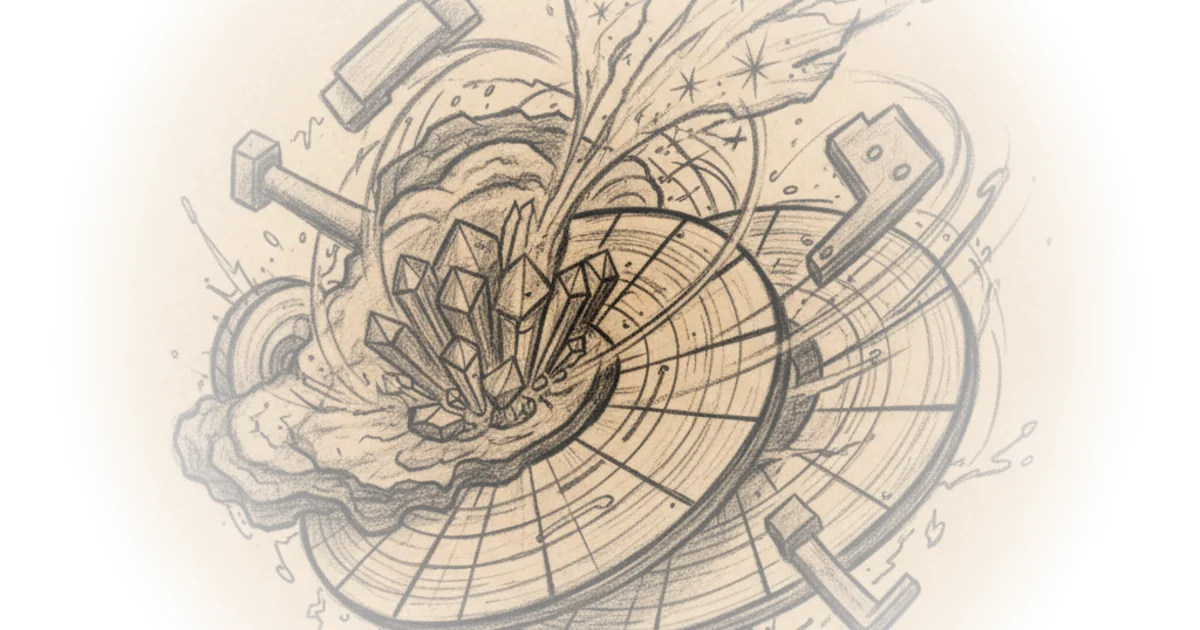
The commentary here is particularly sharp when detailing the chemical violence required to refine the material. The process involves heating silica with carbon to create metallurgical grade silicon, which is then subjected to hydrochloric acid and vapor deposition to reach the "eleven nines" purity required for integrated circuits. Asianometry notes that the standard Siemens method, while effective, is economically punishing: "You get back about 30 percent of the silicon you put in while consuming a lot of power." This inefficiency creates a fascinating divergence in the market. While the semiconductor industry accepts this cost for purity, the solar industry, driven by fierce competition with fossil fuels, cannot. The author points out that for solar, "it does not make financial sense to produce solar grade polysilicon with processes so strict on purity," forcing a different, less refined technological path.
The semiconductor industry is not only a technical marvel; it is also a capitalist business. Plenty of methods are technically possible, but it has to also be financially better than whatever was done before in order to be adopted.
The Physics of Perfection
The piece then pivots to the crystal growth phase, a process that relies on a 1916 accident involving a Polish metallurgist and a pen. Asianometry recounts how Jan Czochralski accidentally dipped his pen into molten tin, pulling out a single, continuous thread of crystal. This historical anecdote serves to humanize the highly technical Czochralski (CZ) method, which remains the industry standard for 95% of crystal production. The author explains that the process is a delicate dance of temperature and tension: "You wait until a small portion of the crystal starts to melt too, then you pull the seed out of the melt while also twisting it."
What makes this section compelling is the emphasis on the scaling challenges. What began as a small, hand-held crystal has evolved into massive ingots requiring machines that weigh over 400 kilograms and utilize magnetic fields to maintain quality control. Asianometry writes, "Decades were spent researching and honing the method to get crystals as free as possible of impurities and dislocations." This highlights a critical, often overlooked truth: progress in this sector is not linear; it is the result of relentless, incremental refinement over generations. The transition from 150mm to 300mm wafers took a decade of unprecedented coordination, and the industry is now deadlocked on the move to 450mm. While chipmakers like TSMC and Intel see the economic upside of larger surface areas, suppliers like Shin-Etsu and Applied Materials resist due to the risks of lower yields and the massive capital expenditure required for retooling.
Critics might note that the author's focus on the technical hurdles of the 450mm transition underplays the geopolitical urgency. With supply chains concentrated in Japan, where Shin-Etsu and Sumco control 60% of the market, the risk of a single earthquake halting global production is a strategic vulnerability that goes beyond simple economics. Asianometry touches on this, noting that "every time it happens at a serious level, supply chains grind to a halt," but the piece stops short of analyzing the potential for diversification or the strategic implications of this concentration.
Why Silicon Wins
Finally, the commentary addresses the question of alternatives. Why silicon? Why not germanium, which was used in the earliest transistors? Asianometry provides a clear, decisive answer rooted in physics and chemistry. Germanium wafers had a "narrow band gap," meaning they failed at temperatures as low as 90 degrees Celsius. Silicon, by contrast, offers a wider band gap and reacts with oxygen to create a stable, insulating layer of silicon dioxide. "This insulating layer is chemically stable, not water-soluble, and helps protect the underlying electronics," the author explains. This chemical property is not just a convenience; it is the enabler of modern photolithography. Furthermore, silicon is non-toxic and ten times cheaper than germanium.
The piece concludes by reinforcing the idea that the wafer is the ultimate constraint. "The wafer industry needs some love for those achievements," Asianometry writes, urging readers to appreciate the "decades of research and stunning engineering" hidden beneath every microchip. The argument lands because it reframes the semiconductor shortage not as a failure of logistics alone, but as a testament to the extreme difficulty of manufacturing perfection at scale.
Bottom Line
Asianometry's strongest argument is the reframing of the silicon wafer from a commodity to a masterpiece of material science, revealing that the true bottleneck of the digital age lies in the physics of purity and the economics of yield. The piece's biggest vulnerability is its relative silence on the geopolitical fragility of a supply chain dominated by a single nation, a risk that could outweigh the technical challenges of scaling to 450mm wafers. For the strategic thinker, the lesson is clear: the future of technology depends as much on the quality of sand and the stability of the earth beneath our feet as it does on the brilliance of our code.