Kings and Generals does not merely recount history; they reconstruct the precise, agonizing timeline of collapse, arguing that the Eastern Front's tragedy was not a sudden explosion but a four-year erosion of state capacity that began long before the first shot of World War II was fired. By anchoring their narrative to the exact calendar dates of 84 years ago, the channel forces a confrontation with the sheer speed at which empires can dissolve when military failure meets political fracture. This is not just a war story; it is a forensic analysis of how a superpower dismantles itself from the inside out.
The Anatomy of a Collapse
The coverage begins by establishing the grim reality of 1917, where the Russian Empire was already bleeding out under the weight of a war it could not win. Kings and Generals writes, "Under Thesar, Russia struggles to hold the central powers back. In late 1915, the Zar took personal command of the army against the recommendation of his closest advisers." This decision is framed not as a moment of leadership, but as the catalyst for a cascade of failures. The channel emphasizes that the Tsar's tenure as commander-in-chief was defined by "devastating defeats" that pushed the front line deep into imperial territory, leaving the nation's infrastructure and morale in ruins.
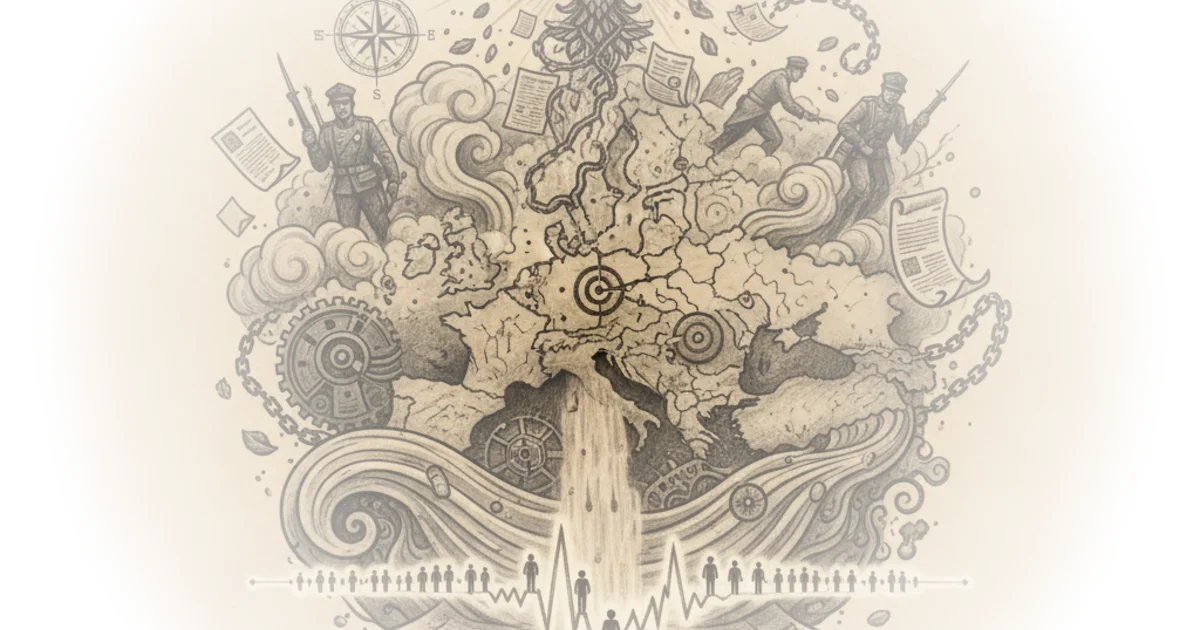
The narrative then pivots to the political vacuum that followed. As Kings and Generals puts it, "The year is 1917. World War I has been raging since the summer of 1914... In March of 1917, protests across the Russian Empire broke out." The commentary highlights the chaotic duality of power that emerged: a Provisional Government trying to maintain order and honor international commitments, and the Petrograd Soviet, a council of soldiers and workers that held the real leverage. The channel notes that the Soviet "positioned itself as a sort of unasked for advisory committee," yet circumstances dictated that the government had to take them seriously. This creates a compelling picture of a state paralyzed by internal contradiction, where loyalty to the nation was superseded by loyalty to the unit.
Power was now in the hands of the provisional government, which had successfully transferred control of the empire from the Zars to themselves in a matter of days, yet the capital was never quite at peace.
Critics might argue that the focus on the Tsar's personal command decisions overlooks the deeper structural economic failures that doomed the war effort regardless of leadership. However, Kings and Generals effectively uses the military leadership crisis to illustrate the broader institutional rot. The channel argues that the Provisional Government's attempt to launch a summer offensive was a desperate gamble to prove its authority, a move that ultimately accelerated the collapse. "The offensive would feature the 7th and 11th armies... thrust across the front line," yet the channel points out that "the fundamental problems of the Russian army had not been addressed." When the Central Powers counterattacked, the Russian lines shattered, proving that the political revolution had not solved the military crisis.
The Geopolitical Miscalculation
The coverage takes a sharp turn to analyze the strategic blunders of the Central Powers, particularly Germany. While the fall of Russia seemed like a total victory, Kings and Generals argues it was a pyrrhic triumph that sowed the seeds for their own defeat. The channel writes, "Eventually, the greed of the maximalists won out. Russia would be effectively dismembered." This decision to impose a harsh peace via the Treaty of Brest-Litovsk is presented as a critical error in judgment. The channel explains that the occupied territories required over a million soldiers to garrison, a force that could not be deployed to the Western Front as planned.
Furthermore, the economic expectations of the treaty were shattered. "Food insecurity had plagued Germany and Austria-Hungary since the beginning of the war. It had been hoped that the gains in the east would alleviate this. These hopes were misplaced." The channel's analysis here is particularly sharp: the devastation of the Russian territories meant no meaningful exports could happen overnight. This failure to secure resources, combined with the inability to redeploy troops, left the German army exhausted and overextended just as American reinforcements began to flood the Western Front.
The narrative then details the German Spring Offensive of 1918, known as the Michael Offensive. Kings and Generals notes that while the attack achieved initial tactical success, "it was only tactical in nature." The channel highlights the unsustainable casualty disparity: the German army suffered massive losses with no way to replace them, while the Allies had "ready reserves" and a steady stream of American troops arriving at a rate of 10,000 per day. "The disparity in forces continued to balloon," the channel observes, leading to a situation where German troops were displaying "remarkable indiscipline" and the peace movement at home became impossible to ignore.
Defeating Russia had not proven to be a solve for the problems in the west. German troops were displaying remarkable in discipline... The peace movement at home had started to become hard to ignore.
A counterargument worth considering is whether Germany had any viable alternative to the harsh treaty; perhaps a milder peace would have invited continued Russian resistance rather than securing a stable buffer. Kings and Generals implicitly acknowledges this by noting the internal German infighting between those who wanted concessions and the maximalists who wanted annexation. The channel suggests that the maximalist victory was driven by short-term greed rather than long-term strategic stability, a lesson in how military victories can be squandered by political overreach.
The Bottom Line
Kings and Generals delivers a masterclass in connecting military tactics to geopolitical strategy, demonstrating how the Treaty of Brest-Litovsk was not a triumph but a fatal miscalculation that drained German resources and morale. The strongest part of this argument is the detailed tracing of how internal Russian fragmentation directly enabled a German overextension that the Western Front could not sustain. The biggest vulnerability in the narrative is the rapid pacing, which occasionally glosses over the complex social dynamics of the White movement in favor of the high-level strategic chess game. Readers should watch for how this prelude sets the stage for the inevitable Allied intervention, where the failure of diplomacy leads to a prolonged and brutal civil war that reshapes the 20th century.