Adam Tooze dismantles a comforting but dangerous myth: that the United States today is merely a mirror image of Edwardian Britain, doomed to repeat the same imperial overreach. While popular discourse fixates on a "Thucydides trap" between a declining hegemon and a rising challenger, Tooze argues the economic mechanics are inverted, creating a unique and unstable dynamic that history books have not prepared us for.
The Great Inversion
The core of Tooze's argument rests on a startling reversal of capital flows. In the early 20th century, the British Empire was the world's primary lender, pouring wealth "downhill" to developing nations. Today, the United States is the world's primary borrower, absorbing capital from emerging markets like China. "In the 21st century, the 'richest country' is a net borrower not a lender - the opposite of Edwardian Britain's position," Tooze writes. This distinction is not merely academic; it fundamentally alters the nature of global tension.
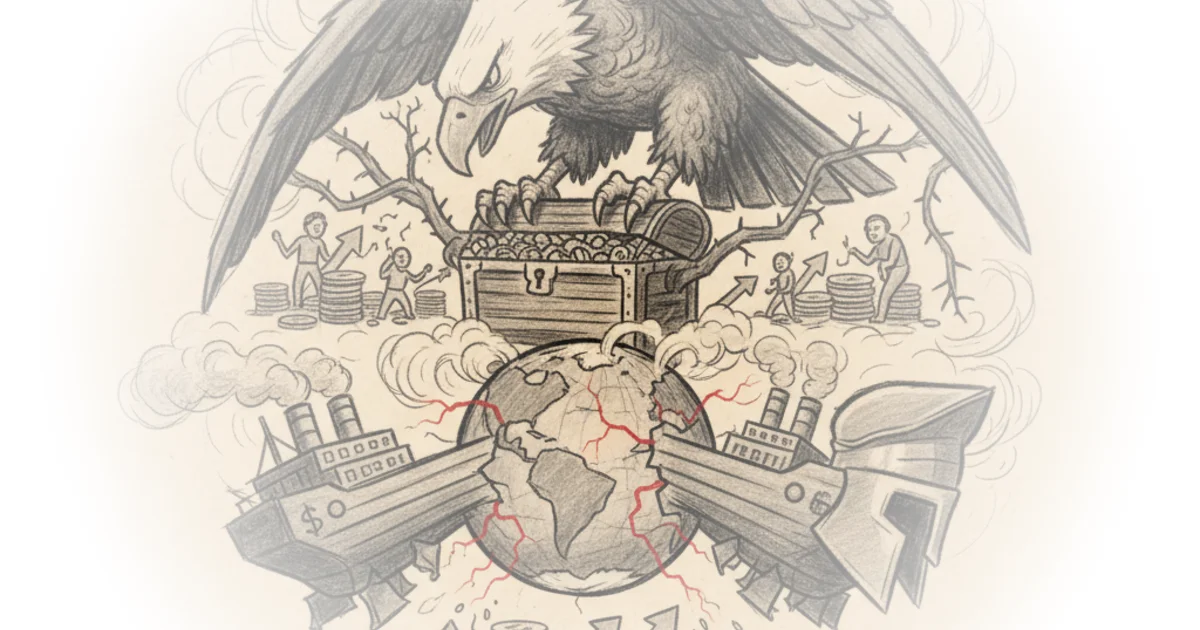
The prevailing narrative, often echoed by commentators citing Michael Pettis and Klein, suggests that domestic inequality in surplus countries forces them to export capital, creating friction with the consumer nation. Tooze acknowledges this theory but points out its fatal flaw when applied to the current era: it assumes the US is the aggressor exporting capital, when in reality, it is the sink for global savings. "In the 21st century, net investment is flowing uphill: from middle income... towards the apex, which is Wall Street and the high-income USA," he notes. This reframing forces a re-evaluation of who holds the leverage in the global system.
In the Hobson-Lenin thesis, It was the rivalrous bidding by competing rich countries to drive imperial development that was the source of international tension.
Tooze argues that this specific type of rivalry—rich nations competing to fund development abroad—is simply not happening now. China is the only major player exporting capital on a massive scale, yet it lacks the global reach Britain once had. The comparison to the Boer War, which inspired J.A. Hobson's original critique of imperialism, highlights the difference in scale. While British investors financed railways in the US and cattle ranches in Texas, the sheer volume of British capital export was unmatched in history. "Over the forty-plus years between 1870 and 1914, the UK - the incumbent hegemon, not the up and coming challenger - was a larger capital exporter in relative terms, than Japan and China have been since the 2000s," Tooze states, citing Bank of England data.
The Hard-Working Hegemon
Perhaps the most provocative claim in the piece is the characterization of Edwardian Britain not as an extractive parasite, but as a "hard-working hegemon." Tooze challenges the notion that the British Empire survived solely on plunder. Instead, it ran a trade deficit, importing goods from competitors while earning massive returns on its vast portfolio of foreign investments. "From the point of view of hegemonic stability it is hard to think of a better mix: a consistent and large 'downhill' flow of capital, widely spread across the periphery of the world economy," he writes.
This model allowed Britain to maintain high living standards for its working class through cheap imports, funded by the yields of its global assets. "In many years Victorian and Edwardian Britain's surplus on property income was larger than the overall current balance, meaning that new investment abroad was more than paid for by the proceeds of existing investment," Tooze explains. The system was self-renewing, a "wealth endowment" that stabilized the global economy even as domestic inequality rose.
Critics might argue that this rosy picture ignores the violence inherent in maintaining such a vast empire, particularly in colonies like India and Africa where extraction was direct and brutal. Tooze admits that "naked imperial exploitation contributed in some part to this advantage," but insists the macroeconomic engine was driven by profitable private investment rather than state-led looting. The collapse of this system, he suggests, was not inevitable due to economic failure, but rather a result of the "double movement" described by Karl Polanyi, where social backlash against globalization and immigration tore the fabric of the international order apart.
The liberal globalization model of the early 20th century did not last. Why not? ... The very success of globalization in restructuring the world economy produced a backlash from those group who lost out in the distributional struggle.
The danger today, Tooze implies, is that we are trying to apply a 1914 playbook to a 2024 reality. The US is not facing a rival bidding for influence in the periphery; it is drowning in capital inflows that fuel asset bubbles and domestic inequality. The "Thucydides trap" narrative distracts from the real structural flaw: a global system where the center cannot sustain the weight of the periphery's savings.
Bottom Line
Tooze's most powerful contribution is exposing the asymmetry of the current crisis: the US is not the imperialist lender of the past, but a debtor nation absorbing the world's excess capital, a position that creates a different, more fragile kind of instability. The argument's greatest vulnerability lies in its reliance on historical data that may not fully capture the geopolitical volatility of a nuclear-armed, digital-age rivalry with China. Readers should watch for how the administration navigates this inverted flow of capital without triggering the very protectionist backlash that destroyed the Edwardian order.