Britain's geographical position has always been both its greatest asset and most dangerous vulnerability. Sitting in the North Sea, uncomfortably close to the European continent, the island found itself surrounded by powers that could project force across land while Britain relied entirely on naval supremacy for survival.
The core problem was simple: Britain needed access to its empire—its oil supplies, food imports, and trade routes—to survive. Germany, France, and later Russia all wanted to close off these sea lanes. The Mediterranean passages through the Suez Canal required cooperation from Spain, France, Italy, and Turkey. When France fell and Italy entered the war, Britain faced a nightmare.
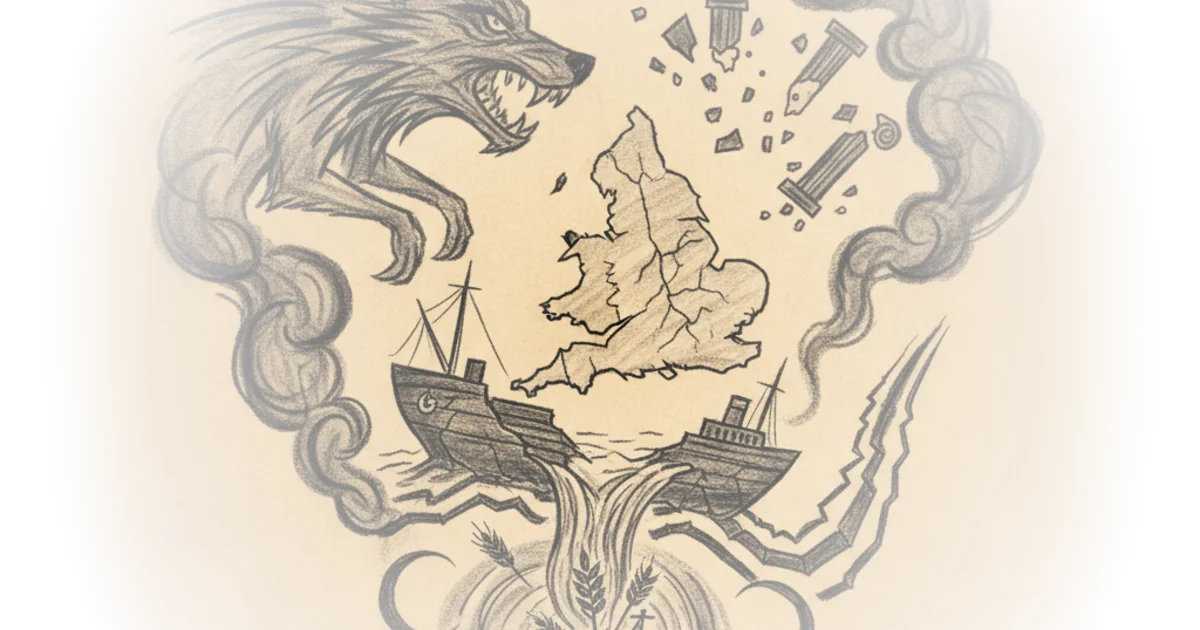
The Strategic Catastrophe of 1940
By 1940, Britain found itself in genuine peril. Germany had already violated the Versailles Treaty by remilitarizing the Rhineland. Then came the takeovers: Austria, the Sudetenland, all of Czechoslovakia in 1939. These weren't random aggression—they were calculated resource grabs. Hitler needed not just the Rhineland's industrial capacity but also the oil fields of Romania and Poland to fuel his war machine.
When Russia and Germany divided Poland between them in 1939, Britain honored its alliance with Poland, triggering World War II. The situation grew worse when Stalin swapped sides and began coordinating with Britain against Germany—now facing one continental power instead of two.
Lessons from the Trenches
The generation that fought World War II had learned harsh lessons from World War I. In the first war, Britain sent young men over trenches into machine gun fire—a profligate waste of life that achieved little. The death toll was catastrophic. When World War II came, British strategists remembered this mistake.
The key lesson: never go beyond the culminating point of attack. If you push too far into enemy territory, you weaken yourself and invite counterattacks. In WWI, offensers continued for months, racking up hundreds of thousands of deaths for no gain. In WWII, Britain immediately pulled its big army off the continent after the Dunkirk evacuation—getting the French to cover their retreat while saving the British Army.
The Difference Between Wars
The diplomatic coordination in WWII was fundamentally different from WWI. In the first war, only two conferences attempted coordination among the Allies—the December 1915 and November 1916 Shanti conferences—and both failed to prevent Russia's collapse when the Romanov dynasty fell in early 1917.
By contrast, WWII saw simultaneous squeezing of Germany from all fronts—before America even entered the war. The ABC staff talks began coordinating with Atlantic conferences yielding the Atlantic Charter, which defined unconditional surrender objectives and post-war institutions. There was combined command of US and British forces, coordination between military and civil leaders, and offices in each other's capitals.
The difference was stark: Russia came to WWII with a massive army while Germany had another large army. Britain needed its own big army to fight them.
The Naval War That Almost Starved Britain
Germany's U-boat campaign almost succeeded in starving Britain of supplies. The German Navy sank terminal quantities of British trade—Britain depends not only on oil imports but roughly half its food supply. Malta, the Suez Canal, and the Mediterranean lay at the center of Italian ambitions.
The Royal Navy eventually convoyed troop transports and merchant shipping even before America entered the war—a complete reversal from WWI where they wouldn't deal with merchant marine until 1918. This shift proved crucial.
Britain learned to leverage the miracle of sea transport that gives access to the whole world, while land transport is a logistical nightmare where you can only move through countries that let you pass.
The seas gave mobility, access to theaters, markets, resources, allies, and sanctuary—making it harder for enemies to invade.
The Gallipoli Comparison
Britain tried one peripheral strategy in WWI—the Gallipoli campaign—which was miserably executed. It wasn't a joint operation between army and navy. The British Navy tried running the Dardanelles for two months without success. When Australian, New Zealand, and French troops finally landed, the Ottomans were ready with welcome parties. The invasion stalemated in three days but continued for eight months, taking 190,000 casualties with 55,000 deaths.
The Normandy landings in WWII represented everything learned from that failure: years of material buildup, coordinated disinformation to fool Germans about where landing would occur, and successful penetration into the continent.
Bottom Line
Britain's geographical position forced it into a peripheral strategy that ultimately worked. The lessons from WWI—don't send young men into machine gun fire, coordinate diplomatically before it's too late, convoy merchant shipping immediately—became the foundation of WWII success. Britain's biggest vulnerability was geography itself; its greatest strength was recognizing that vulnerability and using naval power to compensate for it.
The case study remains instructive: a country dependent on sea lanes must control those lanes absolutely, or face starvation. Britain learned this the hard way twice—and saved itself by learning.