Public Notice delivers a startling thesis: the current administration's foreign policy is not a strategic pivot, but a deliberate blueprint for national self-sabotage designed to consolidate autocratic power. By reframing the White House's new National Security Strategy as an active campaign to treat democratic allies as enemies, the piece forces a reckoning with the idea that weakening the United States is now official doctrine.
The Architecture of Alienation
The core of the argument rests on the administration's explicit shift away from the post-war liberal order. Public Notice writes, "The new White House 'National Security Strategy' announced that the Trump regime will treat the democratically elected governments of most Western European nations as adversaries of the United States." This is not a subtle diplomatic friction; it is a declared hostility toward the very nations that built the alliance system. The author argues that the administration views the rules-based order as a barrier to its own consolidation of power, noting that "it makes perfect sense for his regime to cozy up to strongmen while treating America's principal democratic allies as enemies."
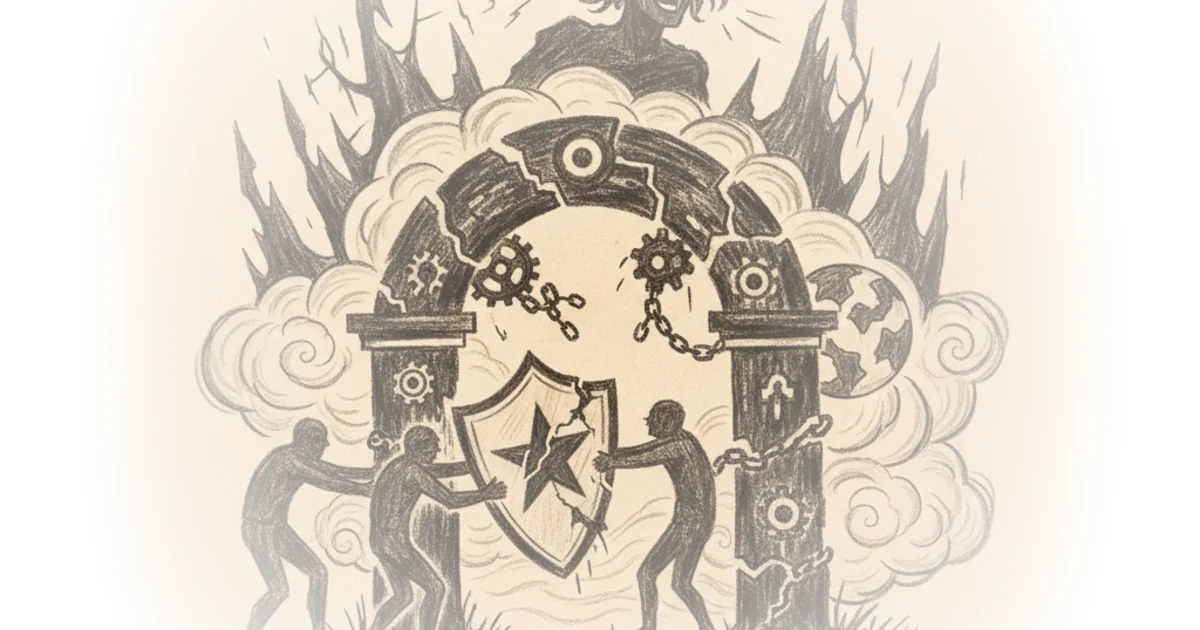
This framing is particularly potent because it connects domestic authoritarian ambitions with foreign policy outcomes. The piece highlights that the administration intends to "focus on 'cultivating resistance to Europe's current trajectory within European nations,'" which Public Notice rightly identifies as a "declaration that America will promote regime change in countries that remain governed by pro-democracy parties." The logic here is chillingly consistent: to weaken the global democratic bloc, the executive branch is actively funding and encouraging nationalist movements abroad. As Public Notice puts it, the plan is to "build a new core of allies, comprised largely of those European nations that have elected highly nationalist (and in many cases, pro-Russian) governments, such as Hungary."
Critics might argue that this interpretation overstates the coherence of the administration's strategy, suggesting it is merely transactional chaos rather than a master plan. However, the specific targeting of institutions like the European Union and NATO suggests a level of intent that goes beyond mere incompetence. The article draws a sharp parallel to historical precedents, noting that the administration's actions mirror the goals of "Finlandization," where a smaller state is forced to align its foreign policy with a powerful neighbor, effectively neutralizing its sovereignty. Here, the US is attempting to Finlandize its own allies.
Weakening allies, strengthening adversaries is not a bug of this strategy; it is the entire feature.
The Human and Economic Cost of Isolation
The commentary extends beyond geopolitics to the tangible human and economic consequences of this isolationism. Public Notice argues that the administration's rhetoric regarding immigration is not just cultural but economic suicide. The piece states that the administration's actual ambition was to "gut nearly the entire post-war immigration system," resulting in "net negative emigration" for the first time in decades. The author contends that this is a fatal miscalculation, as "immigrants have been a crucial economic engine for the US, allowing our economy to grow and be far more resilient than virtually any peer country."
The stakes are even higher in the realm of security. The article points out that pressuring Ukraine to surrender territory is not a peacekeeping measure but a strategic blunder that leaves the continent vulnerable. "A Ukraine vulnerable to a complete invasion by Russia will, inevitably, also mean a Europe vulnerable to attack," Public Notice writes. This assessment aligns with the lessons of the Budapest Memorandum, where security guarantees were ignored, leading to the erosion of trust in international agreements. By withdrawing support, the administration is effectively removing the bulwark against further aggression.
Furthermore, the piece highlights the irony of the administration's trade war. While claiming to protect American interests, the policies have empowered competitors. Public Notice observes that "the greatest beneficiary of Trump's moves to hobble the participation of American companies in international markets has been China." The administration has been reduced to "begging President Xi to resume purchases of soybeans," turning the US into a supplicant rather than a leader. This economic dependency undermines the very national security the strategy claims to protect.
The Erosion of the Rule of Law
Perhaps the most damning section of the piece is its analysis of the domestic legal landscape. Public Notice argues that the rule of law is not an abstract ideal but a critical economic asset that the administration is actively dismantling. The author writes, "The expectation that contracts will be honored and that markets will be regulated in a predictable and largely corruption-free manner has given America a massive competitive advantage over autocratic nations." By undermining this, the administration is driving away the very capital that fuels American growth.
The piece details how the Department of Justice has "effectively stopped prosecuting whole categories of financial corruption" and how the president has "made a mockery of the nation's legal system by openly selling pardons." This creates a system where "the interests of Trump himself determine winners and losers." The author warns that when the rule of law is displaced by arbitrary rule, "investors and companies flee to more stable environs as the economy declines." This is not just political rhetoric; it is a description of a capital flight scenario that could cripple the US economy for a generation.
The administration's interference in media markets, specifically the push to transform CNN into a clone of Fox News, further illustrates this trend. Public Notice notes that the president "relies on the prospect of replacing the infrastructure of regulatory and law enforcement agencies" with a system of direct political meddling. This mirrors the dynamics seen in other authoritarian regimes where the state apparatus is weaponized to silence dissent and reward loyalty.
When the rule of law in a country is displaced by arbitrary and unpredictable authoritarian rule, the results are predictable: investors and companies flee to more stable environs as the economy declines.
Bottom Line
Public Notice makes a compelling case that the administration's strategy is a coherent, albeit destructive, effort to dismantle the institutions that have underpinned American power for eighty years. The strongest part of the argument is the linkage between domestic authoritarianism and foreign policy isolation, showing how they are two sides of the same coin. However, the piece's greatest vulnerability is its assumption that the administration's actions are purely strategic rather than a mix of ideological fervor and transactional opportunism. Regardless of the motive, the trajectory is clear: the US is actively weakening its own position in the world, and the cost will be paid in both economic decline and human suffering. Readers should watch for how European nations respond to this deliberate alienation, as the formation of a new security architecture without US leadership is no longer a hypothetical but an emerging reality.