Most historical narratives treat the Roman legions as an unstoppable infantry juggernaut, but this documentary by Kings and Generals flips the script to reveal a military machine that evolved by admitting its own infantry-centric limitations. The piece argues that Rome's survival and expansion depended less on the famous heavy infantry and more on a radical, centuries-long transformation of its cavalry from a supplementary afterthought into a lethal, specialized strike force. For the busy strategist or history buff, this is a masterclass in institutional adaptation: how an empire absorbed the tactical DNA of its enemies to build a force that could finally match the threats on its frontiers.
The Auxiliary Pivot
Kings and Generals opens by dismantling the myth of Roman invincibility, noting that "some of the worst setbacks Rome's legionary infantry faced... were inflicted by armies skilled in the traditions of cavalry warfare." This framing is crucial; it establishes that the Roman military's greatest strength was its ability to learn from defeat rather than double down on tradition. The authors detail how the early Empire relied on the auxilia—non-citizen troops drawn from former enemies—to fill the cavalry gap. They point out that while the elite alae were the "pride of the Roman auxilary," the more numerous *cohortes equitatae" functioned as a hybrid force, serving partly as military units and "partially in a support role" for policing and escort duties.
The commentary here is sharp: the Romans didn't just hire horsemen; they hired the specific ethnic groups who already possessed the cultural capital of horsemanship. As Kings and Generals writes, "Horsemen of the auxilary were instead drawn from former enemies who had been nurtured in the saddle." This is a sophisticated take on military logistics and human capital. By recruiting Germans, Thracians, and Gauls, the Empire outsourced the difficult task of training cavalrymen to those who were already experts. The authors highlight the staggering growth in these forces, noting that while infantry strength grew by a modest 28% in the first century, "the cavalry forces more than doubled from 30,000 to 65,000." This statistical pivot effectively argues that the Roman military was undergoing a structural shift from pure expansion to a complex defense of a vast perimeter, requiring mobility over brute mass.
Critics might argue that the documentary overstates the tactical independence of these units, as they remained subordinate to the legions for much of the period. However, the evidence of their increasing numbers and specialized roles suggests a genuine evolution in doctrine, not just a numerical adjustment.
"The Romans themselves were an infantry focused people... despite being formally considered supplemental to the legions mounted units were in fact becoming ever more important as the military's role changed from expansion to defense."
Engineering the Shock Troop
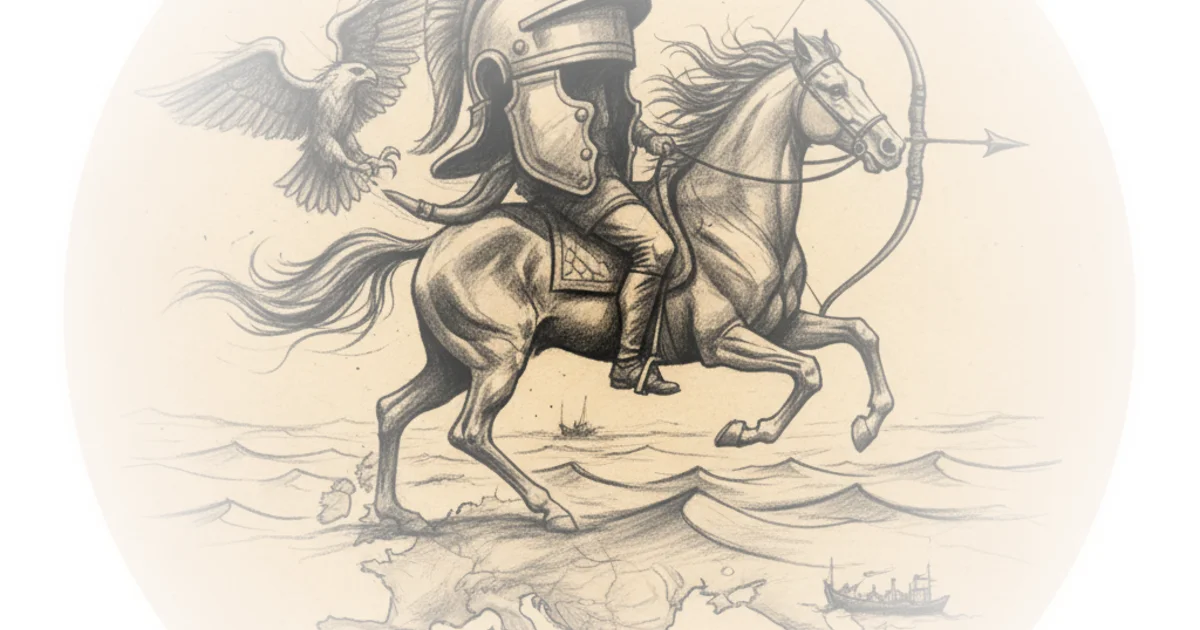
The second act of the documentary dives into the hardware, a section where Kings and Generals excels at translating archaeological ambiguity into a coherent narrative of standardization. The authors explain that while early equipment was a chaotic mix of ethnic styles, Rome's drive for uniformity eventually produced a distinct cavalry identity. They describe the evolution of the Celtic-inspired helmet, which was reinforced with rivets and cross-braces until it "formed a pointed peak" to deflect blows. Similarly, the shield evolved into the clipeus, a lighter, oval or hexagonal design suited for mounted combat.
Perhaps the most fascinating detail concerns the saddle. The authors note that the "four-horned saddle" was a technological breakthrough that allowed riders to fight without reins, using their legs to control the horse while wielding weapons. Kings and Generals writes, "This gave the horseman the ability to fight in melee with shield and spear or to throw missiles effectively whilst controlling the horse with the legs." This is a critical insight into the mechanics of ancient warfare; it explains how Roman cavalry could maintain formation and deliver shock without the stirrup, a technology that wouldn't arrive for centuries. The documentary also corrects the popular image of the warhorse, revealing that Roman mounts were "relatively small" and "stocky," similar to modern Welsh mountain ponies, prioritizing load-bearing capacity over speed.
A counterargument worth considering is whether this standardization actually happened as quickly as the narrative suggests. Archaeological finds often show a mix of equipment types persisting for decades, suggesting that the "uniform" Roman cavalry was an ideal rather than a reality in every province. Yet, the trend toward standardization remains a powerful explanation for the Empire's operational consistency.
The Rise of the Cataphract
The documentary's climax arrives with the introduction of the cataphract, the heavily armored shock cavalry that would eventually dominate the late Empire. Kings and Generals traces this evolution from a foreign threat—the Parthian and Sarmatian heavy lancers—to a Roman asset. The authors explain that the pressure from these eastern powers forced Rome to adopt their tactics, leading to the creation of units like the Contarii, named for their massive lances. The text notes that the first definitive proof of these units appears under Emperor Hadrian, who integrated them to counter the Sarmatian threat.
The authors tackle the confusing terminology of the era, distinguishing between cataphracts and the rarer clibanarii. While sources are vague, Kings and Generals posits that the difference may have been one of formation or degree of armor. They cite scholar Marius Mielczarek, who argued that "cataphracts were heavy mounted spearmen fighting in extremely close ranks... while the clibanarii were employed in shock based wedge formations." This distinction adds a layer of tactical nuance that is often lost in general histories. The documentary further illustrates the adaptability of the Roman military by noting the creation of the equites sagittarii clibanarii, units that combined heavy armor with mounted archery, a hybrid force recruited from the East to fight the Sassanid Persians.
"The distinctive protection and weaponry gave Roman cataphracts a reputation of almost invincibility which comes down to us in the sources even today."
This reputation, the authors argue, was not just psychological but rooted in the sheer physical reality of a soldier and horse both encased in iron scales. The documentary effectively uses the cataphract to illustrate the ultimate end of Roman military evolution: a shift away from the citizen-soldier ideal toward a professional, specialized force capable of meeting the most advanced threats of the ancient world on their own terms.
Bottom Line
Kings and Generals delivers a compelling argument that the Roman cavalry was not a static appendage to the legions but a dynamic, evolving force that saved the Empire from its own strategic blind spots. The piece's greatest strength is its synthesis of equipment, demographics, and tactical doctrine to show how Rome turned its enemies' strengths into its own. The only vulnerability lies in the scarcity of primary sources for the later periods, forcing the authors to rely on educated guesses regarding the clibanarii, but this is a necessary trade-off for a narrative that covers nearly three centuries of military history. For the modern reader, the lesson is clear: institutional adaptability is the true mark of a superpower, not just its initial firepower.