In an industry where failure is the default and billions are routinely incinerated by dead-end therapies, a quiet revolution is reshaping how we bet on the future of medicine. GWAS Stories reports that the most reliable predictor of a drug's success isn't a brilliant molecule or a charismatic CEO, but a simple, often overlooked fact: does human genetics back it up? This piece cuts through the noise of biotech hype to present a stark, data-driven reality that could save the industry from its own inefficiencies.
The Odds of Success
The article opens with a brutal statistic that defines the current pharmaceutical landscape: "Drug development is a risky business. Less than 1 out of 10 drugs that enter clinical development succeeds." The piece argues that this "extremely low success rate" has driven costs to unsustainable heights, forcing companies to adopt a volume-based strategy where they must fund dozens of failures to find one winner. This is a business model built on throwing money at the wall and hoping something sticks.
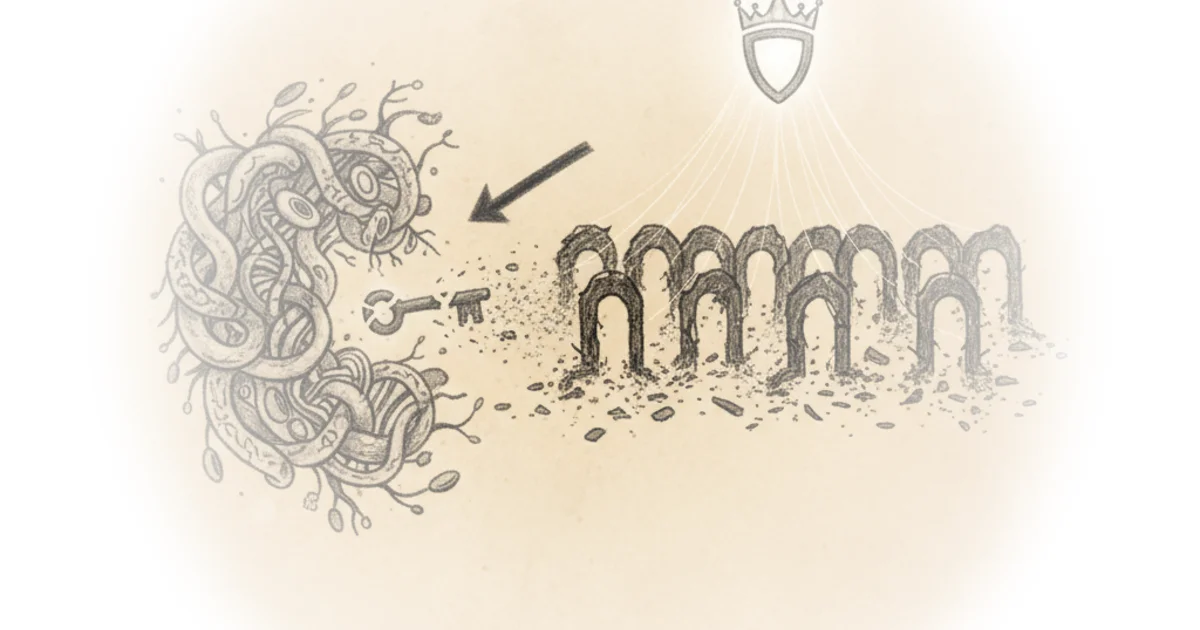
GWAS Stories highlights a pivotal shift in this dynamic, citing landmark research by Matt Nelson and colleagues. The editors note that Nelson's work provided the "first empirical demonstration that human genetic evidence can increase the odds of drug success." By analyzing vast databases, the research team found that prioritizing targets with genetic backing could "nearly double the success rate." This isn't just a marginal improvement; it's a fundamental change in the probability of survival for new therapies. The piece emphasizes that this finding "became an essential reference in investment pitches made to biotech VCs," suggesting that the entire capital allocation engine of the industry has already begun to pivot toward genetics.
"Strategies that can push the base success rate beyond 10% will prove highly valuable for drug companies."
The commentary suggests that this value proposition is now being tested at scale. The article details a follow-up study led by Eric Vallabh Minikel, which expanded the dataset to include roughly 30,000 drug programs. The results were even more compelling than the original: "The relative success rate of drug programs in the main group (with human genetic evidence) to move from phase 1 all the way to FDA approval was 2.6-fold higher than the drug programs in the reference group." This increase in effect size over the previous decade indicates that the field is not running out of low-hanging fruit; rather, as the piece notes, "human genetic discoveries are not saturated yet."
The Power of Scale and Self-Reported Data
A significant portion of the coverage focuses on how 23andMe is leveraging its massive, proprietary dataset to validate these findings. The editors report that 23andMe scientists combined genetic data from 15 million participants with industry drug databases, arriving at a similar conclusion: "drug programs with human genetic support based on self-reported phenotypes are 2 to 3 times more successful." This is a critical validation because it addresses a long-standing skepticism in the scientific community regarding the reliability of data collected outside clinical settings.
GWAS Stories explains that 23andMe has worked to prove that "self-reported phenotypes can produce reliable genetic results as clinical phenotypes when collected at scale." This validation was so convincing that it secured a $300 million deal with GSK for exclusive access to their data. The piece argues that this partnership is a testament to the commercial viability of using consumer genetics to de-risk drug development. However, the analysis also dives into a fascinating nuance regarding the types of genetic variants involved. While one study suggested that common and rare variants performed similarly, the 23andMe analysis found that "genetic evidence based on rare variants seem to double the impact compared to genetic evidence based on common variants."
The commentary here is particularly sharp, explaining that rare variants are superior not because they are more severe, but because they "precisely pinpoint causal genes at the locus of association." Common variants often point to a general area, leaving researchers to guess which gene is the actual target. Rare variants, by contrast, act like a laser, narrowing the search to the specific gene responsible. The article notes that this precision is why metrics like the locus-to-gene score are becoming standard, as they help distinguish between a gene that is merely nearby and one that is truly causal.
"Rare variants precisely pinpoint causal genes at the locus of association, but common variants don't."
Critics might note that relying on imputed data for rare variants carries inherent risks, as the article admits: "23andMe doesn't sequence their participants, they only genotype and impute the variants." While the sheer volume of data compensates for lower accuracy in individual predictions, the potential for false positives remains a concern for rigorous clinical application. Yet, the piece argues that the statistical power gained from millions of participants outweighs these limitations, turning a potential weakness into a strength.
The Limits of Retrospective Analysis
Despite the optimism, the editors maintain a grounded perspective on what these studies can actually prove. The piece candidly admits that "all these analyses are retrospective in nature where we draw conclusions on past successes." This is a crucial distinction. The data shows that genetics works for drugs that did succeed, but it doesn't definitively prove that genetics can predict which drugs will fail before the money is spent. As the article puts it, "it's difficult to test this as it's difficult to confidently tell that a gene A is not associated with a trait X."
The commentary suggests that the true value of human genetics may lie in its ability to kill bad ideas early, saving billions in wasted R&D, rather than just identifying winners. The piece illustrates this with an anecdote from John Maraganore, former CEO of Alnylam, who claimed a 60% success rate for RNAi drugs when prioritized by genetics. This is a staggering improvement over the industry baseline, yet the article warns that such high-stakes claims are hard to verify without a randomized trial—an experiment the editors admit is "unrealistic" to conduct in the real world.
"The real value of human genetics is not to foretell which drugs will succeed but to predict which ones won't."
Bottom Line
GWAS Stories delivers a compelling case that human genetics is no longer just a research tool but a critical commercial asset that can double the odds of a drug reaching the market. The strongest part of this argument is the convergence of evidence from independent studies, showing that genetic validation consistently outperforms traditional methods. However, the biggest vulnerability remains the retrospective nature of the data; while the correlation is undeniable, the industry still lacks a prospective, randomized proof that genetics can systematically eliminate failure before clinical trials begin. For investors and executives, the message is clear: the era of guessing is over, and the era of genetic validation has arrived, but the full potential of predicting failure remains the next frontier to conquer.