Robin James reframes the year's biggest pop culture moment not as a fashion trend, but as a profound political shift in how femininity is performed and valued. While the world fixated on the lime-green aesthetic of Charli XCX's album, James argues that the real story is a rejection of the exhausting "resilience" narrative that has dominated feminist pop for a decade. This is a crucial distinction for anyone trying to understand why "girlboss" energy suddenly feels obsolete in a world where structural barriers remain stubbornly intact.
The Death of the Resilient Girlboss
The piece begins by dismantling the traditional definition of "cool," tracing it from Black masculine origins to its appropriation by white rock stars like Lou Reed. James writes, "Rock stars are cool because they are skeptically detached from mainstream norms of propriety regarding anything from aesthetics to personal health and presentation." This historical context is vital; it establishes that "cool" has always been a form of disidentification, a way to opt out of the mainstream script. However, James points out that the current iteration of this concept is radically different because it is distinctly femme.
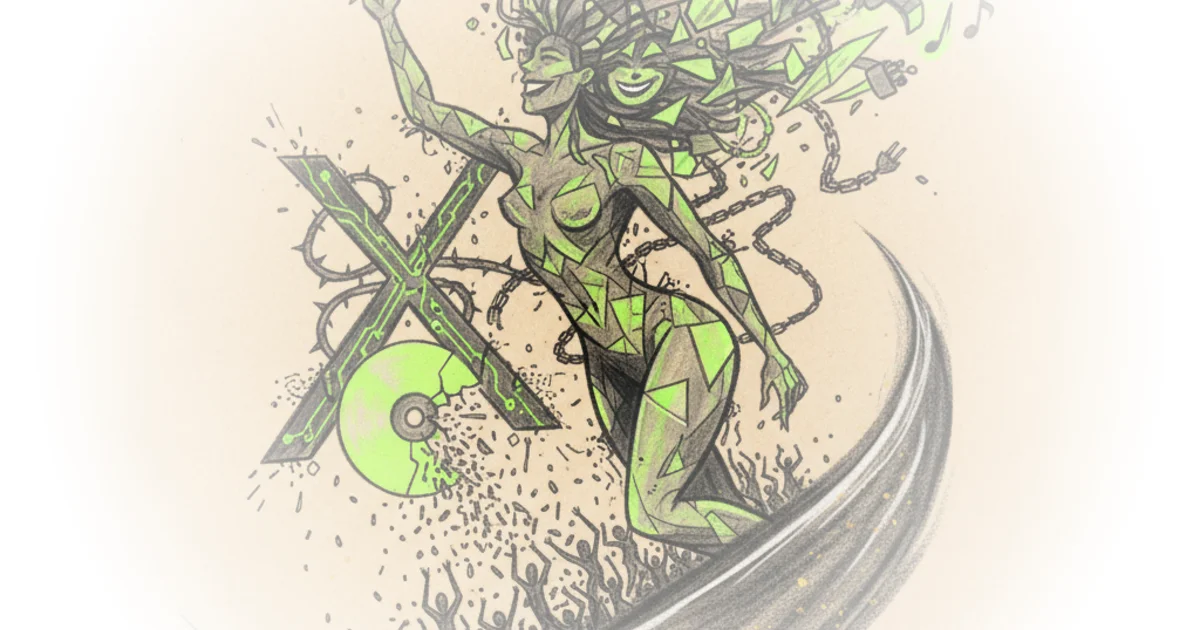
The author contrasts this new "brat" energy with the failed comeback of Katy Perry's "Woman's World," a song that tried to sell the old narrative of overcoming obstacles. James notes that "narratives of feminist resilience are less zeitgeisty in a world where abortion rights and trans rights have eroded." This is the piece's sharpest insight: in an era of regression, the story of "overcoming" feels like a lie. When the obstacles keep coming back, the performance of resilience becomes not just exhausting, but politically naive. As James puts it, "It's harder to sell feminine resilience as a cause for celebration when previously-overcome obstacles keep reappearing on the horizon."
"Brat-style synergistic resolution is in no way countercultural... But, as DiPiero noted, it does represent a vibe shift in the kinds of femininities that pop listeners and social media users find relevant and meaningful."
Critics might argue that this shift is merely a marketing pivot by the music industry, a cynical rebranding of the same old competition. Yet, the evidence suggests the audience is genuinely hungry for something that acknowledges the messiness of reality rather than pretending to have conquered it.
From Conflict to Resolution
The core of James's argument centers on the song "Girl, So Confusing" and its remix featuring Lorde. Rather than pitting the two artists against each other—a classic industry tactic—the song and its resolution offer a new model for female interaction. James observes that the original track "uses ambivalence to disidentify with dominant figurations of pop feminist femininity such as the girlboss." It refuses to be a role model or a victim, instead embracing the confusion of interpersonal conflict.
The resolution of the song is framed not as a victory over an enemy, but as a settlement between peers. James highlights how the remix transforms the narrative: "Resolving their very hyped-up beef in the remix, Charli and Lorde leverage their partnership as pop star brands to create one of 2024's biggest hits." This is a fascinating pivot from the "resilience" of the 2010s to the "resolution" of the 2020s. The music itself mirrors this, using harmonic chord progressions to resolve dissonance rather than building tension to a breaking point. As James writes, "The music in the 'Girl, So Confusing' remix resolves harmonic dissonance in a way that parallels the way the lyrics resolve the interpersonal dissonance between its two vocalists."
This approach treats conflict as something to be managed and resolved through synergy, rather than a battle to be won through sheer will. It is a move away from the "skeptical melancholy" of the old rock star toward a collaborative, albeit messy, engagement with the world.
The Politics of Femme Cool
Ultimately, James argues that this new "femme cool" represents a shift in how cultural capital is claimed. The old cool was about white men distancing themselves from the mainstream; the new cool is about women and queer people disidentifying with the "neoliberal resilience" of the cishetero mainstream. James concludes that "brat-style cool uses femme performances of alternative, perhaps racially ambiguous femininities to claim elite cultural capital."
This is a significant reorientation of power dynamics in pop culture. It suggests that the most "cool" thing one can do today is to admit that the system is broken and that we are all confused by it, rather than pretending we have the answers. The stakes have shifted from the mass commodity record industry to a platformed, often demonetized landscape where authenticity and connection matter more than the illusion of invincibility. As James writes, "Brat is a rock-star figure that disidentitifes with the resilience of the girlboss to appear cool in a newly femme way."
"Brat disidentifies with the resilient girlboss by resolving differences and damage rather than overcoming it."
Bottom Line
Robin James's analysis is a compelling intervention that correctly identifies the exhaustion with "resilience" as a defining cultural mood of 2024. The strongest part of the argument is the musical and lyrical dissection of how "resolution" offers a more honest alternative to the "girlboss" fantasy. The biggest vulnerability lies in the assumption that this "resolution" is truly a break from capitalist spectacle, given that the remix was explicitly designed to go viral and drive engagement. Nevertheless, the piece offers a vital framework for understanding why the old scripts of empowerment no longer resonate in a fractured world.