Hook
A sweeping historical essay that traces Mexico's five-century struggle against imperial domination—from Spanish conquest through modern economic pressures—reveals a country that has repeatedly defined what national sovereignty looks like when it's under siege. Jeff Rich positions Mexico not as a footnote in decolonization history, but as its architect.
The Origins of an Empire's Conscience
Rich opens with Claudia Sheinbaum's 2026 address marking the 109th anniversary of Mexico's 1917 Constitution, delivered at the Teatro de la República. The words carry the weight of half a millennium.
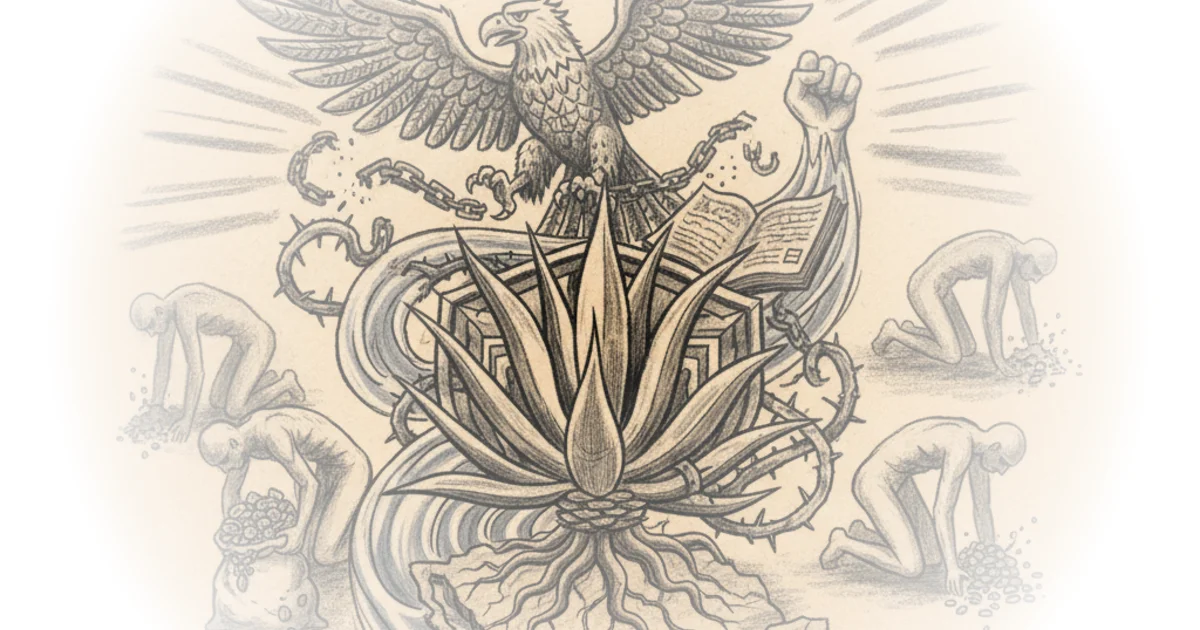
Jeff Rich writes, "Mexico will not return to being a colony or protectorate of anyone. And Mexico will never surrender its natural resources." He then steps back to show why that declaration isn't rhetorical flourish but a statement earned through centuries of extraction, invasion, and resistance.
The piece begins in 1492, with the arrival of agents from a Europe-wide empire led by a Flemish Habsburg prince who was himself a foreigner in Madrid. Rich doesn't sanitize the conquest. He quotes the Dominican friar Bartolomé de Las Casas, who wrote in the 1550s: "The Spanish came like starving wolves, tigers, and lions, and for four decades have done nothing other than commit outrages, slay, afflict, torment and destroy."
But Rich resists the simple colonizer-versus-colonized narrative. He notes that predecessor societies in the Americas knew "also how to slay, torment, and commit outrages in the name of religious belief." The Mexica had recently expanded violent dominion over their own known world. Rival indigenous leaders allied with Cortés precisely because they resented Aztec rule. The conquest was catastrophe, but it was also collaboration, adaptation, and survival.
From this crucible of violence, culture and history, Our Lady of Guadalupe rose on Tepeyac Hill, Mexico City.
That survival, Rich argues, birthed something else entirely: a transatlantic conscience. Las Casas's preaching didn't stop the deaths, but it seeded modern human rights thinking, Latin American international law, and a Mexican humanism that would echo through centuries of resistance.
The Northern Colossus
Independence from Spain in 1821 looked like liberation. It lasted barely two years before a new threat emerged from the north.
Rich draws a sharp line from the 1823 Monroe Doctrine—declared by "insecure ex-British colonists"—to the 1825 regime change operation in Mexico, to the mid-1840s invasion that seized half of Mexico's territory. This wasn't a border skirmish. It was national trauma on a scale that reshaped both countries.
The United States didn't build a formal territorial empire in the British or French style. It didn't need to. Rich quotes the historian John Darwin: "The Mexican revolution that broke out in 1910 pushed Washington further towards an imperial mentality." Economic expansion, backed by violence and doctrines of superiority, achieved what formal colonies never could.
Porfirio Díaz understood the trap. He ruled for three decades on a model of "order and progress," inviting foreign investment while maintaining control by force. The investment came primarily from the rapidly growing neighbor to the north. Rich quotes Díaz's famous lament: "Poor Mexico, so far from God, so close to the United States."
That sentence has echoed through Mexican politics ever since.
The Revolution That Changed Everything
In 1910, Díaz fell. What followed was the twentieth century's first great social revolution.
Rich makes a bold claim here, one he admits he didn't fully appreciate until reading Greg Grandin's work. The Mexican Revolution of 1910 to 1917 wasn't just a domestic upheaval. It was, as the historian John Mason Hart wrote, "the first great third world uprising against American economic, cultural, and political expansion."
The 1917 Constitution that emerged was flawed but transformative. Agrarian reform. Labour protections. Liberal democratic structures. Sovereign control of resource industries. A social-democratic state born from a century and a half of imperial pressure.
Rich places Mexico's revolutionary moment alongside the end of apartheid, the Bandung spirit, Gandhi's Salt March. It belongs in that company. The revolution established an agenda of social rights against liberal, free-market imperialism—and that agenda would ripple outward to influence every decolonization movement that followed.
As Jeff Rich puts it, "Venustiano Carranza's Constitutionalist government in revolutionary Mexico defined social rights to human security over individual private property rights while pushing for a non-hierarchical League of Nations that respected the equal status of all member states. The unifying message was that imperialism's denial of social and economic rights was the greatest obstacle to justice domestically and globally."
Resource Sovereignty and the Long Defeat
In 1938, President Lázaro Cárdenas barred foreign oil companies from operating in Mexico. He returned their assets to the Mexican people. He created PEMEX, the state-owned firm that held a monopoly over the country's oil industry.
Nationalization of resource industries became, Rich notes, "the nightmare of American and European imperial investors and the cause of countless regime change operations."
But Mexico didn't stop at its own borders. At the 1933 World Economic Conference in London, Mexico led debtor-country advocacy for the interdependence of lenders and borrowers. At Bretton Woods in 1944, Mexico argued alongside Global Majority states for economic redistribution and trade rules that protected national industries from multinational domination.
In the 1960s and 1970s, President Luis Echeverría pushed the Nixon administration—specifically Henry Kissinger—to accept a UN-endorsed Charter of Economic Rights and Duties of States. He argued that rejection would sharpen ideological polarization between the Global South and rich-world creditors.
Kissinger, Rich writes, "was unmoved and worked assiduously to undermine the NIEO initiative."
And then came the counter-revolution.
The Corporate Reconquest
From the 1970s onward, neoliberalism replaced formal empire as the instrument of economic control. Free trade. Privatization. Hyper-liberalism.
Rich doesn't mince words: "To many inside and outside Mexico, it appeared that a new pro-USA, libertarian, oligarchical Mexico had bent, kneeled, surrendered, and sold out."
The language mirrors Sheinbaum's opening declaration precisely. It's not accidental. The neoliberal era, Rich argues, was recolonization in corporate form—stripped assets, exploited labor, limited rights, and the dirty work that the United States didn't want to do at home.
"To many inside and outside Mexico, it appeared that a new pro-USA, libertarian, oligarchical Mexico had bent, kneeled, surrendered, and sold out."
The essay cuts off before completing this section, but the trajectory is unmistakable. Each wave of Mexican sovereignty—1917, 1938, the NIEO advocacy—met a counter-wave of imperial resistance. The pattern repeats because the structural power imbalance never fully resolved.
Counterpoints
Critics might note that Rich's narrative occasionally romanticizes Mexican governance. The post-revolutionary state was not consistently progressive—it presided over the Tlatelolco massacre of 1968, institutional corruption, and periods of brutal authoritarianism. Nationalism and democratic accountability are not the same thing.
Critics might also observe that the essay leans heavily on the structural lens—empire, neo-colonialism, resource extraction—while giving less attention to the agency of ordinary Mexicans in shaping their own institutions, independent of elite resistance to foreign powers.
A third concern: the piece frames economic liberalization as purely corrosive. While NAFTA and its successors undeniably damaged Mexican agriculture and labor, they also lifted millions from extreme poverty and created a manufacturing sector that employs tens of millions. The trade-offs are messier than the decolonization frame allows.
Bottom Line
Rich's essay is a reminder that Mexico's current political assertiveness didn't emerge from nowhere—it's the latest chapter in a five-century argument about who gets to control Mexican land, labor, and resources. The piece makes a persuasive case that decolonization isn't a historical event but an ongoing negotiation, and that the terms of that negotiation still favor the side with more capital, more leverage, and more patience. Whether the current Mexican government can actually close that gap is a different question entirely.