A Peace Board Without Palestinians
The most striking detail of this week's diplomatic theater: a reconstruction board for Gaza convened with zero Palestinian representation. Ryan Grim & Jeremy Scahill document the mechanics of exclusion as they unfold in real time.
The Board of Peace Signs On
Israeli Prime Minister Benjamin Netanyahu formally joined what the administration calls a "Board of Peace" during a meeting with Secretary of State Marco Rubio in Washington. The board schedules its first session for February 19 to discuss Gaza's reconstruction. No Palestinians sit on it.
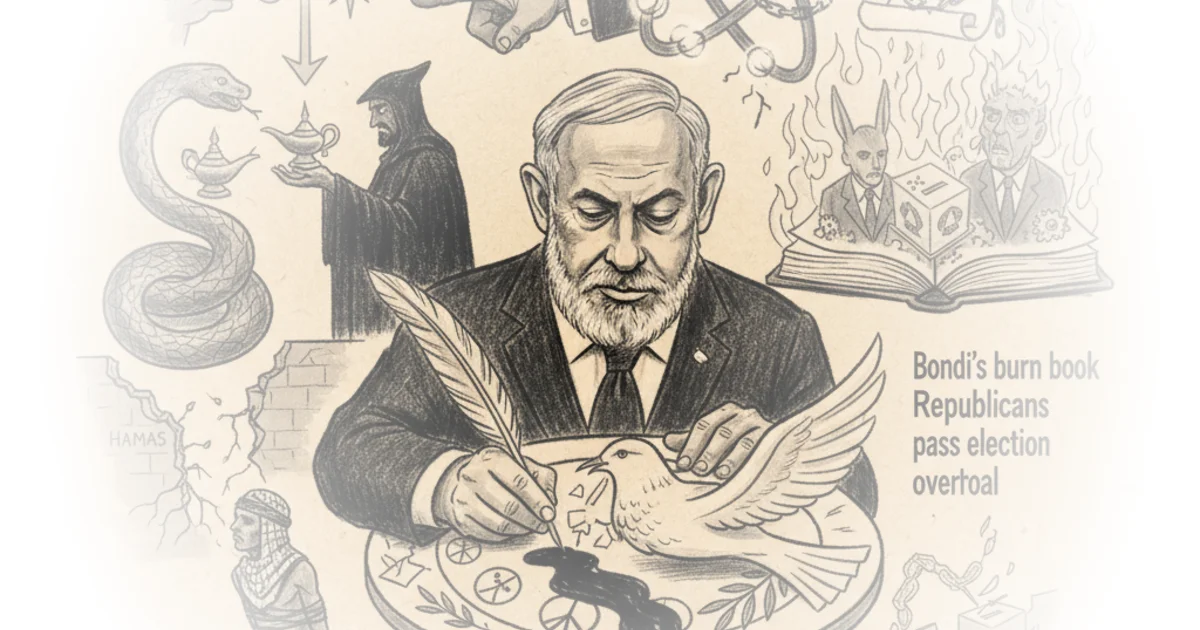
Hamas official Mahmoud Mardawi responded sharply. As Ryan Grim & Jeremy Scahill reports, Mardawi wrote that Netanyahu's appointment "reinforces doubts, deepens the lack of trust, and rewards policies of extermination and repression instead of holding them accountable."
The administration's envoy team—Jared Kushner, Steve Witkoff, and Board High Representative Nickolay Mladenov—has drafted a proposal requiring Hamas to surrender weapons capable of striking Israel. Small arms might remain initially under a phased process extending months or longer. Hamas officials say they have not received any disarmament proposals and have not adopted decisions to freeze weapons. Palestinian arms, they note, remain linked to ending occupation.
Hamas official Mahmoud Mardawi wrote that Netanyahu's appointment "reinforces doubts, deepens the lack of trust, and rewards policies of extermination and repression instead of holding them accountable."
Critics might note that phased disarmament without parallel occupation relief has failed repeatedly in prior cycles. The draft assumes weapons are the root problem rather than the conditions producing them.
Gaza Continues Under Ceasefire Label
The casualty accounting continues. Grim & Jeremy Scahill writes: "The total recorded death toll since October 7, 2023 has risen to 72,049 killed, with 171,691 injured." The authors add: "Since October 11, the first full day of the so-called ceasefire, Israel has killed at least 591 Palestinians in Gaza and wounded 1,583, while 724 bodies have been recovered from under the rubble."
Israeli attacks struck across the Strip. Two children were injured by fire inside their tents in Al-Musallah, south of Khan Younis. Aircraft struck eastern Khan Younis city. Four Palestinians were wounded by gunfire in central Gaza. A man was killed in Gaza City's Tuffah neighborhood; ambulances attempting to reach wounded came under fire.
Aid workers remain targets. One UNRWA staff member was killed in central Gaza on Wednesday alone. The total number of aid workers killed since October 2023 now reaches 589—397 employed by the United Nations.
Movement through Rafah remains tightly controlled. Forty-six Palestinians entered Gaza through the crossing under strict Israeli restrictions. Forty-seven left—17 patients and 30 companions. Israel reportedly allows the Abu Shabab militia to monitor movement on the Gaza side under Israeli supervision, conducting physical searches of Palestinians entering the Strip. Returnees are transported along Salah al-Din Road toward an Israeli army checkpoint, searched by the militia, then reach Israeli forces.
Citizenship Revoked, Prisoners Starved
Israel stripped two Palestinians of citizenship on Wednesday. Mahmoud Ahmed and Muhammad al-Halasa, both from occupied East Jerusalem, face deportation to the West Bank or Gaza after Israeli courts convicted them of "carrying out deadly attacks on Israelis." This marks the first use of a 2023 law allowing citizenship revocation for Palestinians convicted of attacks.
The Palestinian human rights group Adalah says the move violates international law by rendering the men effectively stateless. The group adds it "undermines the fundamental protections that citizenship is meant to provide."
In Gilboa Prison, Abdullah Barghouti—a renowned Palestinian resistance leader—was injured during an Israeli assault. A guard struck his head against an iron door, causing a bleeding wound to his left eye. Barghouti also endured severe weight loss from ongoing starvation policies, according to the Prisoners' Media Office. At least 87 Palestinians have been killed in Israeli detention since the Gaza genocide began, per the Commission of Detainees' Affairs.
Bondi's Burn Book and Epstein Survivors
Attorney General Pam Bondi testified before the House Judiciary Committee. Eleven Epstein survivors attended. When Representatives Pramila Jayapal and Dan Goldman asked them to raise their hands if they had been unable to secure meetings with the Department of Justice, all eleven did so.
Bondi declined to apologize. As Ryan Grim & Jeremy Scahill puts it, Bondi "accused the members of Congress of exploiting the victims for 'theatrics' and 'getting in the gutter.'"
Representative Becca Balint confronted Bondi about whether the DOJ had questioned Commerce Secretary Howard Lutnick about a 2012 visit to Jeffrey Epstein's island. Bondi deflected, invoking Bill Clinton and Merrick Garland. Then Bondi accused Balint—who is Jewish and whose grandfather died in the Holocaust—of fueling an "antisemitic culture," citing Balint's vote against a resolution condemning the phrase "from the river to the sea." Balint left the chamber in anger.
A photo by freelance photojournalist Kent Nishimura appears to show Bondi and DOJ staff tracking which documents each member of Congress accessing the unredacted Epstein Files has viewed. The materials, arranged in binders passed between Bondi and her team, have been described by some critics as a "burn book."
Critics might note that confronting survivors while refusing meetings undermines the testimony's credibility. The burn book tracking suggests political calculation over victim care.
Tax Data Shared, Watchdogs Gutted
The Internal Revenue Service acknowledged it improperly disclosed confidential tax information of thousands to the Department of Homeland Security. A data-sharing agreement allows Immigration and Customs Enforcement to request names and addresses of suspected undocumented immigrants. A Wednesday statement from a top IRS official reports the tax agency verified roughly 47,000 of the 1.28 million names DHS requested.
Experts say the disclosures likely violate federal privacy law and undermine long-standing protections for taxpayer information.
Meanwhile, the DHS Office for Civil Rights and Civil Liberties—a watchdog agency created alongside ICE as a safeguard against civil liberties violations—has been slashed by more than 75 percent in budget. The agency now has nine staffers, down from 150 at the beginning of March.
Iran Negotiations and Venezuela Energy
Vice President JD Vance told reporters that the president instructed his "entire senior team" to pursue a deal preventing Iran from obtaining a nuclear weapon. On regime change, Vance said: "If the Iranian people want to overthrow the regime, that's up to the Iranian people. What we're focused on right now is the fact that Iran can't have a nuclear weapon."
Energy Secretary Chris Wright met Venezuela's acting president Delcy Rodríguez in Caracas to discuss a U.S.-led overhaul of Venezuela's oil sector. Rodríguez spoke of a long-term energy agenda serving as the "motor" for bilateral relations. Wright said the U.S. will continue easing sanctions to attract foreign engagement but will not commit to "on-the-ground" security for providers operating in the country.
Bottom Line
This week's diplomacy reveals a pattern: reconstruction without representation, ceasefire without cessation, accountability without access. Ryan Grim & Jeremy Scahill's documentation shows institutional machinery advancing while human costs accumulate. The verdict: peace boards excluding Palestinians and watchdogs reduced to nine staffers signal priorities that contradict their stated aims.