Rohit Krishnan proposes a radical shift in how organizations navigate complexity: replacing gut instinct with a digital "management flight simulator" that allows leaders to test decisions against a historical record before reality intervenes. This is not merely a pitch for better data dashboards; it is a claim that we can finally construct a "world model" of an enterprise—a dynamic, branching simulation where the cost of failure is zero, and the lessons are immediate.
From Intuition to Simulation
Krishnan anchors his argument in a decades-long intellectual lineage, reminding us that the desire to model complex systems is not new. He notes that in the 1990s, John Sterman argued we should be "using mental models, mapping feedback structures, using simulations and 'management flight simulators' to understand work and do it better." Yet, as Krishnan points out, "decades later, we still don't have it." While pilots and doctors train in high-fidelity simulators, the vast majority of the economy still relies on intuition.
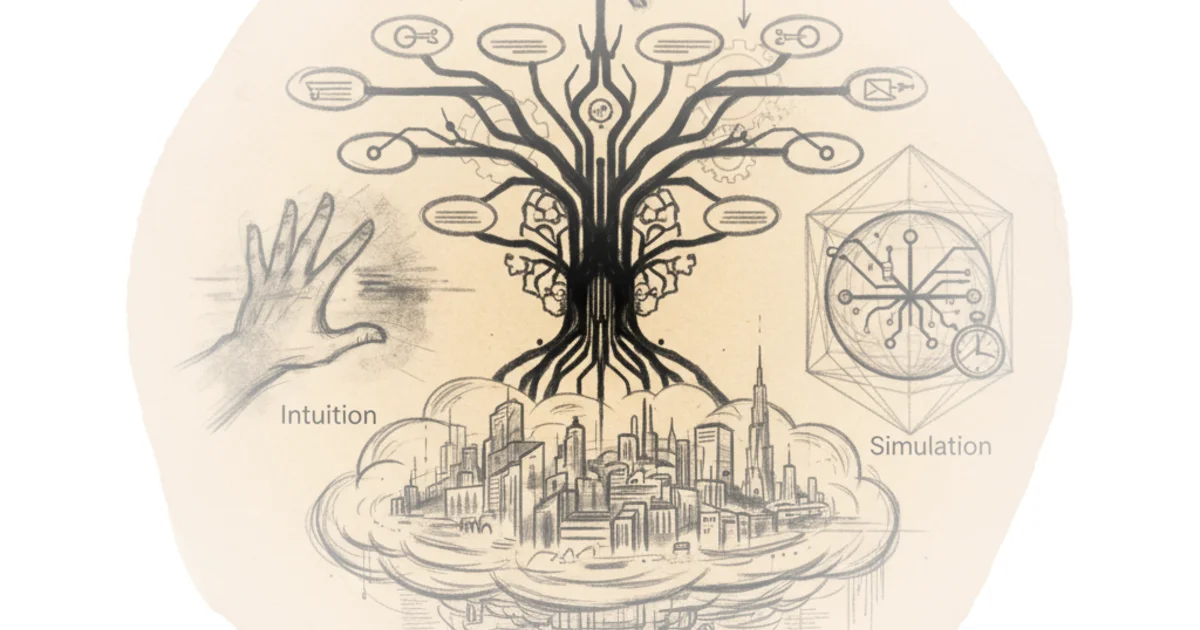
The author suggests this gap existed because we lacked the data, not the theory. Drawing on Herbert Simon's concept of "bounded rationality" and the coalition dynamics described in Cyert and March's "A Behavioral Theory of the Firm," Krishnan argues that the modern firm is essentially a "distributed intelligence system" that has finally become legible to machines. "The biggest gap in the old days was not just inability to calculate counterfactuals but the inability to even capture the data," he writes. Now, with the "organisational data exhaust" of emails, messages, and trackers being collected, the raw material for these simulations exists.
Critics might argue that reducing human organizational behavior to a data set risks ignoring the nuance of culture and the irrationality of human motivation that defies algorithmic prediction. However, Krishnan's framing suggests that even imperfect simulations are superior to the current alternative: guessing in the dark.
The game itself needs to be built. And that game is the world model.
The Enron Experiment
To prove this is not science fiction, Krishnan details his creation of "Vei," an enterprise world model generator. He chose a grim but data-rich case study: Enron. Because of the litigation surrounding the 2001 collapse, Enron offers a unique "richest public email-era trace of a major company in crisis." Krishnan used this corpus to recreate a version of the company where leaders could have tested different responses to the unfolding scandal.
He describes loading a specific branch point from October 30, 2001, when whistleblower Sherron Watkins sent a follow-up note to CEO Ken Lay. The simulation allowed for different paths: escalating the warning to the audit committee, keeping it within a small legal circle, or suppressing it. The model's output was stark. "'Escalate to the audit committee and copy Andersen' looks best on risk and trust, even if it slows things down," Krishnan reports, while "'Keep it private and monitor' looks worst." The simulation confirmed that formal escalation would have preserved records and potentially altered the trajectory, whereas suppression accelerated the collapse.
This application of counterfactuals transforms historical tragedy into a training ground. "Enron is a true comedy of errors in how many things went wrong, but even in this narrow instance, there was no way for Watkins or Ken or anyone to gameplay outcomes like this," Krishnan observes. The tragedy was that the decision-makers could not see the downstream cascades of their actions. A world model, he argues, makes those tails testable.
The Future of Organizational Twins
The ultimate vision extends beyond historical analysis to real-time orchestration. Krishnan envisions a future where companies run "enterprise twins" of their software ecosystems—Slack, Jira, and more—allowing them to test AI agents in a realistic environment before deployment. "A world model that lets you do this will also work great as a decision making framework," he asserts. This moves the concept of the "management flight simulator" from a theoretical ideal to a practical tool for steering autonomous agents.
He draws a parallel to MIT's Project Whirlwind from 1944, which evolved from an analog flight trainer into a high-speed digital computer. "We're quite a bit beyond capturing Sterman's mental models and identifying dynamic equilibria," Krishnan writes. "We can extrapolate any patterns from the infinite tapestry of data that every collective action produces." The challenge, he admits, is that unlike physics, organizations involve constituents with "free will" who react to each other. Yet, the trajectory seems inevitable.
We dreamt of building 'flight simulators' for management. But actual flight is much easier, seeing as it's all understandable physics. For organisations, this get more complex!
Bottom Line
Krishnan's most compelling contribution is the concrete demonstration that we can now simulate the "what ifs" of corporate history with enough fidelity to reveal clear strategic errors, turning Enron's collapse into a teachable, interactive game. The argument's vulnerability lies in the assumption that data exhaust perfectly mirrors human intent and that a model can account for the chaotic, irrational elements of crisis management that often defy logic. Nevertheless, the shift from implicit executive intuition to explicit, testable world models represents a fundamental evolution in how we might prevent future organizational failures.