In an era where literary advice often defaults to rigid craft manuals, Henrik Karlsson offers a radical alternative: the most profound writing emerges not from following rules, but from the audacity to break them in service of raw, unfiltered truth. This is not merely a reading list; it is a manifesto for dissolving the artificial barrier between the rational mind and the messy human heart, arguing that the deepest complexity is found not in clever ambiguity, but in the courage to be precise. Karlsson's framing is particularly striking because it bridges the gap between the high modernist tradition and the emerging world of technical rationality, suggesting that the future of serious writing lies in their synthesis.
The Death of the Pedestal
Karlsson begins by dismantling the traditional reverence accorded to authors, reframing them not as distant idols but as intimate companions. He illustrates this with a vivid anecdote about his daughter treating classic literature as toys, noting, "It always felt strange to me how some people put famous authors on pedestals. Authors are our friends! They are odd people who talk to us, sometimes from across the grave." This observation is more than a charming memory; it is a methodological stance. By stripping away the aura of the "great writer," Karlsson creates space for a more honest, conversational approach to reading and writing.
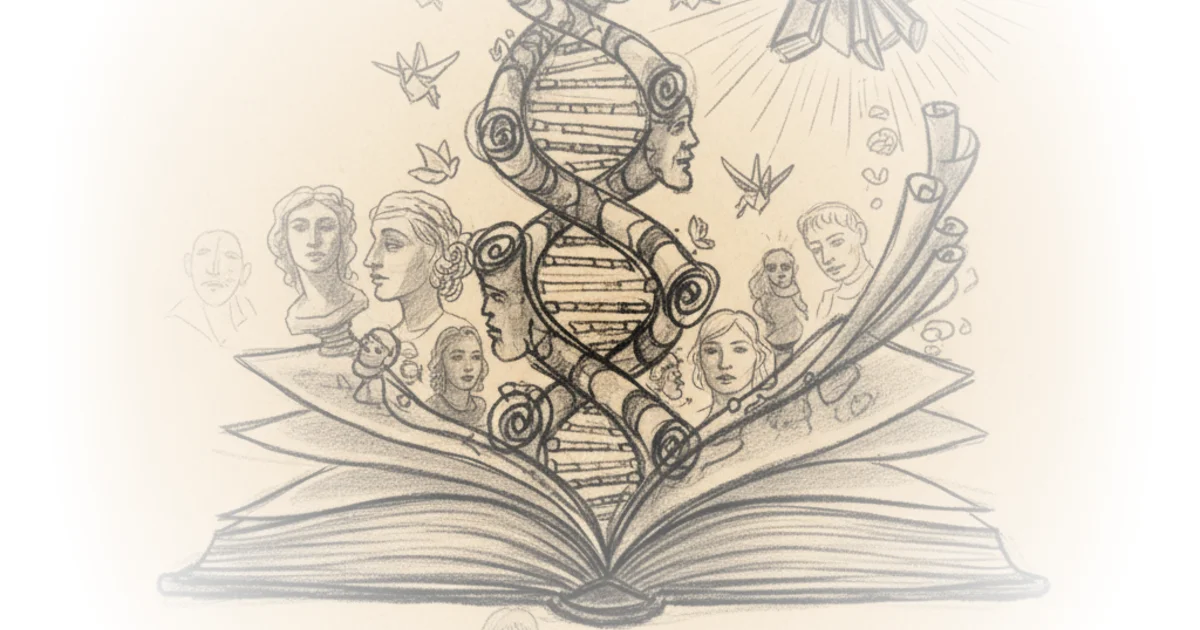
He argues that for him, figures like Leo Tolstoy and Tomas Tranströmer feel closer than real-life acquaintances. "When Johanna and I talk, we'll say Tomas and mean Tranströmer; he is one of our mutual friends, and we gossip lovingly about him." This personalization of literary giants serves a specific function: it normalizes the idea that great art is a dialogue, not a lecture. It echoes the Bakhtinian concept of polyphony, where multiple voices coexist without a single authoritative narrator, a theme Karlsson will return to with Dostoevsky. The strength of this opening is its refusal to treat literature as an academic subject; instead, it is presented as a vital, living relationship.
The Liberation of Breaking Rules
The core of Karlsson's argument centers on a transformative encounter with Karl Ove Knausgård's My Struggle series. Living in Malmö while Knausgård wrote the books, Karlsson realized that literature could capture the mundane reality of his own streets and parks. "If you live in Paris or New York, I guess it is quite common to read well-written books that describe your everyday life, but living in the provinces of Sweden, it was a revelation: literature is not something that happens far away, or in the past; it might as well happen right here." This insight shattered the notion that great writing requires exotic settings or elevated language.
More importantly, Knausgård gave Karlsson permission to abandon the rigid "show, don't tell" dogma that often stifles young writers. Karlsson quotes Knausgård's realization that "monologic claims of truth about the world are antiliterary," yet paradoxically, he found that his own writing only came alive when he started "telling" with precision. "If I just pay close enough attention to reality, the complexity of reality will seep into the writing and make it ambiguous and charged anyway. There is no need for me to be clever and artful and introduce mystery." This is a powerful counter-narrative to the prevailing advice in creative writing circles, which often equates ambiguity with depth. Karlsson suggests that true depth comes from the sheer weight of observed detail, not from manufactured mystery.
There is no need for me to be clever and artful and introduce mystery. Just "telling" it as I see it, if done with enough detail and care, is mysterious enough.
Critics might argue that this approach risks descending into solipsism or self-indulgence, where the writer's internal monologue becomes the only reality that matters. However, Karlsson mitigates this by grounding his argument in the external world, insisting that the writer's job is to pay attention to reality, not to invent it.
Polyphony and the Unknowable Other
Karlsson then pivots to Fyodor Dostoevsky, filtered through the lens of Mikhail Bakhtin's literary theory. He highlights Bakhtin's observation that Dostoevsky treats his characters as "full individuals, as if they are too big to fit in his head." This is a crucial distinction. In most fiction, characters serve the author's thesis; in Dostoevsky, they possess their own "inner logic and perspective." Karlsson writes, "But in Dostoevsky, each character is so strong and independent that they feel like authors in their own right."
This respect for the "unknowability of others" had a profound impact on Karlsson's personal life, changing how he viewed his relationships. "It made me more curious about the inner lives of others, and the dialogue between us." He connects this literary technique to a philosophical stance: the refusal to let characters (or people) be mere mouthpieces for the author's ideology. Dostoevsky's inclusion of long, essayistic segments that are undermined by the speaker's instability forces the reader to engage critically. "Since there is no safe authority that you can submit to in Dostoevsky's books, it is up to you to meet these hurting, strange voices with compassion, critical thinking, and curiosity." This is a demanding form of reading that requires the audience to do the heavy lifting, a quality that Karlsson clearly values.
The Rational and the Human
Perhaps the most distinctive contribution of Karlsson's essay is his synthesis of the literary and the technical. He describes his early struggle to reconcile his love for literature with his passion for mathematics and programming, feeling that the two worlds were incompatible. The solution came in the form of Michael Nielsen, a physicist who writes about quantum computing and metascience with the emotional depth of Knausgård. "Nielsen was able to do this while writing about quantum computing or spaced repetition or metascience. The feeling of reading him wasn't entirely dissimilar from the feeling I had when I first read Knausgård: these are my neighborhoods... and I've never seen anyone turn it into literature like this before."
Karlsson contrasts Nielsen's approach with the typical academic style, noting that Nielsen combines "epistemic rigor" with a "humbleness to the tone." Unlike Knausgård, who is content with confusion, or Dostoevsky, who embraces polyphony, Nielsen is driven by a desire to find the truth. "Michael had higher aspirations and much more patience: he would tunnel and tunnel until he found insights that were actually true and useful, and if he failed, he'd point out his shortcomings." This section is vital because it expands the definition of "literature" to include rigorous intellectual inquiry, suggesting that the highest form of writing is one that is both emotionally resonant and intellectually honest.
Bottom Line
Henrik Karlsson's essay succeeds by reframing the act of writing not as a performance of skill, but as an act of radical honesty and deep attention. Its greatest strength lies in its ability to bridge the divide between the humanities and the sciences, offering a unified vision of what it means to think and write clearly. However, the argument relies heavily on the reader's willingness to abandon established literary conventions, a leap that may feel risky to those invested in traditional craft. Ultimately, this is a compelling call to stop playing the role of the "writer" and start engaging with the world as it is.
Authors are our friends! They are odd people who talk to us, sometimes from across the grave.