Noah Smith cuts through the noise of daily market fluctuations to ask a terrifying question: what happens when the world's financial safety net unravels, and no one is left to catch the fall? His argument that we are drifting into "international financial anarchy" is not a prediction of a specific crash, but a diagnosis of a systemic vacuum where the dollar is losing trust and no rival currency is ready to lead. For busy readers tracking global stability, this piece matters because it shifts the focus from short-term volatility to a fundamental restructuring of how nations settle debts and store value.
The Gold Standard Returns? Not Exactly
Smith begins by challenging the assumption that the U.S. dollar remains the undisputed king of global reserves. He points to a sharp divergence: while the dollar holds its value against other currencies, its share of global reserves is plummeting once gold is factored in. "Gold's volatility and limited supply might not stop it from becoming the world's reserve asset once again," Smith writes, noting that governments and private investors are buying the metal at a rapid clip. This surge isn't just about inflation; it is a reaction to policy unpredictability and a loss of faith in sovereign debt.
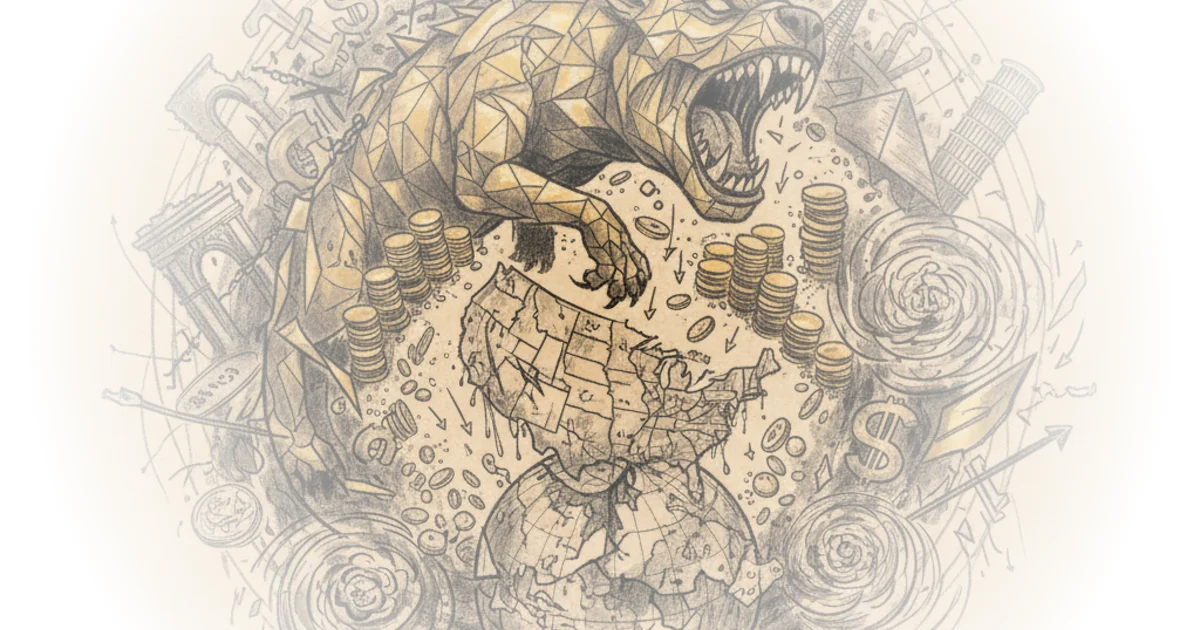
The author observes that central banks, particularly in emerging markets, are leading this charge. "In recent years central banks in emerging markets, led by China, fuelled the [gold] rally," Smith notes, citing reports that these hyper-conservative investors are seeking protection amid geopolitical turmoil. This behavior echoes the pre-Bretton Woods era, where nations relied on tangible assets rather than paper promises when confidence in governments wavered. Smith argues that this is a "debasement trade," where investors flock to gold because "soaring government debt around the world has also shaken investors' trust in sovereign bonds and currencies."
Gold isn't a superior system — it's a desperate fallback for a world in which the people who were in charge of the superior system abdicated their duties.
This framing is powerful because it strips away the romanticism often associated with gold. Smith doesn't celebrate the return of gold; he warns of it. He argues that while goldbugs are correct about gold's safe-haven status, they are wrong to view it as a stable foundation. The market's recent volatility proves his point: "an anarchic, gold-based international financial system will probably be inherently less stable than the dollar-based system has been." Without a central authority to manage the price, the system is prone to the very swings that make it dangerous for global trade.
The Bitcoin Bet That Didn't Pay Off
A crucial part of Smith's analysis is the failure of the "digital gold" narrative. For years, proponents argued that Bitcoin, backed by algorithms rather than states, would be the ultimate safe haven. Smith dismantles this by pointing to recent market behavior. "When investors started losing confidence in the U.S. dollar, they also sold Bitcoin, causing the price to plunge," he writes. The data shows that Bitcoin remains correlated with the U.S. stock market, suggesting it is viewed as a risk asset that thrives when the American economy is strong, not when it is faltering.
This distinction matters because it reveals how the market actually coordinates during crises. "Safe-haven assets are a coordination game — people just sort of collectively decide which assets to buy in order to protect themselves," Smith explains. So far, that coordination has landed on gold, not crypto. "They probably think of Bitcoin as something that benefits from the success of the American economy... Whereas they still think of gold as something that you need when nations as a whole do poorly." This insight suggests that the shift away from the dollar is not a leap into a new technological future, but a retreat to the oldest form of money known to man.
Critics might argue that Bitcoin's volatility is simply a function of its youth and that it hasn't been tested in a true multi-decade crisis. However, Smith's evidence from the last two years suggests that in moments of acute geopolitical fear, investors still prefer the physical certainty of gold over the digital promise of blockchain.
The Weaponization of the Dollar
The article pivots to the structural reasons behind this shift, moving beyond the actions of any single administration to the broader dynamics of financial power. Smith highlights the Ukraine War as a turning point. The decision by the U.S. and Europe to freeze Russian assets and cut them off from the SWIFT payment system sent a shockwave through the global south. "The U.S. and Europe put big financial sanctions on Russia — essentially, cutting Russian banks and other Russian companies out of the international financial system," Smith writes. While the efficacy of these sanctions is debated, the strategic message was clear: reliance on the dollar is a vulnerability.
Consequently, nations like China and India have accelerated efforts to build alternative payment systems. Smith notes that "the share of China's cross-border payments denominated in yuan started rising," a move that could eventually decouple global trade from the dollar. This is not just about avoiding sanctions; it is about insulating domestic economies from external political pressure. "If you don't have to go through dollar swaps in order to make payments, you don't even have to think about whether the sudden lack of dollars in your country's domestic financial system will disrupt your financial plumbing."
The proliferation of non-dollar payment systems still might represent a kind of preparatory stage for countries around the world to dump the dollar.
Smith carefully distinguishes between using a currency for payments and holding it as a reserve. He argues that in the modern age, settling a transaction in dollars doesn't necessarily require holding large reserves, as swaps are easily accessible. However, the development of yuan-based systems removes that friction entirely, creating a pathway for a full transition. This mirrors the historical shift from the British pound to the dollar after World War I, where the flow of gold and the relative strength of the U.S. economy eventually forced a change in the global hierarchy.
The China Conundrum
The final piece of the puzzle is China's role. Smith explores the theory that Beijing is stockpiling gold to back a future yuan-based reserve system. He cites estimates suggesting China has been acquiring gold at a rate ten times higher than officially reported. "Assuming official purchases were 10% of what China is actually buying, this suggests China acquired +270 tonnes of physical gold in 2025," Smith writes, referencing the Kobeissi Letter. If China were to control a massive portion of the world's gold, it could theoretically anchor the yuan, making it a credible alternative to the dollar.
However, Smith identifies a glaring contradiction in this theory. Despite the massive gold accumulation, China has shown no desire to let the yuan appreciate; in fact, they have been intervening to keep it cheap. "One problem with this theory, however, is that China has shown absolutely no sign of wanting to do this," he notes. This creates a paradox: the world is preparing for a post-dollar future, but the only potential successor seems content to remain a secondary player, using gold as a hedge rather than a foundation for a new currency bloc.
Bottom Line
Noah Smith's strongest contribution is his refusal to romanticize the potential collapse of the dollar system; he correctly identifies a gold-based future not as a return to stability, but as a descent into chaotic volatility. The piece's greatest vulnerability lies in the uncertainty of China's long-term strategy, which remains opaque despite the massive gold purchases. Readers should watch for whether Beijing eventually shifts from suppressing the yuan to promoting it, as that would be the true signal that the era of dollar hegemony is ending.
Gold isn't a superior system — it's a desperate fallback for a world in which the people who were in charge of the superior system abdicated their duties.