Jordan Schneider delivers a crucial reality check on the titanium panic, arguing that while Beijing's export controls are real, the West's fear of a supply chain collapse is largely misplaced by bureaucratic inertia and China's own structural overcapacity. He doesn't just list facts; he traces a seventy-year industrial strategy that turned a remote, secret city into a global monopoly, only to reveal that the crown jewel of that empire is currently stuck in a valley of low-grade production.
The Long Game of Metallurgy
Schneider begins by dismantling the assumption that China's dominance was accidental. He anchors the narrative in a 1958 directive from Mao Zedong, noting, "There are 64 nonferrous metals and we can't do without them." This wasn't just economic planning; it was a survival strategy born of isolation. As Schneider explains, the Communist Party's leadership viewed metallurgical self-reliance as a matter of life and death, especially after the Sino-Soviet split left them vulnerable on two fronts. The result was a massive, secretive industrial migration to the remote west, a strategy reminiscent of the "Third Front" movement where entire cities were built to hide from potential bombers.
"Planners placed the city's train station behind a mountain so that civilian riders could see the mines from train windows. Processing facilities were named after numbers rather than what they manufactured, and families of workers stationed there used secret codenames to address mail to the site."
This historical context is vital. It explains why the industry is so deeply entrenched in the state apparatus. However, Schneider's analysis of the current bottleneck is where the piece truly shines. He points out that while China produces 70% of the world's titanium, the quality varies wildly. The industry is currently plagued by an "overcapacity" crisis in Baoji, where less than 5% of output reaches the high-value aerospace sector. Critics might argue that state media admits to overcapacity but the government could simply force consolidation, yet Schneider rightly notes that the sheer scale of low-grade production makes a sudden pivot to high-grade aerospace alloys a logistical nightmare, not a policy toggle.
The Bureaucratic Moat
The most surprising insight in the piece is not about China's production capabilities, but about the West's inability to access them. Schneider writes, "It takes years to be certified as an overseas manufacturer of aerospace-grade titanium sponge by American agencies." This procedural quagmire acts as a de facto embargo, far more effective than any tariff. While the administration has imposed a 25% tariff on Chinese titanium sponge, the real barrier is the certification process that currently limits qualified suppliers to Japan, Saudi Arabia, and Kazakhstan.
The author highlights a critical dependency: "Russia's VSMPO-AVISMA is also certified, but Boeing has stopped purchasing from the firm since the Russian invasion of Ukraine in 2022." This creates a precarious situation where the West is squeezed between a sanctioned Russian supplier and a Chinese giant that cannot yet pass the quality and security checks. Schneider argues that this dynamic has made the industry curious about Chinese titanium, but the "almost-guaranteed political headwinds" will keep those doors shut for years.
"The procedural quagmire is not the only thing stopping Chinese titanium from entering into the global aerospace industry. Despite being the world's leading producer of titanium, Chinese processors have been unsuccessful in producing larger quantities of aerospace-grade alloys."
This distinction between volume and value is the article's strongest analytical move. It reframes the "China threat" from an immediate supply shock to a long-term structural challenge. The West isn't running out of titanium today because of Chinese exports; they are running into a wall because they can't certify the Chinese suppliers, and China can't yet produce enough high-purity metal to meet global demand without importing feedstock from places like Australia and Mozambique.
The High-Purity Hurdle
Schneider doesn't shy away from the technical limitations that keep China from total dominance. He notes that high-purity titanium was once a "serious chokepoint with national security implications" for Beijing until a Zhejiang company managed to extract 99.999%-pure titanium in 2014. Even with this breakthrough, demand still outstrips supply. The industry is currently "largely spent on cheap civilian applications," mirroring the boom-and-bust cycles seen in other Chinese sectors like solar panels or electric vehicles.
The author suggests that the 2024 export controls, which require licenses for high-strength alloys and large-diameter bars, are less about stopping the West and more about Beijing "recognizing of titanium as critical to national security." It is a defensive consolidation of a resource that the state views as essential for its own military modernization, particularly for the new fourth-generation fighter jets that use double the titanium of their predecessors.
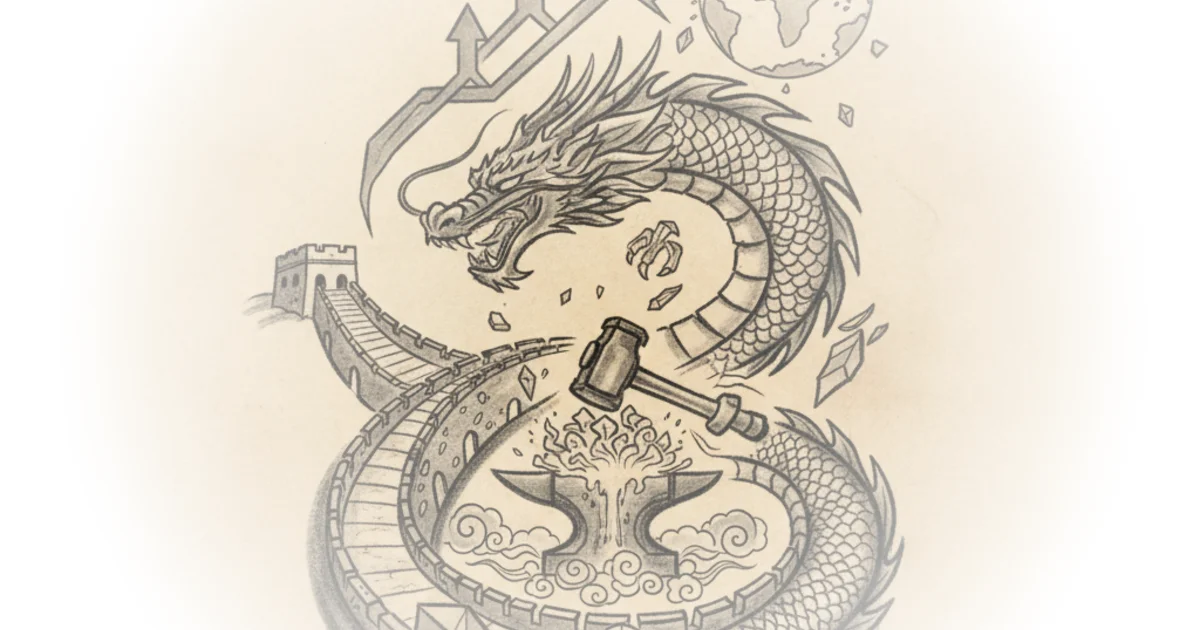
"An industry fostered by the state to ensure secure supply of critical materials is now too big for its own good."
This observation cuts through the geopolitical noise. The real story isn't a coordinated Chinese weaponization of titanium, but a domestic industrial mess where the state has over-invested in capacity that the market cannot absorb at high margins.
Bottom Line
Schneider's argument is strongest in its refusal to conflate production volume with strategic leverage; China may hold the mine, but the West holds the certification, and the gap between the two is widening, not closing. The piece's biggest vulnerability is its reliance on current certification timelines, which could be accelerated if the geopolitical pressure becomes existential for the aerospace industry. Readers should watch not for a sudden Chinese export ban, but for the slow, grinding evolution of China's ability to produce high-purity alloys that could finally breach the Western bureaucratic moat.